Also called: EPO formula I, (15) Medulla (6) Lt. Swt
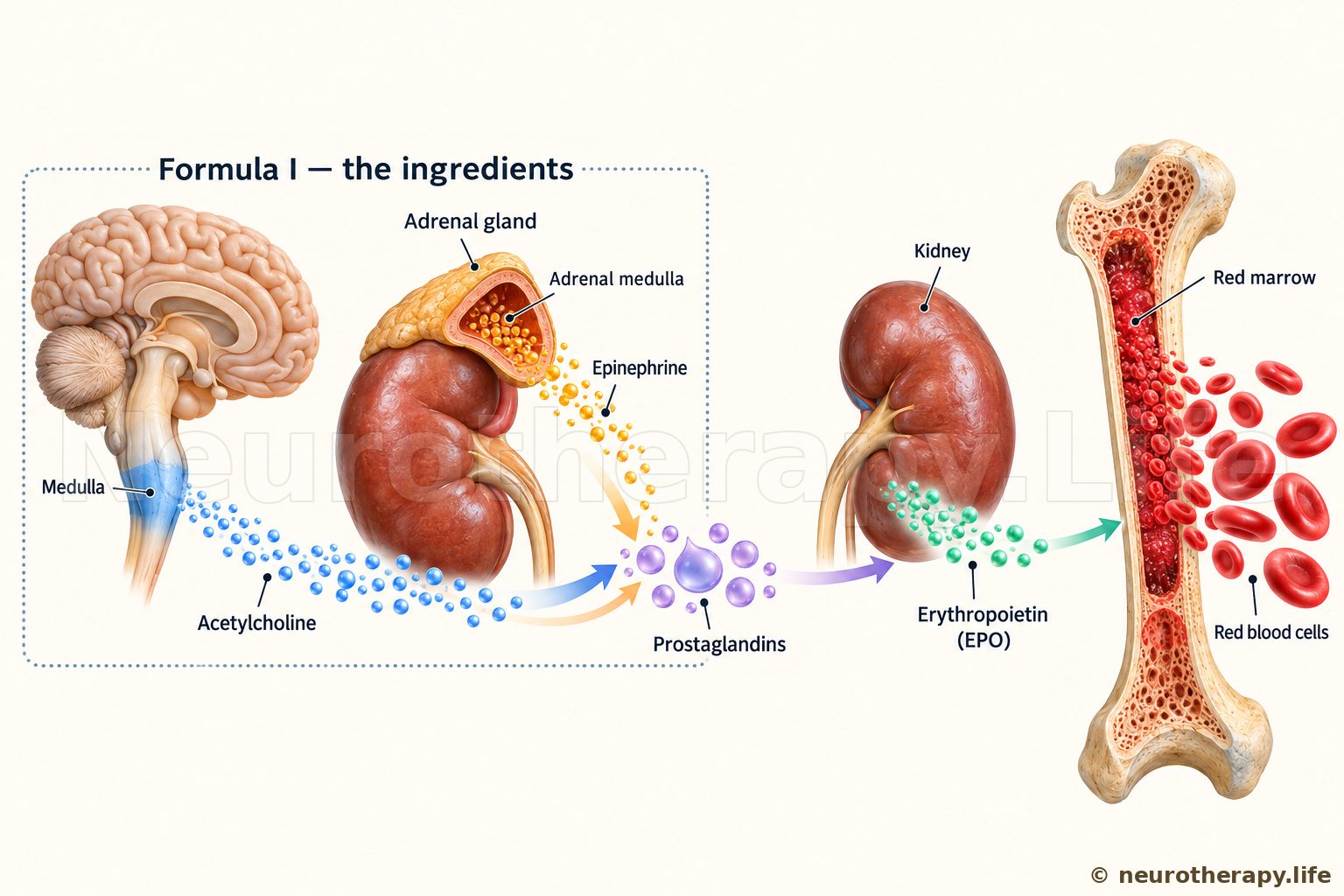
Erythropoietin formula I pairs (15) Medulla with Left Swt to raise acetylcholine and epinephrine — two of the body's own messengers. It is the first of two reasoned formulas aimed at the red-blood-cell hormone, erythropoietin, and is printed as something 'to be tried on a suitable patient'.
Overview
What is erythropoietin formula I?
Erythropoietin (EPO) is the hormone that tells the bone marrow to make red blood cells. Most of it is made in the kidneys. When the kidneys are not working well, EPO falls, red cells fall, and the person becomes anaemic — pale, tired and breathless.
Neurotherapy (LMNT) reasoned its way towards this hormone. Acetylcholine and epinephrine (adrenaline) both stimulate prostaglandins, and prostaglandins, norepinephrine and epinephrine together are held to raise erythropoietin. Formula I supplies the first two ingredients: acetylcholine and epinephrine.
The teaching is open about its status: this is to be tried on a suitable patient. It is printed as reasoned, not as proved. Formula I is the ingredient; formula II is the dish.
Formula I aims at the first link of the chain: acetylcholine from the Medulla point and epinephrine from the adrenal core.
What it is for
What is formula I for?
To raise acetylcholine and epinephrine — the two substances that stimulate prostaglandins.
As the first step of the reasoning towards erythropoietin, where a weak kidney has left the body short of red cells — to be tried on a suitable patient.
Points it works through
Which points does formula I work through?
(15) Medulla (6) Lt. Swt
Two points, listed as a set. The exact method is taught hands-on in the Neurotherapy (LMNT) course. This page lists the points of the formula and what each one contributes; it does not describe how any point is given. For the method, watch the demonstration video of each point on its own page and learn hands-on from a trained Neurotherapist. Please do not give a formula from a written description alone.
(15) Medulla, on both sides of the neck below the ears, patient seated — held to make or stimulate acetylcholine, the messenger of the calming nerves and of the muscles.
Left Swt, beside the spine in the middle of the back, patient face down — held to provoke the adrenal medulla, the inner core of the adrenal gland, which releases epinephrine.
Position:Seated for the Medulla point, then face down (prone) with pillows under the chest for Swt.
The exact technique is taught hands-on in the Neurotherapy (LMNT) course. See the course →
How it works
How was it reasoned?
(15) Medulla is the point Neurotherapy (LMNT) links with acetylcholine. It is the first member of the Medulla family to be given — before the calming nervous system, the gut's nerves or any cranial nerve is stimulated — because acetylcholine is the hand-over messenger at the relay stations of both automatic nerve systems.
Swt is linked with the adrenal medulla, the source of epinephrine. In Neurotherapy (LMNT), side is part of a point's identity: Left Medulla and Left Swt are taught to open or relax sphincters and arteries, Right to narrow them. This formula uses the left side.
Together the two supply the ingredients that stimulate prostaglandins. Formula II then adds the prostaglandin point itself. The two formulas differ in exactly one place — the Medulla count.
Its family
Which formulas are related?
Formula I belongs to the Medulla family, where two members are combined with a point from the back.
Erythropoietin formula II — The second formula: (30) Medulla for prostaglandins with Right and Left Swt — for making erythropoietin.
Side matters: Left and Right Swt are opposite instructions. A therapist never swaps them. SWT
This formula is printed as 'to be tried on a suitable patient'. It is not a replacement for medical treatment of anaemia or kidney disease. Unexplained anaemia always needs a doctor to find its cause. How to tell a patient to see a doctor
Keep taking the medicines and injections your doctor prescribed. Neurotherapy (LMNT) works alongside your medical care.
Common questions
Does this formula give me erythropoietin?
Nothing is given into the body. The idea is that the body's own messengers are stirred so that its own erythropoietin may rise. The teaching itself calls it something to be tried, not a proven result.
What is the difference between formula I and formula II?
Formula I raises acetylcholine and epinephrine. Formula II adds the prostaglandin point and both sides of Swt, aiming at erythropoietin itself.
I am on dialysis and get EPO injections. Should I stop them?
No. Never stop or change a prescribed treatment because of Neurotherapy (LMNT). Your kidney doctor decides your medicines.
Surprising facts
1The kidney is the body's oxygen meter
Special cells in the kidney sense how much oxygen arrives in the blood. When it is too little, they release erythropoietin, which tells the bone marrow to build more red cells.
Source: Schoener B, Borger J. Erythropoietin Stimulating Agents. StatPearls, 2024 (EPO made mainly by peritubular cells of the renal cortex in response to low oxygen).
2Before birth, the liver makes it
In the unborn baby the liver is the main source of erythropoietin. The kidneys take over the job after birth.
Source: Schoener B, Borger J. Erythropoietin Stimulating Agents. StatPearls, 2024.
3The adrenal is two glands in one
The outer layer of the adrenal makes cortisol on orders from the brain's hormones. The inner core is nerve tissue turned gland: it releases adrenaline straight into the blood when the alarm nerves fire.
Source: Guyton & Hall Textbook of Medical Physiology, 14th ed., the adrenal medulla and the sympathetic nervous system.
Test yourself
Research
Strong evidence
A medical reference confirming that most erythropoietin in adults is made by cells in the kidney in response to low oxygen, and that damaged kidneys make less of it — which is why kidney disease causes anaemia.
This page explains what a Neurotherapy (LMNT) treatment is for; it is not a self-treatment guide and does not diagnose. Neurotherapy (LMNT) works alongside your medical care — keep taking the medicines your doctor prescribed.
Ready to begin?
Send COURSE for course details, or your name, age and health issue for a consultation.