Face-down treatments of the back: what each is for and when it is held back
A group of Neurotherapy (LMNT) treatments is given with the patient lying face down, over the upper back, the spine and the base of the spine. This page gathers what each one is for and the conditions in which each one is held back.
Overview
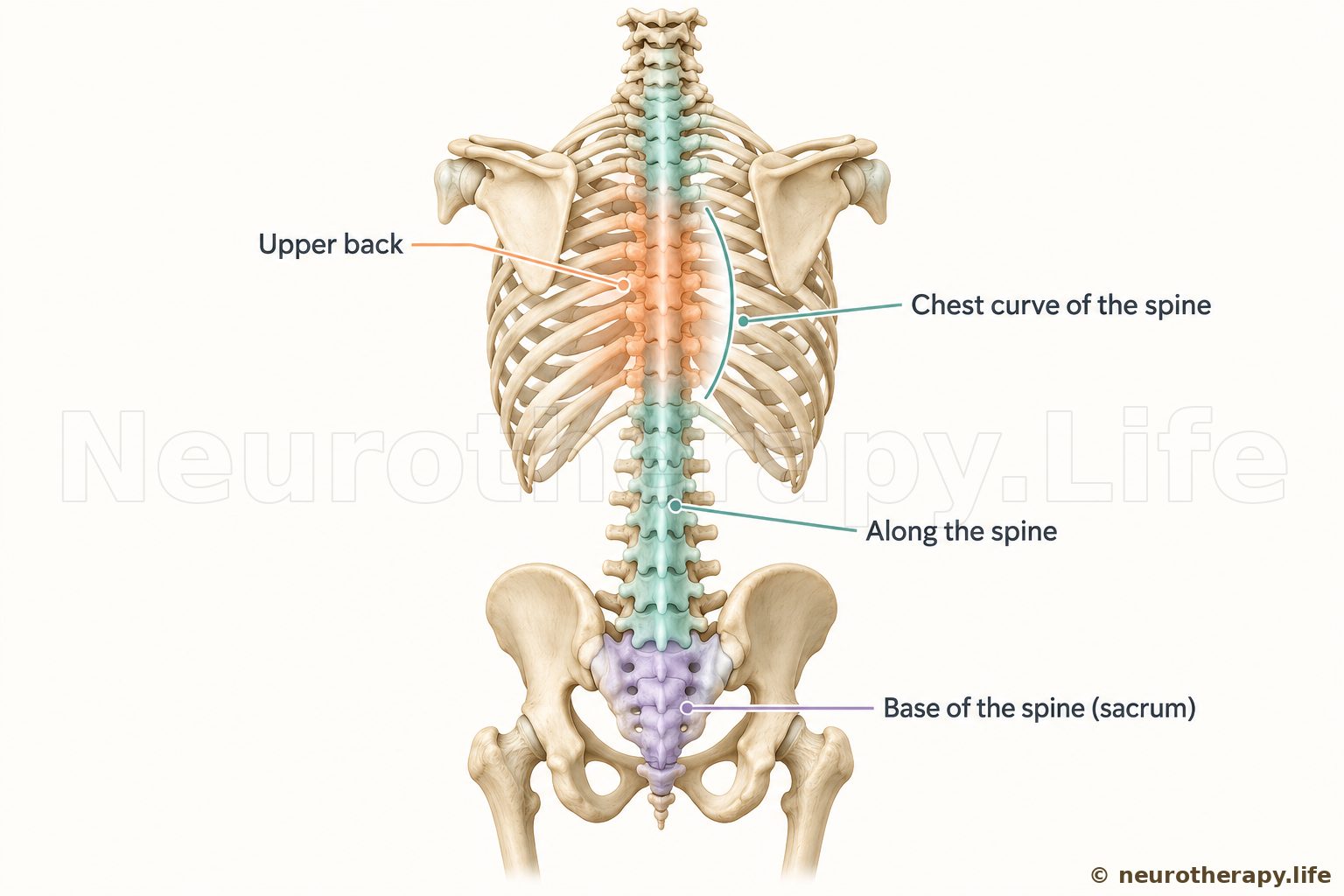
Every treatment in this group is given with the patient face down and one and a half pillows under the chest. The chest rests on the upper pillow, the chin on the lower one, and the head stays straight, never turned to the side. This arrangement is compulsory, not a comfort.
The group includes Adr near the middle of the upper back, for the adrenal glands; Swt along the middle back; a family of arrows that travel along and beside the spine, such as Back arrow, H arrow, On the spine, Beside the spine and Round arrow; Organ clearance over the whole back; Ku at the bottom of the spine; and two treatments at the base of the spine that work in opposite directions, Triangle for piles and (2) S4–S5.
Each has its own purpose. (2), (4) and (6) Adr are three separate treatments, not three strengths of one: (2) Adr raises sodium, (4) Adr raises sugar, and (6) Adr is used for inflammation. In some people Ku leaves a pain at Mu°, a sign of rising acid, and Round arrow is the treatment used to clear it.
Sudhakar works over the same area. It is said to move the muscles around the vertebrae back to their correct place and to help the neck, the back and general pains, but no method for it is written down, so none is described here. The exact methods of all these treatments are taught hands-on in the course.
Key points
- One and a half pillows under the chest are compulsory for every face-down treatment.
- (2), (4) and (6) Adr are three different treatments with three different effects.
- Round arrow is used to clear the Mu° pain that Ku can leave behind.
- Triangle for piles and (2) S4–S5 work the base of the spine in opposite directions.
- Every treatment here carries its own holds, and they travel with it into every formula.
Go deeper
ADR
The adrenal point and its three separate forms
Round Arrow
The arrow that clears the Mu° pain after Ku
(4) Ku
Ku at the bottom of the spine, and its holds
Organ Clearance
A treatment over the whole back for circulation
Triangle for Piles
Lifting the base of the spine towards the head in piles
(2) S4 – S5
The opposite treatment at the same place
Sudhakar
The back treatment whose method is not written down
Face Down: Treatments Given on the Back and Spine
The full guide to treatments given face down
Read the full guide
This topic is part of: Face Down: Treatments Given on the Back and Spine
Safety: when it is held back
- (2) Adr raises sodium, so it is not given in high blood pressure. High blood pressure
- (4) Adr raises sugar, so it is not given in diabetes. Diabetes
- (6) Adr is not given where immunity is low, and not in high blood pressure. (6) Adr
- Ku is not given to women during menstruation, and not to people with low blood pressure. Low blood pressure
- If pain at Mu° remains after Ku, Round arrow is given until that pain clears. Mu° pain (examination sign)
- Triangle for piles is not given where urine is scanty; (2) S4–S5 is not given where urine is excessive. Urinary problems
Watch
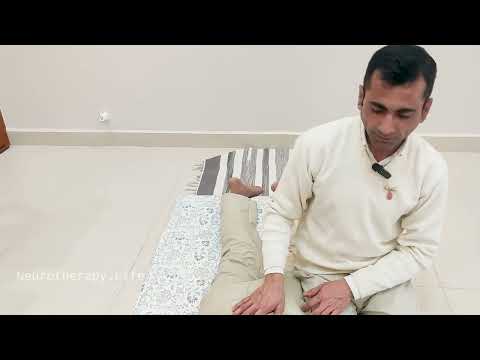
A short Hindi demonstration of Organ Clearance: the patient lies face down on two pillows, and the therapist's open hands work over the whole back in overlapping strokes — first up and down, then side to side — twice each, leaving no area out.
This page explains what a Neurotherapy (LMNT) treatment is for; it is not a self-treatment guide and does not diagnose. Neurotherapy (LMNT) works alongside your medical care — keep taking the medicines your doctor prescribed.