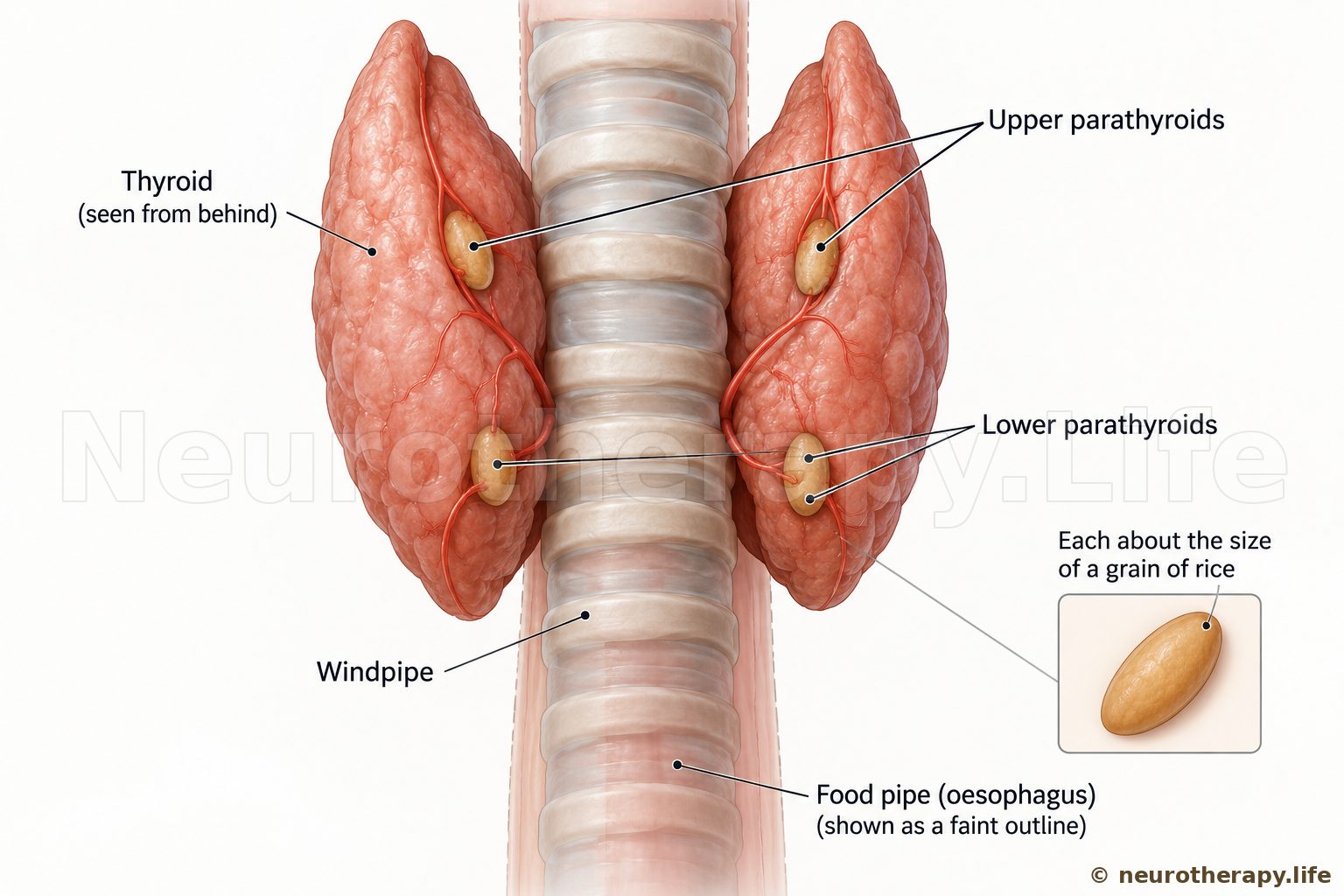
Four glands the size of rice grains, hidden behind the thyroid, guard the calcium in your blood minute by minute. They were the last major organ to be discovered in humans, in 1880 — and in Guruji's teaching the parathyroid point stands at the centre of the calcium formula.
Overview
What are the parathyroid glands?
The parathyroids are usually four tiny glands on the back of the thyroid in your neck. They make one hormone, parathyroid hormone (PTH), and have one main job: to keep the calcium in your blood within a narrow, safe range. Despite the name, they have nothing to do with thyroid hormone — 'para' simply means 'beside'.
Calcium in the blood lets nerves send signals, muscles contract, the heart beat and blood clot. Almost all the body's calcium is stored in the bones; only a tiny amount floats in the blood, and it must stay steady. When it falls, PTH draws calcium out of the bone 'bank', tells the kidneys to hold on to calcium, and has the kidneys make active vitamin D so the gut absorbs more.
The commonest parathyroid problem is an overactive gland, usually from a small harmless growth in one gland. It is often found by chance, when a routine blood test shows high calcium — most often in women after menopause.
Four rice-grain glands on the back of the thyroid: small, separate, and in charge of the blood's calcium.
Function
What do the parathyroid glands do?
The parathyroids work like a calcium thermostat. Their cells feel the level of calcium in the blood flowing past them every moment. When it drops even slightly, they release PTH within minutes; when it rises, they hold back.
Senses blood calcium every moment through special calcium-sensing cells.
Releases calcium from bone when the blood level falls.
Tells the kidneys to keep calcium and pass out phosphate.
Tells the kidneys to finish making active vitamin D, which lets the gut absorb calcium from food.
Protects the nerves, muscles and heart, which misfire when calcium is too low.
Sunlight starts it
Sunlight on the skin turns a cholesterol-based substance into vitamin D3.
The liver's step
The liver changes vitamin D3 into a storage form (25-hydroxy vitamin D) — the form measured in a vitamin D blood test.
The parathyroid's signal
When blood calcium is low, the parathyroids release PTH.
The kidneys finish the job
Pushed by PTH, the kidneys turn the storage form into the active hormone, 1,25-dihydroxy vitamin D (calcitriol) — the '1,25 DCC' after which LMNT names its calcium formula.
The gut absorbs
Active vitamin D lets the intestine absorb far more calcium from food.
Back in range — PTH falls
As calcium returns to normal, the parathyroids sense it and release less PTH.
Thyroid — The next-door neighbour. Its C cells make calcitonin, which works the other way, though it matters less in adults.
Muscles — Low calcium makes muscles twitch and cramp; high calcium makes them weak.
Anatomy
What are the parts of the parathyroid glands?
There is no single parathyroid organ — just a set of tiny separate glands, and inside each, the cells that make PTH.
The glands
Upper pair — Sit on the back of the upper part of each thyroid lobe. Their position is fairly fixed.
Lower pair — Usually near the lower poles of the thyroid, but their position varies — they travel down with the thymus before birth and can end up lower in the neck or even in the chest.
Extra or fewer glands — Most people have four, but some have five or more, and a few have three.
Inside each gland
Chief cells — The main cells. They sense calcium and make PTH.
Oxyphil cells — Larger cells that increase with age; their exact job is still not clear.
Fat cells — Gradually mix in with age, making the gland paler.
The calcium partners
Osteoclasts — Bone cells that dissolve old bone and release its calcium — PTH works through them.
Osteoblasts — Bone cells that lay down new bone and lock calcium into it.
Kidney tubules — Where calcium is saved from the urine and vitamin D is activated.
Where are the parathyroid glands located?
The parathyroids lie in the front of the neck, tucked against the back of the thyroid — two on the left and two on the right, one higher and one lower on each side. They sit between the thyroid and the windpipe and food pipe behind it.
Because the lower pair travels down with the thymus before birth, a gland is sometimes found far from home — low in the neck or inside the chest. Surgeons searching for an overactive gland use scans to find it first.
In LMNT, nothing is pressed on the neck for the parathyroid. The Para point is given on the right arm — near the elbow, then near the shoulder.
Each parathyroid is a small, flat, oval bean — soft and yellowish-brown, a little like a grain of cooked rice or a lentil. They grow paler with age as fat cells mix in.
They look so much like the little lumps of fat and lymph nodes around them that finding them is one of the hardest tasks in neck surgery.
How big are the parathyroid glands?
Each gland is only about 6 mm long, 3–4 mm wide and 1–2 mm thick, and weighs about 30–50 milligrams. All four together weigh well under a quarter of a gram.
An overactive gland with a growth (adenoma) may swell to the size of a pea or larger, which is how scans can find it.
Conditions and disorders
What conditions and disorders affect the parathyroid glands?
The main problems are too much PTH or too little. Primary hyperparathyroidism — one gland growing a small harmless lump and making too much PTH — raises blood calcium. Secondary hyperparathyroidism is the glands working overtime because vitamin D is low or the kidneys are failing. Hypoparathyroidism, too little PTH, most often follows neck or thyroid surgery and lowers blood calcium. Vitamin D shortage, which feeds into all of this, is very common in India despite the sunshine.
When calcium runs high (too much PTH)
Kidney stonesExtra calcium in the urine can form stones — sometimes the first sign of an overactive gland.
OsteoporosisConstant high PTH keeps withdrawing from the bone bank, thinning the bones.
Heel spurThe same use of (4) Para alone, for bone that has grown where it should not.
Lactation (breastfeeding)The teaching gives (4) Para to a breastfeeding mother whose milk has recently stopped.
What are common signs of a parathyroid problem?
High calcium: kidney stones, bone pain or fractures, stomach pain and constipation, tiredness, low mood, forgetfulness
High calcium: great thirst and passing a lot of urine
Low calcium: tingling around the lips, fingers and toes
Low calcium: muscle cramps and spasms of the hands and feet
Low calcium, severe: fits or an irregular heartbeat
Often no symptoms at all — found only on a routine blood test
What tests check the parathyroid glands?
Blood calcium — Usually about 8.5–10.5 mg/dL in adults; each lab prints its own range. Doctors often correct it for albumin or measure 'ionised' calcium.
PTH — Read together with calcium: high calcium with a high or normal PTH points to an overactive gland.
Vitamin D (25-hydroxy) — Shows the body's vitamin D store.
Phosphate, kidney function and urine calcium — Help tell the different causes apart.
Bone density scan (DEXA) — Shows whether the bones have thinned.
Neck ultrasound and sestamibi scan — Used to find which gland is overactive before surgery.
How are parathyroid conditions treated?
Surgery — Removing the one overactive gland usually corrects primary hyperparathyroidism.
Watchful waiting — Mild cases without symptoms may simply be checked regularly — calcium, kidneys and bones.
Medicines — Some medicines lower PTH or protect the bones when surgery is not possible.
Calcium and active vitamin D — For low PTH, usually taken for life, with regular blood tests to keep calcium in range.
Treating vitamin D shortage — Correcting low vitamin D often lets overworked glands settle.
Neurotherapy (LMNT)
Guruji's teaching walks the same road the body uses to make active vitamin D: sunlight on the skin, then the liver, then the parathyroid (PTH), then the kidneys. From that pathway the first calcium formula was built — the liver, the parathyroid and the two kidney points, stimulated in the order in which the body runs the line. Later Guruji added (8) Ch. Only and (20) Round Arrow, and that six-step form is the one given to most patients. The teaching is exact about counts at the Para site. (4) Para inside the full formula maintains blood calcium; (4) Para given alone draws calcium out of bone into the blood, which is why it is used where bone has grown in the wrong place — and why it is never given alone in osteoporosis. (2) Para at the same site is a different treatment altogether: it was found when a patient with years of low blood pressure felt 'extremely well' after two applications, and his pressure came up. The teaching names it after vasopressin, and says openly that such names are inferences from what patients reported, not laboratory measurements. Calcium is only useful if it is absorbed, so the intestine is set right as well. This is support alongside your doctor's care, never instead of it.
Points
Para — The parathyroid point: on the right arm, near the elbow then near the shoulder, six seconds at each — four contacts make one Para.
(4) Para — Inside the 1,25 DCC formula it maintains blood calcium — the teaching uses it for cramps from low calcium and for women with very heavy periods. Alone, it lifts calcium out of bone. Never alone in osteoporosis.
(2) Para — Two applications only. The teaching links it with vasopressin: for long-standing low blood pressure and for diabetes insipidus. Never in high blood pressure.
(7) Liv — Step one of the calcium formula: the liver, which makes the storage form of vitamin D.
Liv° — The right kidney code beside the navel — step three.
Mu° — The left kidney code beside the navel — step four, where the teaching places the making of 1,25 DCC.
(8) Ch. Only — Added later by Guruji. Rubbed on the left side of the chest first, then the right; it balances the Round Arrow.
Round Arrow — (20) Round Arrow along both sides of the spine, patient face down — the last step of the ordinary 1,25 DCC formula.
Thrd 'P' — The teaching links (4) Thrd 'P' with bone building through the osteoblasts, so it is not given where bone has grown unwanted.
The same six steps with the order turned about — Mu° before Liv°, and the Round Arrow before Ch. Only — chosen when the week's stool is medium and soft. The written form of the calcium formula is picked by what the stool looks like.
“Wherever there is a question mark, it is an indication that this is my own thinking, on which other people can now do research.”
— Dr. Lajpatrai Mehra
“Whoever wishes to take appropriate steps in this direction, or wishes to test the success of our treatments — we are always ready to cooperate with them.”
— Dr. Lajpatrai Mehra
“Whether or not the patient gets immediate benefit from our treatment, let no harm reach him through our carelessness — attend to this.”
— Dr. Lajpatrai Mehra
Never do this
Emergency: tingling around the mouth with cramps or spasms of the hands, or a fit — especially in the days after neck or thyroid surgery — call 108/112. Very high calcium with confusion, vomiting and great thirst also needs a hospital the same day. How to tell a patient to see a doctor
Osteoporosis: (4) Para is never given alone — only inside the full 1,25 DCC formula. Small children, very weak persons and anyone with osteoporosis are treated with the hand only, never the foot. (4) Para
(2) Para is never given to a patient with high blood pressure. (2) Para
Two kinds of low blood pressure are treated in opposite ways. Low pressure for years: (2) Para only. Low pressure that came on suddenly after an accident, a miscarriage or heavy bleeding: not (2) Para — and first of all, that is an emergency. Cold, clammy, pale, a fast pulse, faint on sitting up, still bleeding: the patient goes to a hospital today. Low blood pressure
Where a report shows the kidneys are failing, the kidney points are withheld — and with them the usual calcium formula changes. The therapist reads the kidney report first. Medical reports that change a Neurotherapy (LMNT) plan
Bamboo spine, heel spur or any unwanted bone growth: Thrd and Thrd 'P' are not given, because the teaching says they lay more calcium into bone. Thrd 'P'
Do not start high doses of calcium or vitamin D without a blood test, and never stop calcium or vitamin D tablets prescribed after neck surgery. Too much can cause kidney stones; too little can cause fits.
Cancer: if the person has cancer, (10) Pan, Thymus, Pit, Lu + Sh, Rt. Ov / Lt. Ov and (30) Medulla are never given — the therapist changes the plan. Cancer care: Neurotherapy (LMNT) support
Care
How can I keep my parathyroids and bones healthy?
The parathyroids cannot be exercised, but you can make their job easier by keeping calcium and vitamin D in good supply.
Take the gentle morning sun
Guruji's teaching advises 10 to 15 minutes of gentle morning sun on the back every day. Avoid burning in strong midday sun.
Eat calcium-rich foods
Milk, curd, paneer, ragi and sesame (til) — Guruji's teaching adds jaggery and says black sesame has more. Banana has little calcium and more potassium.
Keep the gut working
Calcium must be absorbed to be of use. Guruji's teaching sets the intestine right first, because swallowed calcium that is not absorbed simply passes through.
Load your bones
Walking, climbing stairs and gentle strength work tell the bones to stay strong.
Drink enough water
Plenty of water helps prevent kidney stones, especially if your calcium runs high.
Test before you supplement
Ask for calcium and vitamin D tests before taking large doses, and repeat them as your doctor advises.
Common questions
Are the parathyroids part of the thyroid?
No. They sit on the back of the thyroid, but they are separate glands with a different hormone and a different job — calcium, not metabolism.
Can I live without my parathyroids?
Yes, but blood calcium then has to be kept up with daily calcium and active vitamin D tablets and regular blood tests. Even one healthy gland is usually enough.
Why is vitamin D low in so many Indians, with so much sunshine?
Indoor work, covered skin, air pollution, little time outdoors, and darker skin needing longer in the sun all play a part, along with diets low in calcium. That is why a test is better than a guess.
Will calcium tablets alone make weak bones strong?
Not by themselves. Calcium needs vitamin D and a working gut to be absorbed, and bones need exercise to use it. Keep taking what your doctor prescribed; Guruji's teaching adds that the intestine must be set right so the calcium is actually taken in.
What is the difference between (2) Para and (4) Para?
Same place on the right arm, different count, different treatment. The teaching links (2) Para with vasopressin — for long-standing low blood pressure. It links (4) Para with the parathyroid's PTH and blood calcium. Read the number before you read the point.
Can Neurotherapy (LMNT) be taken with calcium or vitamin D medicines?
Yes — LMNT is given alongside medical care. Tell the therapist about osteoporosis, kidney disease, blood pressure and any recent neck surgery, because each changes which points are given and how.
What should I ask my doctor or therapist?
What are my calcium, PTH and vitamin D levels, and what should they be?
Is my high (or low) calcium coming from the parathyroids, the kidneys or vitamin D?
Do I need a bone density scan or a kidney scan for stones?
Should I take calcium or vitamin D, and how much?
Which symptoms of low calcium mean I should come back at once?
(To the therapist) Am I being given (2) Para or (4) Para, and is (4) Para alone blocked for me?
Surprising facts
1The last major organ ever discovered in humans
The parathyroid glands were first described in humans in 1880 by Ivar Sandström, a medical student in Uppsala, Sweden. By then the heart, brain and every other large organ had been known for centuries. His finding was largely ignored at first.
Source: Sandström I. Upsala Läkareförenings Förhandlingar 1880;15:441–471; Carney JA. The glandulae parathyroideae of Ivar Sandström. Am J Surg Pathol 1996;20(9):1123–1144.
2All four weigh less than a quarter of a gram
Each parathyroid is about the size of a grain of rice and weighs about 30–50 milligrams. Yet if all four are lost, blood calcium falls within days and the muscles begin to spasm.
Source: Gray's Anatomy (dimensions and weight); StatPearls, 'Hypoparathyroidism'.
3Some of them travel before you are born
The lower pair starts life high in the neck of the unborn baby, next to the thymus, and travels down with it. Sometimes a gland does not stop in the usual place and ends up low in the neck or inside the chest — a puzzle for surgeons.
Source: Moore KL, Persaud TVN. The Developing Human — third pharyngeal pouch (inferior parathyroids and thymus); Gray's Anatomy — ectopic parathyroids.
499% of your calcium is in bone — the 1% runs your heartbeat
An adult body holds roughly a kilogram of calcium, and about 99% of it is in the bones and teeth. The tiny remainder in blood and cells lets nerves fire, muscles contract and the heart beat. The parathyroids guard that small 1% above all else — even if it means borrowing from the bones.
Source: NIH Office of Dietary Supplements, 'Calcium — Health Professional Fact Sheet' (99% in bones and teeth); Guyton & Hall (about 1–1.2 kg total body calcium).
5The same hormone can thin bone or build it
When PTH stays high all the time, bone thins. But when the very same hormone is given as one short daily injection, bone gets thicker — it is used as a medicine for severe osteoporosis. The difference is not the substance but the rhythm. It echoes Guruji's careful rule that (4) Para is never given alone in osteoporosis, only within the full formula.
Source: Neer RM, et al. N Engl J Med 2001;344(19):1434–1441 (daily PTH 1-34 reduced fractures and increased bone density). LMNT rule: §25.6 / §12.3-4.
6They glow for surgeons
Parathyroids are hard to tell apart from fat and lymph nodes by eye. But under near-infrared light they give off a faint natural glow of their own, stronger than the tissue around them. Surgeons now use special cameras to spot them and protect them during thyroid surgery.
Source: McWade MA, Paras C, White LM, et al. A novel optical approach to intraoperative detection of parathyroid glands. Surgery 2013;154(6):1371–1377.
7'Stones, bones, groans and moans'
Medical students learn the signs of an overactive parathyroid with a rhyme: stones (kidney stones), bones (bone pain and thinning), abdominal groans (stomach pain, constipation) and psychic moans (tiredness, low mood, poor memory). Today most cases are found earlier, on a routine calcium test.
Source: StatPearls, 'Primary Hyperparathyroidism' (classic mnemonic; most cases now detected on routine biochemistry).
8Sunny country, low vitamin D
India has plenty of sunshine, yet studies across the country find low vitamin D in a large share of people of every age. Indoor lives, covered skin and polluted air all block the sun's work. Guruji's teaching gives a simple habit: 10 to 15 minutes of gentle morning sun on the back every day.
Source: Aparna P, Muthathal S, Nongkynrih B, Gupta SK. Vitamin D deficiency in India. J Family Med Prim Care 2018;7(2):324–330. LMNT habit: §12.3-7 / §28.9-1.
Your calcium in numbers
4parathyroid glands in most people
~1 kgof calcium in an adult body
99%of it in bones and teeth
~8.5–10.5mg/dL — the usual blood calcium range
Minutesfor PTH to answer a fall in calcium
10–15 minof gentle morning sun, as Guruji's teaching advises
Yoga
Tāḍāsana — the mountain Tāḍāsana
Benefits
A standing, weight-bearing pose — the kind of load that tells bones to stay strong.
Improves posture and awareness of balance.
How to do it
Stand with feet together or slightly apart, weight spread evenly.
Breathe in and raise the arms overhead, palms facing each other.
Stretch up through the spine; keep the chin level and the shoulders relaxed.
If steady, rise onto the toes for a few breaths; otherwise keep the heels down.
Breathe out and lower the arms. Repeat 3 to 5 times.
Take care
If your balance is poor, stand beside a wall or a chair and keep the heels on the floor. With osteoporosis, avoid rounding the back or twisting hard in any practice.
Vṛkṣāsana — the tree Vṛkṣāsana
Benefits
Trains balance, which lowers the risk of falls — the main cause of broken bones in people with thin bones.
Strengthens the ankle, leg and hip of the standing side.
How to do it
Stand beside a chair or wall and rest one hand on it.
Shift your weight onto one leg.
Place the sole of the other foot on the inner ankle or calf — never on the side of the knee.
Hold for 5 to 10 slow breaths, eyes on a fixed point.
Lower the foot and repeat on the other side.
Take care
Always keep a support within reach if you have osteoporosis, dizziness or poor balance. Stop if the standing knee or hip hurts.
Vīrabhadrāsana II — the warrior Vīrabhadrāsana II
Benefits
Loads the bones of the legs and hips while keeping the spine upright — safer than forward bends for thin bones.
Builds leg strength and stamina.
How to do it
Stand with the feet wide apart, about one leg-length.
Turn the right foot out to point forward and the left foot slightly in.
Raise the arms to shoulder height.
Breathe out and bend the right knee over the right ankle, keeping the body upright.
Hold for 3 to 5 breaths, straighten, and repeat on the other side.
Take care
Bend the knee only as far as is comfortable, and never let it go past the toes. Skip it with a painful knee or hip, or do it holding a chair.
Watch
(2) Para vs (4) Para — One Point, Two Powerful Actions | LMNT Neurotherapy Explained
This video explains the Para point and how (2) Para differs from (4) Para, in relation to low calcium, bone pain and blood pressure.
LOW BP DUE TO HEADY BLEEDING DURING PERIODS
A demonstration of the Angiotensin No. 2 formula — (7) Liv, (7) Mu° and (6) Lu + Sh — for low blood pressure that comes on suddenly after very heavy bleeding in a period.
The video suggests using the formula at the moment of fainting. In LMNT teaching, a person who is still bleeding, cold, pale or fainting is taken to hospital first; this formula is for after the bleeding has been stopped. Lu + Sh is not given in cancer.
Test yourself
Research
Strong evidence
In a large trial, women with severe osteoporosis given a short daily injection of PTH had fewer spinal fractures and denser bones — showing that the rhythm of this hormone decides whether it builds or thins bone.
Researchers showed that parathyroid glands give off their own near-infrared glow, stronger than the thyroid and surrounding tissue, which lets surgeons find and protect them.
A widely cited review of vitamin D deficiency: how sunlight, liver and kidney make active vitamin D, why deficiency is so common worldwide, and how it weakens bones.
This page explains how the body works; it does not diagnose. Neurotherapy (LMNT) works alongside your medical care — keep taking the medicines your doctor prescribed, and see a doctor for any new or severe symptom.
Ready to begin?
Send COURSE for course details, or your name, age and health issue for a consultation.