1The heart eats what the legs throw away
During hard exercise the heart muscle takes up lactate from the blood and burns it for energy, often in preference to sugar.
Source: Guyton & Hall, Textbook of Medical Physiology (cardiac metabolism).
Also called: Twelve Liv, (12) Liv
(12) Liv is the highest form of the Neurotherapy (LMNT) liver point. The teaching finds it very helpful for dissolving gallstones, and it is the liver step of the Lactic Acid Conversion formula for knee pain and tired legs. Like every Liv form, it is never given in liver cancer.
(12) Liv is a named form of Liv, the liver point. It is the highest form of this point that the teaching gives, and it has uses of its own — it is not simply "more Liv".
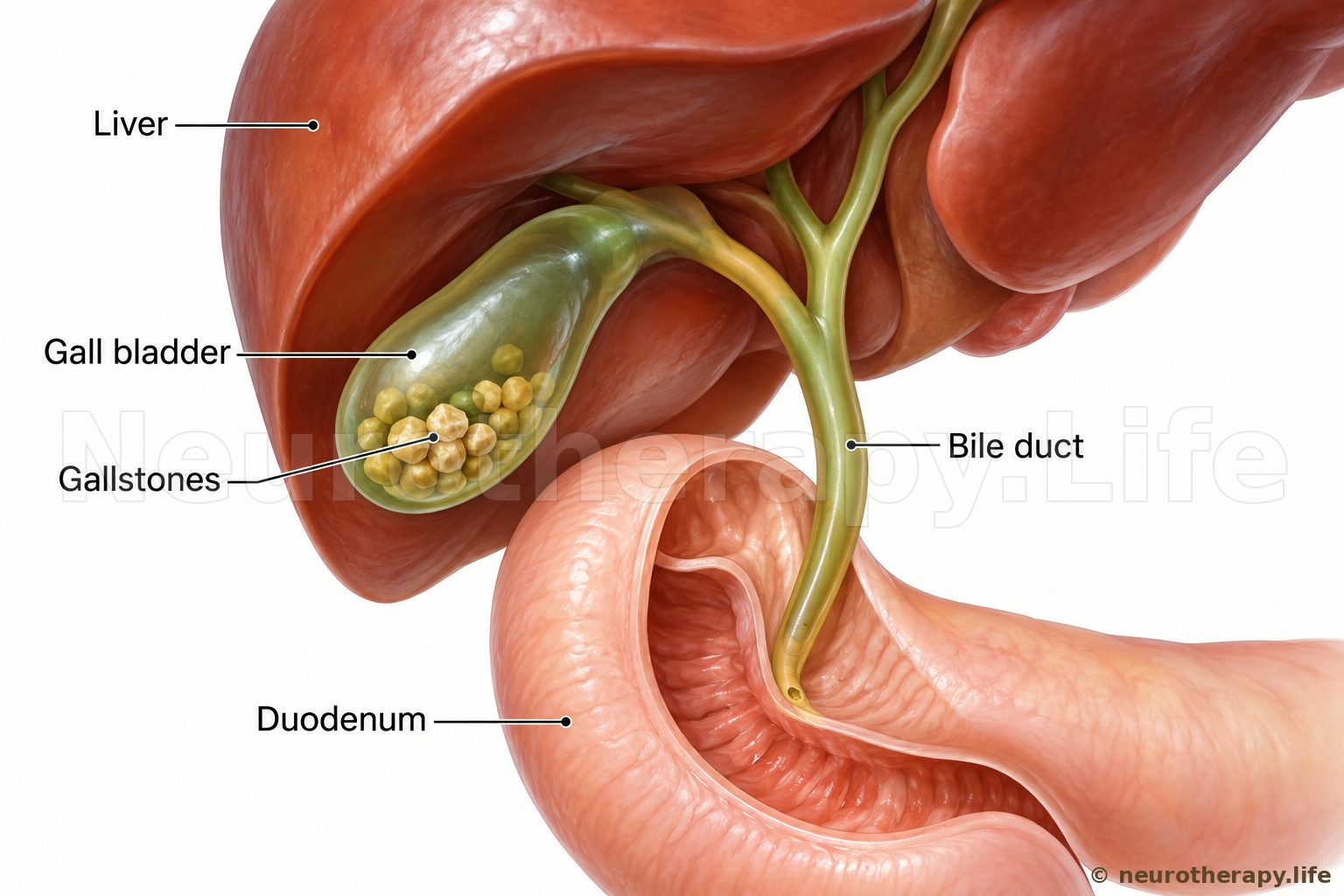
Its first use is for gallstones — hard pebbles that form in the gall bladder when bile, the liver's digestive juice, becomes too rich in cholesterol. The teaching says, keeping its own word perhaps, that it perhaps works something like cholic acid, one of the bile acids that keep cholesterol dissolved.
Its second use is inside the Lactic Acid Conversion formula, made for the person whose knees give up after a long climb or hard exercise and recover after a short rest.
You lie on your back with a pillow under both thighs and a flat, soft pillow under the left hand. It is given at the same places as Liv: the left forearm just below the elbow (on the muscle, not the joint) and the left thigh, together.
How this point is given — the tool, the pressure, the count and the exact movement — is deliberately not described here. A demonstration video for this point is being prepared; until it is on this page, learn the method hands-on from a trained Neurotherapist before giving it. Please do not give any point from a written description alone: a point given in the wrong place or the wrong way can do harm.
The number written before a point's name is not a strength setting. Each numbered form is a separate named treatment with its own method and timing, taught hands-on in the course.
The exact technique is taught hands-on in the Neurotherapy (LMNT) course. See the course →
The teaching names two uses, and keeps its own hedge on the first.
Each form of Liv is its own treatment.
Directly, and through the Lactic Acid Conversion formula:
Knee pain, tired legs after exertion, RA and osteoarthritis — (12) Liv is its liver step.
A teaching case from the founder's own practice: a man said that after many stairs or heavy exercise his knees would not lift, and then recovered by themselves within a short while. He was not breathless, which pointed away from the heart. He was very tender at Liv and Pan and at both ovary points, and was given the treatment that later became the Lactic Acid Conversion formula; he reported great relief the same day and a good day after.
A composite case written to teach the reasoning — not one patient’s file.The teaching reports it as very beneficial for dissolving gallstones, and says perhaps it works like cholic acid. That is clinical experience, not a promise. Keep your doctor and your scans in the picture.
The liver turns lactic acid from tired muscles back into sugar. The Lactic Acid formula uses (12) Liv for that reason, with other points.
No. Each Liv form is a separate treatment with its own uses.
During hard exercise the heart muscle takes up lactate from the blood and burns it for energy, often in preference to sugar.
Source: Guyton & Hall, Textbook of Medical Physiology (cardiac metabolism).
Lactate made by working muscles travels to the liver, which turns it back into glucose — a loop known as the Cori cycle.
Source: Guyton & Hall, Textbook of Medical Physiology (Cori cycle).
In Western countries most gallstones are made mainly of cholesterol, which settles out when bile carries too much of it for its bile acids to keep dissolved.
Source: Lammert F et al., Gallstones, Nat Rev Dis Primers 2016;2:16024.
This page explains what a Neurotherapy (LMNT) treatment is for; it is not a self-treatment guide and does not diagnose. Neurotherapy (LMNT) works alongside your medical care — keep taking the medicines your doctor prescribed.
Send COURSE for course details, or your name, age and health issue for a consultation.