PT. Heparin is one of the three newest members of Neurotherapy (LMNT)'s Heparin family. It is the parent P. Heparin with its last step changed — Chest Only taken out, Thymus + Chest put in — and it is chosen for paralysis where an infarct or poor blood supply comes with pain, and for people who get more relief from pain with it than with P. Heparin.
Overview
What is PT. Heparin?
The Heparin formulas are a family of Neurotherapy (LMNT) treatments aimed at clots and at the blood's flow. Their idea is that the body can be roused to make more of its own heparin — a natural substance that keeps blood from clotting — mainly in the liver and the lungs. The parent of the family is P. Heparin, which can be given to all patients.
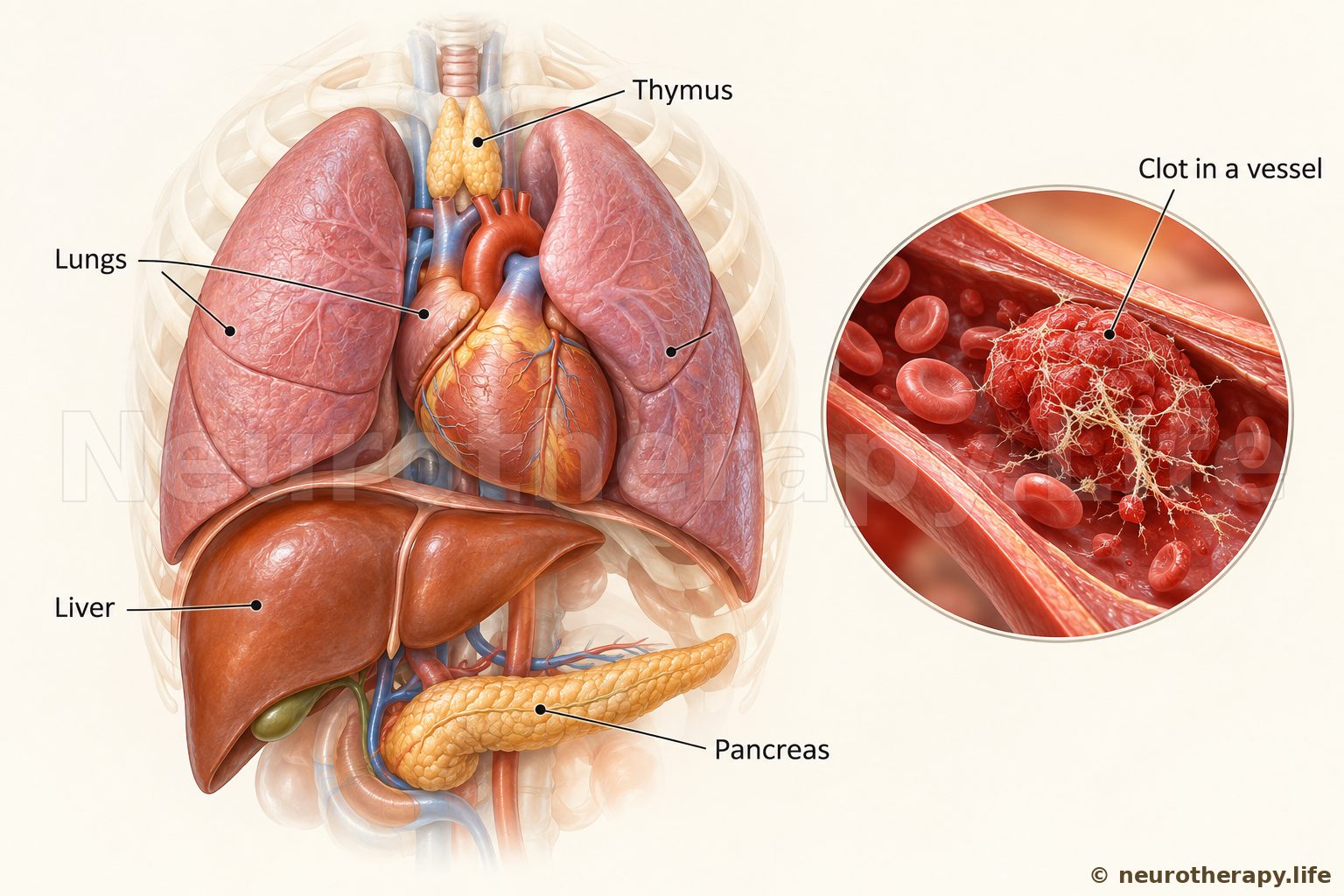
PT. Heparin keeps the parent's first two steps — the pancreas and the liver — and changes only the last one. Instead of Chest Only, it ends with Thymus + Chest, which works over the breastbone, where the thymus gland lies, as well as the chest.
It was made late in the family's history, and the teaching is frank about it: these newest formulas have proved useful for all kinds of paralysis, more will be known from experience, and research on them is continuing.
PT. Heparin works through the pancreas, the liver and the chest with the thymus — the parent Heparin formula with its last step changed.
What it is for
What is PT. Heparin used for?
All kinds of paralysis — the teaching says all three of the newest Heparin formulas have proved useful here.
Paralysis in which there is an infarct (tissue damaged by a blocked artery) or ischaemia (too little blood reaching a part), and there is pain as well.
For pain: some people get relief from pains when PT. Heparin is given in place of P. Heparin.
Points it works through
Which points does PT. Heparin work through?
(8) Pan (7) Liv (8) Thymus+Chest
Three steps, the first two shared with the parent P. Heparin. They are listed here as a set, with what each contributes. The exact method is taught hands-on in the Neurotherapy (LMNT) course. This page lists the points of the formula and what each one contributes; it does not describe how any point is given. For the method, watch the demonstration video of each point on its own page and learn hands-on from a trained Neurotherapist. Please do not give a formula from a written description alone.
The armpits. Wherever Thymus + Chest is given, the armpits must be given too, without fail — Thymus + Chest without them is incomplete.
Position:Lying on the back (supine).
The exact technique is taught hands-on in the Neurotherapy (LMNT) course. See the course →
How it works
How does PT. Heparin work?
Heparin is the body's own anti-clotting substance, stored mainly in mast cells — immune cells found in large numbers in the liver and the lungs. The Heparin family is built on the idea of rousing those places so that the body's own heparin helps break down clots and keep the blood flowing.
The teaching offers a 'perhaps' for why paralysis patients benefit: the brain is guarded by the blood–brain barrier, which keeps out most man-made medicines but lets the body's own chemicals through. A chemical the body itself makes may reach where an injection cannot. The teaching keeps its own 'perhaps' on this explanation, and so do we.
Why change the last step? Thymus + Chest reaches the thymus as well as the chest. In practice it was seen that some patients got more relief from pain when it took the place of Chest Only. The price is that it brings the long list of Thymus bars with it.
Its family
Which Heparin formulas are related?
PT. Heparin is one of the three newest Heparin formulas. Each of the three changes just one thing in the parent, and each works differently.
P. Heparin (plasmin) — The parent, ending with Chest Only. It can be given to all patients — including heart, kidney and diabetic patients, for whom PT. Heparin is closed.
F. Heparin (fibrinolysin) — A newest sister: Pan raised, for breaking the fibrin set in old clots. Also listed with PT. Heparin for infarct or ischaemia with pain.
T. Heparin (thymus) — Another Thymus + Chest member, for a blow once the wound has dried.
TT. Heparin — The stronger Thymus + Chest member, for the deeper or old blow.
Multi Heparin — The largest member, six stages as one treatment, for multiple infarcts or calcification.
What it is used for
When is PT. Heparin given?
The Heparin formula is chosen from a selection table. PT. Heparin's row is: in paralysis there is infarct or ischaemia, and there is pain as well. The Thymus bars are checked before it is written.
Paralysis and blood supply
Paralysis and strokeParalysis after an infarct or ischaemia, with pain — alongside medical care
Thymus + Chest is not given — so PT. Heparin is not given at all — in pregnancy, polio or inflammatory diseases, heart disease, diabetes, rheumatoid arthritis and autoimmune disorders, or kidney disease. No substitute is written inside PT. Heparin; for these patients the parent P. Heparin is the form without the thymus. P. Heparin (plasmin)
Wherever Thymus + Chest is given, the armpits are given too, without fail. Armpit
The gate of the Heparin family: if blood is flowing or there is an open wound, no Heparin treatment is started until the wound has healed — heparin keeps blood from clotting, and a clot is how a wound begins to heal. Wound healing
Signs of a stroke happening now — sudden drooping of the face, weakness of an arm, slurred speech — are an emergency. Call 108/112 at once; Neurotherapy (LMNT) comes only afterwards, alongside medical care. Paralysis and stroke
Inherited bars: Liv is not given where there is cancer in the liver; Pan is not given in cancer of the pancreas or in schizophrenia. In cancer, Thymus is one of the absolute bars — never (10) Pan, Thymus, Pit, Lu + Sh, Rt. Ov. / Lt. Ov. or (30) Medulla. Cancer care: Neurotherapy (LMNT) support
Keep taking blood-thinners and every other medicine exactly as your doctor prescribed. Children receive light treatment.
Common questions
What does 'PT' stand for?
It is read as the parent P. Heparin with Thymus + Chest — the 'T' — in its last step.
Why not just give P. Heparin?
P. Heparin is the default and can be given to all patients. PT. Heparin is chosen when paralysis with an infarct or ischaemia also brings pain, because some people get more relief from pain with it.
Can a diabetic or heart patient have PT. Heparin?
No. Thymus + Chest is barred in diabetes and heart disease, so PT. Heparin is closed to them. The parent P. Heparin, which has no thymus step, remains open.
Does it replace my blood-thinning medicine?
No. Nothing is given by mouth, and no medicine is stopped. Any change in your medicines is your doctor's decision.
Surprising facts
1Heparin was discovered by a medical student
In 1916 Jay McLean, a second-year student, found an anti-clotting substance while studying extracts of dog liver. It was named heparin, from the Greek word for liver.
Source: Wardrop D, Keeling D. The story of the discovery of heparin and warfarin. Br J Haematol. 2008;141(6):757–763.
2Your body dissolves small clots every day
Blood is always balancing clotting against clot-breaking. An enzyme called plasmin cuts the fibrin threads that hold a clot together — the system doctors call fibrinolysis.
Source: Chapin JC, Hajjar KA. Fibrinolysis and the control of blood coagulation. Blood Rev. 2015;29(1):17–24.
3The thymus is biggest in childhood
The thymus, behind the breastbone, trains the immune T cells. It is largest in childhood and slowly shrinks and turns to fat after puberty.
Source: Gray's Anatomy, 41st ed. — thymus.
Test yourself
Research
Strong evidence
The history of how heparin was found in the liver and became a medicine — the body science behind the name of the whole Heparin family.
This page explains what a Neurotherapy (LMNT) treatment is for; it is not a self-treatment guide and does not diagnose. Neurotherapy (LMNT) works alongside your medical care — keep taking the medicines your doctor prescribed.
Ready to begin?
Send COURSE for course details, or your name, age and health issue for a consultation.