P. Heparin and its family: the conditions they are used for
P. Heparin is used where clots or poor blood flow sit behind a complaint: paralysis, heart and kidney disease, a raised lower blood pressure, clots in the periods and more. Its sister formulas are chosen by the patient's own findings, such as pain at Mu°.
Overview
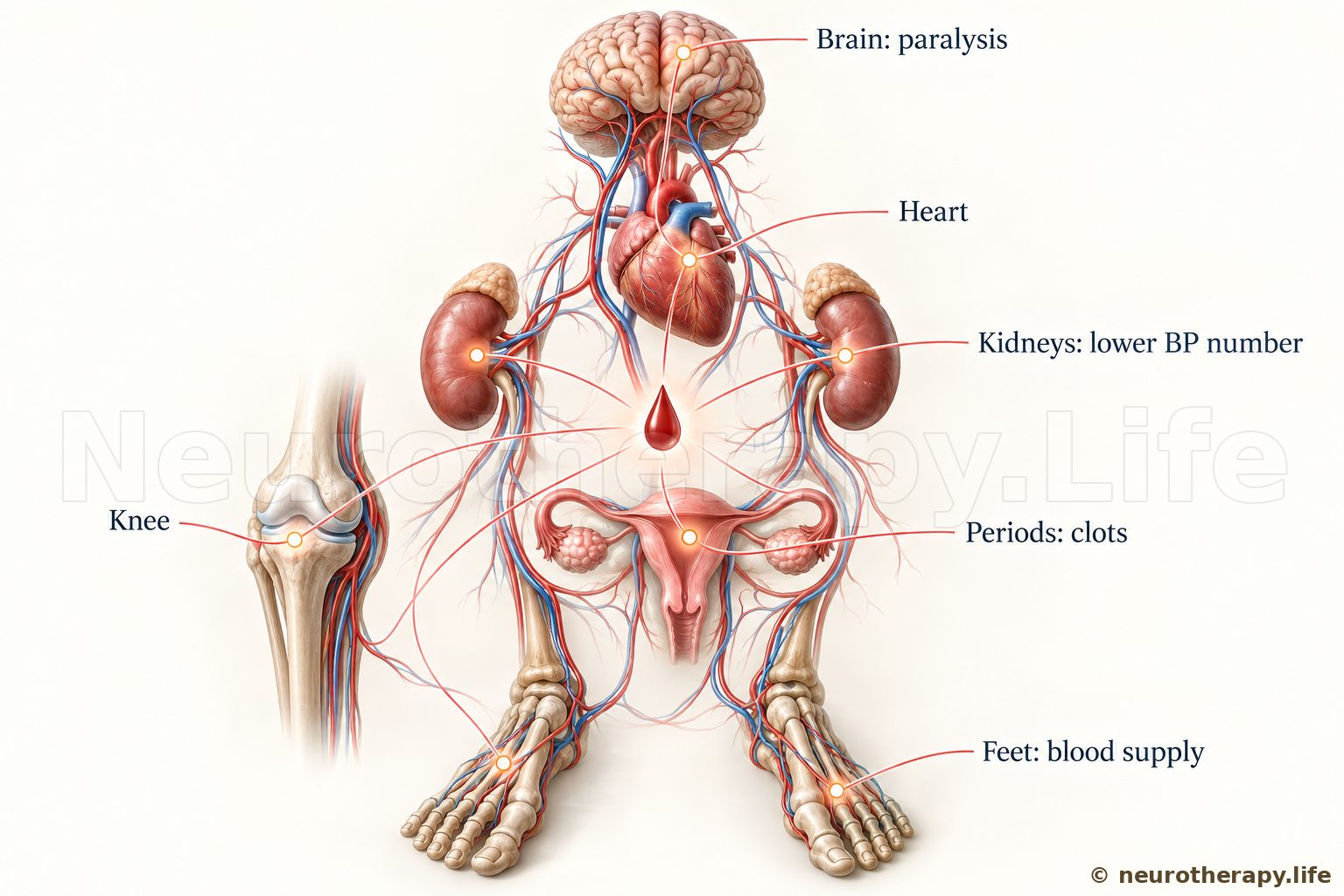
P. Heparin is named for paralysis, atherosclerosis and angina, diseases of the kidney and heart, thrombosis, clots and pain in the periods, too many platelets, clots anywhere, poor circulation, diabetes, carpal and tarsal tunnel syndrome, hypothyroidism and children of slow intellect. It also lowers a raised diastolic pressure, the lower number.
The reasoning for that last use is the renin argument. If too little blood reaches a kidney, perhaps through a clot in its artery, the kidney releases renin, which narrows vessels all over the body and raises the lower number. Open the narrowing, and the kidney stops calling for it.
The sister formulas are chosen by findings, not by the name of the disease. Pain at Mu° with signs of acidosis points to A. Heparin, which is also used in knee pain, burning feet and diabetic feet. A knee that is hot, red and swollen, with no Mu° pain, points to G. Heparin. Inflammation means all four together: swelling, pain, heat and redness; anything less is only swelling.
J. Heparin helps night cramps and tiredness, and its effect lasts about two days, so a digestive formula is not given the next day. M. Heparin is for the brain: headache, meningitis, hydrocephalus and Bell's palsy. T. and TT. Heparin follow a blow once the wound has dried, and X. Heparin answers pain at Pan or Gas. The exact method is taught hands-on in the Neurotherapy (LMNT) course.
Key points
- P. Heparin can be given to all patients, outside its safety bars.
- It lowers the diastolic number; G. Heparin is named for the systolic.
- Pain at Mu° decides between A. Heparin and G. Heparin in a knee.
- Inflammation needs all four signs: swelling, pain, heat and redness.
- J. Heparin's effect lasts two days; what follows it matters.
Go deeper
Paralysis and stroke
Paralysis and stroke
High blood pressure
High blood pressure and the two numbers
Knee pain
Knee pain, read by the findings
Avascular necrosis (AVN)
AVN, when bone loses its blood supply
A. Heparin (acid)
A. Heparin, for pain at Mu°
G. Heparin ('glandins)
G. Heparin and the prostaglandins
M. Heparin (medulla)
M. Heparin for the brain
The River: Heparin and the Heparin Formulas
The full guide to the Heparin family
Read the full guide
This topic is part of: The River: Heparin and the Heparin Formulas
Safety: when it is held back
- No Heparin treatment is given while blood is flowing or a wound is open. A diabetic foot with a wound sees a doctor first. Gangrene
- G. Heparin is not given in heart disease, because it contains (30) Medulla. G. Heparin ('glandins)
- (6) Adr, used in J. Heparin and with A. Heparin, is not given when immunity is low or in high blood pressure, nor to diabetics who felt unwell after it. (6) Adr
- X. Heparin carries (10) Medulla: not in diabetes, cancer or raised stomach acid, and in heart patients only (10) Left Medulla. (10) Medulla
- T., TT. and PT. Heparin contain Thymus Chest, which is barred in pregnancy, heart, kidney and autoimmune disease, diabetes and cancer. Th + Ch
- Neurotherapy (LMNT) works alongside your medical care. If your blood pressure falls after treatment, do not stop your tablets; ask your own doctor.
Watch

Shows the P. Heparin formula: (8) Pan at the top of the thighs, (7) Liv on the thigh and forearm, and (8) Chest Only with the palms on the chest. In the video it is given as the last part of the Angina treatment, to support circulation.

A demo of the M. Heparin formula — the Heparin formula headed by Medulla ((6) Medulla, (8) Pan, (7) Liv, (8) Chest Only) — used for neck and shoulder pain and for headache that keeps coming back.
This page explains what a Neurotherapy (LMNT) treatment is for; it is not a self-treatment guide and does not diagnose. Neurotherapy (LMNT) works alongside your medical care — keep taking the medicines your doctor prescribed.