Also called: TT Heparin, Double-thymus Heparin, TT. Heparin formula
TT. Heparin is the member of the Neurotherapy (LMNT) Heparin family for the deeper or older blow — a bruise that went deep, an old injury, or paralysis from a collection of blood after a blow. It is given only after the wound has dried, usually after the Injury formula, to help heal the vessels of that place and open its circulation again.
Overview
What is TT. Heparin?
Heparin is the body's own anticoagulant — a substance whose work is to stop clots from forming. Most of it is made by mast cells in the liver and lungs. The Neurotherapy (LMNT) Heparin formulas are named after it because they are held to produce a similar effect. Nothing is injected or swallowed: 'we applied a formula named after heparin' is the honest way to say it — never 'we gave heparin'.
The family is built on one parent formula, P. Heparin, with a different step placed in front for each member. In T. and TT. Heparin that front step is Thymus + Chest. 'T' stands for thymus at single strength, for the ordinary blow; 'TT' stands for the same step at double strength, for the deeper blow.
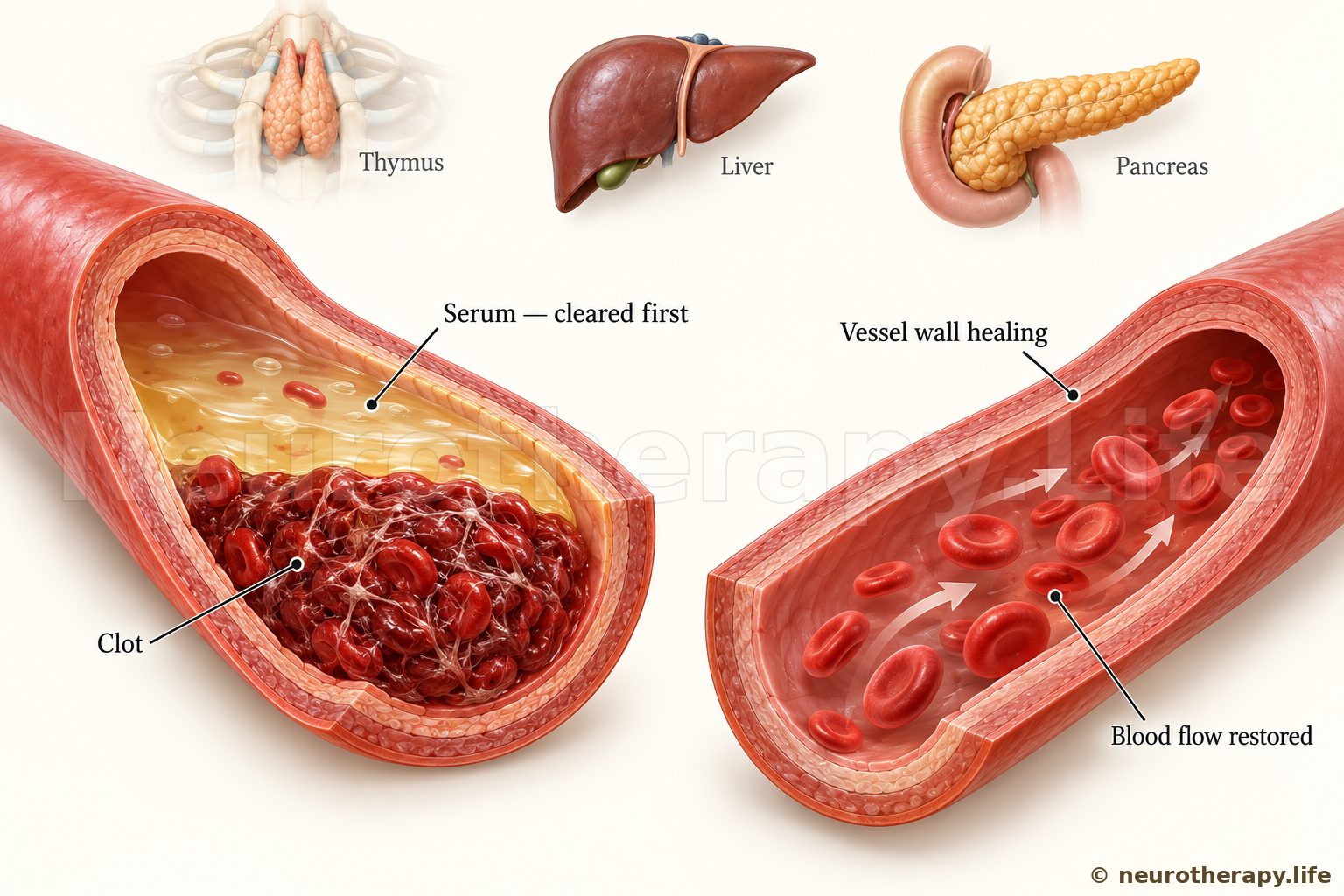
The reasoning is simple. After a blow, blood sets into a clot below, and the watery serum collects above it. So the serum is cleared first, with the Injury formula, for ten to fifteen days or until it dries up. Only then is TT. Heparin given, to heal the wound inside the blood vessels of that place and restore its circulation.
After a deep blow the serum is cleared first; TT. Heparin then helps the vessels of that place heal and open again.
What it is for
What is TT. Heparin used for?
The deeper blow — a bruise or injury that went deep.
An old blow, received long ago, that still troubles the place.
Paralysis from a haematoma — a collection of blood — after a blow.
The treatment given after the Injury formula, once the serum has completely dried; also after an accident or an operation.
Points it works through
Which points does TT. Heparin work through?
(8) Thymus+Chest (8) Pan (7) Liv (8) Ch. Only
The thymus-and-chest step, with the armpits, in front of the parent P. Heparin. They are listed here as a set, with what each contributes. The exact method is taught hands-on in the Neurotherapy (LMNT) course. This page lists the points of the formula and what each one contributes; it does not describe how any point is given. For the method, watch the demonstration video of each point on its own page and learn hands-on from a trained Neurotherapist. Please do not give a formula from a written description alone.
Thymus + Chest, over the breastbone and chest, here at double strength — the step that makes this formula 'TT'. It reaches the thymus gland and the lungs.
The pancreas point on both thighs. The teaching links it with digesting the fibrin of an old clot, since plasmin, the clot-dissolving enzyme, resembles the pancreas's trypsin.
Chest Only, a soft glide from chest to shoulders, reaching the lungs — the other place where much heparin is made.
Position:Lying on the back (supine) throughout, with no pillow under the head for the chest work.
The exact technique is taught hands-on in the Neurotherapy (LMNT) course. See the course →
How it works
Why the liver, the lungs and the pancreas?
The teaching notes that the liver and the lungs are the two places where the body slows its own blood on purpose — in the liver so its cleaning cells can do their work, in the lungs so gases can be exchanged. Slow blood is in danger of setting, so heparin is made exactly there. If the liver and the lungs are roused, the reasoning goes, heparin can be made and clots can be prevented.
The pancreas step is there to digest the fibrin of the old clot. In front of all this, the double thymus step is added for the deeper blow, which needs more repair than an ordinary one.
Two formulas, two phases, in that order: the Injury formula clears the wreckage; TT. Heparin repairs the vessel wall underneath. The changeover is decided by a finding — the serum has dried — not by the calendar.
Its family
Which formulas are related to TT. Heparin?
TT. Heparin is one branch of the Heparin family, all built on P. Heparin.
T. Heparin (thymus) — The same formula with the thymus step at single strength — for the ordinary blow, after the wound has dried.
P. Heparin (plasmin) — The parent formula, which every Heparin formula is built on — and the default when nothing else fits.
PT. Heparin — The parent with Thymus + Chest at the end instead of in front — for all kinds of paralysis, and where there is pain as well.
Injury treatment formula — Given first after a blow, until the serum dries up. TT. Heparin follows it.
Multi Heparin — For multiple infarcts or calcification — the broadest of the family.
What it is used for
When is TT. Heparin used?
Only after the wound has dried, for the deeper or older blow.
Injuries
Sprain and injuryA deep or old blow, after the Injury formula has cleared the serum
Wound healingOnly once the wound has closed and dried
No Heparin formula at all while blood is flowing or a wound is open — heparin stops blood clotting, so the wound would not heal. TT. Heparin is given only after the wound has dried. Wound healing
Thymus and Thymus + Chest are not given in pregnancy, polio, inflammatory disease, heart disease, diabetes, rheumatoid arthritis, autoimmune disorders or kidney disease. A patient with any of these is not a patient for TT. Heparin at all, and no substitute is written — the therapist asks a senior teacher. Th + Ch
In cancer, Neurotherapy (LMNT) never gives Thymus, (10) Pan, Pit, Lu+Sh, Rt.Ov/Lt.Ov or (30) Medulla — so TT. Heparin is not given in cancer. Cancer care: Neurotherapy (LMNT) support
Where Thymus + Chest is given, the armpits must be given too. Armpit
A head injury with headache that gets worse, vomiting, drowsiness, confusion, a fit, or new weakness is an emergency. People on blood thinners need their doctor's advice before any Heparin formula. How to tell a patient to see a doctor
Pan is not given in fits, convulsions or seizures, or in schizophrenia. Liv is not given with cancer in the liver. Chest Only is not given in lung cancer. Pan
Children get light treatment. Keep taking the medicines your doctor prescribed — Neurotherapy (LMNT) works alongside your medical care, never instead of it.
Common questions
Is heparin injected in this treatment?
No. No medicine and no instrument is used. The formula is named after the body's own heparin, whose effect it is held to resemble.
What is the difference between T. and TT. Heparin?
Both put Thymus + Chest in front of P. Heparin. T. Heparin uses it at single strength for an ordinary blow; TT. Heparin at double strength for a deeper or older blow.
Why must I wait before it is given?
Because the serum collected after a blow is cleared first with the Injury formula, and because no Heparin formula is given while a wound is open.
I have diabetes. Can I have TT. Heparin?
No. Thymus + Chest is barred in diabetes, so TT. Heparin is not given. Your therapist will ask a senior teacher what can be given instead.
Surprising facts
1Heparin was found by a medical student
In 1916 Jay McLean, a second-year student, found an anti-clotting substance in extracts of dog liver. It was named heparin, from the Greek word for liver.
Source: Wardrop D, Keeling D. The story of the discovery of heparin and warfarin. Br J Haematol. 2008;141(6):757–763.
2Your body dissolves clots every day
An enzyme called plasmin cuts the fibrin threads that hold a clot together. Doctors call this fibrinolysis, and it balances clotting all the time.
Source: Chapin JC, Hajjar KA. Fibrinolysis and the control of blood coagulation. Blood Rev. 2015;29(1):17–24.
3Serum is blood without its clotting parts
When blood clots, the cells and the clotting protein fibrinogen are pulled into the clot. The clear, straw-coloured fluid left behind is serum.
Source: Guyton & Hall, Textbook of Medical Physiology, 14th ed. — serum and clotting.
Test yourself
Research
Strong evidence
The history of how heparin was found in the liver and became a medicine — the body science behind the name of the whole Heparin family.
This page explains what a Neurotherapy (LMNT) treatment is for; it is not a self-treatment guide and does not diagnose. Neurotherapy (LMNT) works alongside your medical care — keep taking the medicines your doctor prescribed.
Ready to begin?
Send COURSE for course details, or your name, age and health issue for a consultation.