Pradeep: the knee treatment that begins with an angled pillow
Pradeep is the strongest of the Neurotherapy (LMNT) knee treatments, given after the gentler ones. Much of it is decided before a foot touches the patient: by how the pillow is placed under the knee.
Overview
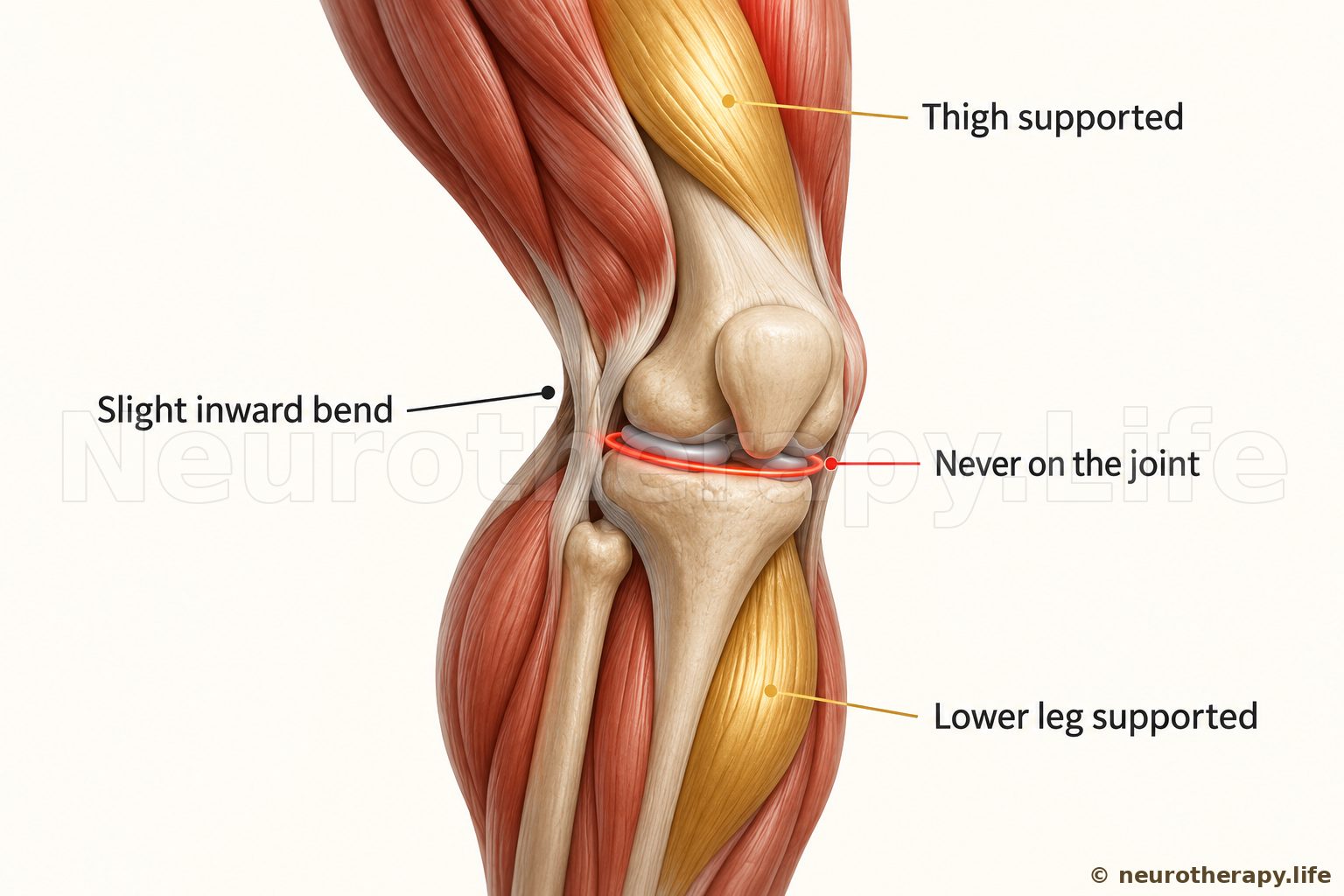
Pradeep belongs to the knee group in Neurotherapy (LMNT), given after the gentler knee treatments have softened the area. Like Giriraj, it is named after a person. It has several stages, and the first is simply the placing of a pillow.
The pillow goes under the knee at a slant, so that both the thigh and the lower leg are carried and the knee rests in a slight bend, turned a little inward. A knee held dead straight passes every downward force through the joint line; a supported, slightly bent knee does not. Set the pillow wrongly and everything after it changes.
The therapist stands between the patient's legs, facing the knee, with the weight carried on two chairs. The feet work beside the knee, never on the joint: one quick downward push, then small close steps along the thigh and down the lower leg, and it ends with a steady full-weight stand on the middle of the kneecap with the soft middle of the sole. A second accepted way works the thigh and the lower leg at the same time. Each knee is treated in turn.
The quick push and the full-weight stand are the two forceful parts, and in some patients they are never given. For them, the rest of the knee group, given lightly by hand, usually stays available. Holding back one stage is not abandoning a treatment. The exact method is taught hands-on in the course.
Key points
- Pradeep is the strongest of the knee treatments and comes after the gentler ones.
- The angled pillow belongs to the treatment, not bedding.
- The therapist's feet never land on the knee joint during the walks.
- Its two forceful parts are left out entirely in certain patients.
Go deeper
Pradeep
The full point page for Pradeep
Giriraj
Giriraj, which loosens the thigh first
Knee Cap Free
Knee Cap Free, for a stuck kneecap
Back of Knees
Back of Knees, which makes the kneecap supple
Knee pain
Knee pain and how it is approached
Arthritis and joint pain (osteoarthritis)
Arthritis and joint pain
Osteoporosis
Brittle bones, where the forceful parts are left out
Knee, Leg and Foot: Neurotherapy (LMNT) for Knee Pain and the Lower Leg
The full guide to the knee, leg and foot
Read the full guide
This topic is part of: Knee, Leg and Foot: Neurotherapy (LMNT) for Knee Pain and the Lower Leg
Safety: when it is held back
- The quick downward push and the full-weight stand of Pradeep are not given — not even lightly — in a replaced or resurfaced knee.
- They are not given in a knee that is hot, swollen or acutely painful, or with a fever; nor after a recent knee injury that has not been checked, nor in a knee that locks or gives way. Knee pain
- They are not given where bones break easily: a frail elder, anyone who has broken a bone from a small knock, or anyone on long-term steroids. Osteoporosis
- They are not given to anyone on blood-thinning medicine or with a bleeding disorder.
- During the walks, the therapist's foot must never fall on the knee joint itself.
- Neurotherapy (LMNT) works alongside your medical care. Do not stop or change any medicine on your own.
Watch

A recorded online class by Dr. Diwakar Shukla on knee pain: the parts of the knee, advice on weight and food (such as keeping away from sour things), and a self-massage and exercise routine, followed by viewers' questions. It is shared as self-care support for knee pain.
This page explains what a Neurotherapy (LMNT) treatment is for; it is not a self-treatment guide and does not diagnose. Neurotherapy (LMNT) works alongside your medical care — keep taking the medicines your doctor prescribed.