Giriraj: loosening the thigh muscles above the knee
Giriraj is a knee treatment given with gathered fingers in small clockwise circles, carrying the thigh muscles from near the knee up towards the groin. Like several Neurotherapy (LMNT) treatments, it is named after a person.
Overview
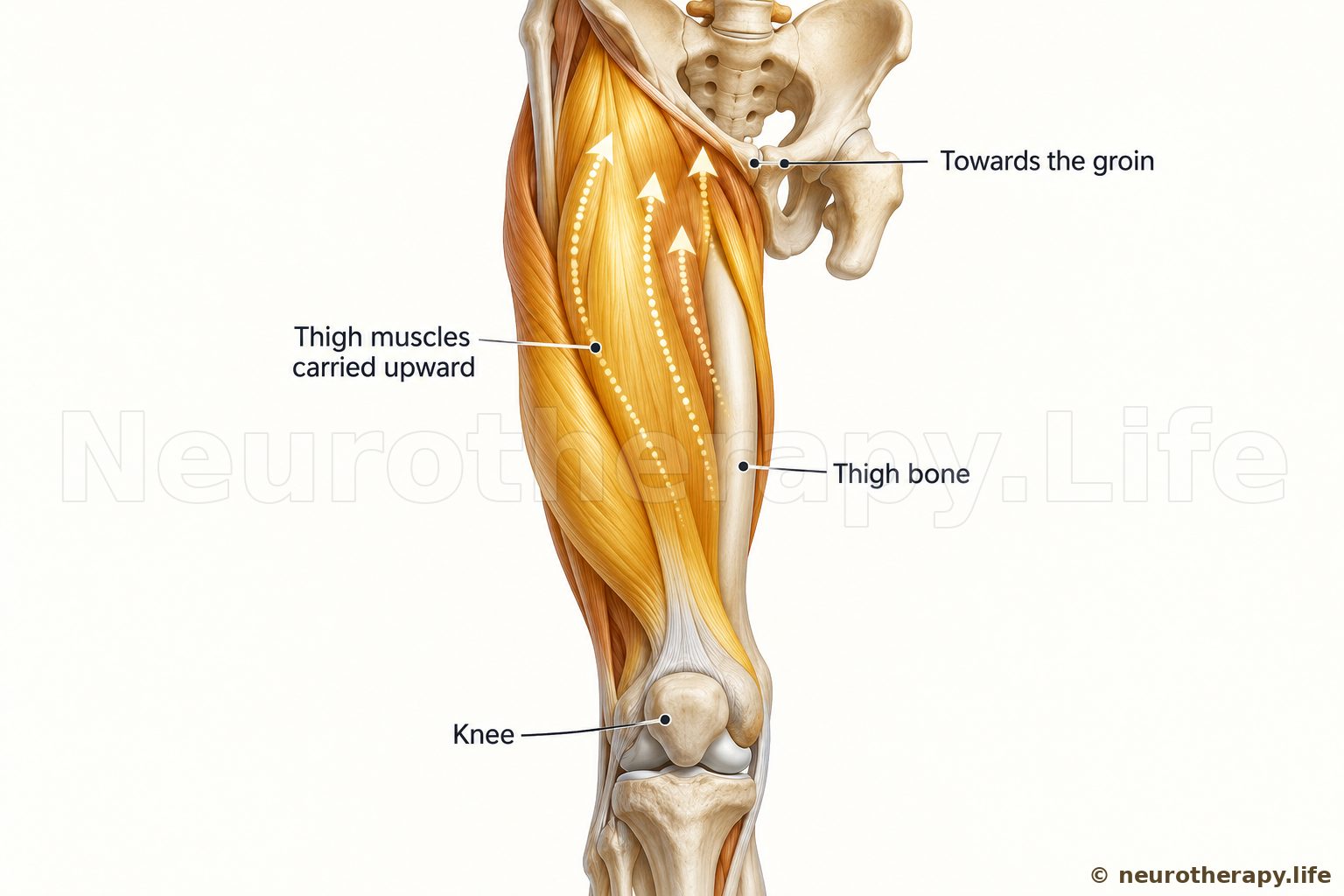
Some Neurotherapy (LMNT) treatments carry a person's name rather than a place: Giriraj and Pradeep for the knee, and elsewhere Loveleen, Raman and Shivaji. The name marks the person in connection with whom the method was found. It tells a newcomer nothing, so these are the names a student must truly learn.
Giriraj is given to loosen the muscles above and below the knee. The patient lies with a pillow under the thigh, or sits. The therapist gathers the fingers together and turns them in small clockwise circles on the thigh, rolling the muscle rather than stroking the skin, working from near the knee up towards the groin along several lines, and finally easing the outer thigh. Both legs are treated.
The direction is the whole idea: the tissue is carried away from the knee, back the way it came. Working from the groin down to the knee would feel pleasant but would be the opposite treatment. Giriraj is given together with Calf Muscle Ghisai for the lower leg, which is done on both legs if both knees hurt, and otherwise only on the painful side.
For most of Indian history people squatted and sat on the floor, folding the knee fully many times a day. Yoga keeps that range in vajrasana and the deep squat, malasana. So a useful first question for a patient whose knees are stiff is what their knees have stopped doing. The exact method is taught hands-on in the course.
Key points
- Giriraj loosens the muscles above and below the knee.
- It rolls the thigh muscle in small clockwise circles, from near the knee towards the groin.
- The direction away from the knee is the point of the treatment.
- It is paired with Calf Muscle Ghisai for the lower leg.
Go deeper
Giriraj
The full point page for Giriraj
Calf Muscle Ghisai (Left)
Calf Muscle Ghisai, given with Giriraj
Pradeep
Pradeep, the strongest of the knee treatments
Knee Cap Free
Knee Cap Free, for a stuck kneecap
Back of Knees
Back of Knees
Knee pain
Knee pain and how it is approached
Knee
How the knee is built
Knee, Leg and Foot: Neurotherapy (LMNT) for Knee Pain and the Lower Leg
The full guide to the knee, leg and foot
Read the full guide
This topic is part of: Knee, Leg and Foot: Neurotherapy (LMNT) for Knee Pain and the Lower Leg
Safety: when it is held back
- One leg that is hot, swollen and tender — especially after surgery, a long illness, a long journey or pregnancy — may hide a clot. That leg is not rubbed or worked on; it is sent to a doctor urgently. Thrombosis (blood clots)
- A knee that is hot, swollen or acutely painful, or one with a recent injury that has not been checked, is seen by a doctor first. Knee pain
- Neurotherapy (LMNT) works alongside your medical care. Do not stop or change any medicine on your own.
Watch

A recorded online class by Dr. Diwakar Shukla on knee pain: the parts of the knee, advice on weight and food (such as keeping away from sour things), and a self-massage and exercise routine, followed by viewers' questions. It is shared as self-care support for knee pain.
This page explains what a Neurotherapy (LMNT) treatment is for; it is not a self-treatment guide and does not diagnose. Neurotherapy (LMNT) works alongside your medical care — keep taking the medicines your doctor prescribed.