Also called: Dysentery point, Dys point, डिसेंट्री, दस्त पॉइंट
Dys is the Neurotherapy (LMNT) point for ordinary loose motions, given in the middle of the left thigh while you lie on your back. It is the mirror of Const, it is used only with great care and only for a day or two, and in practice it is given next to never.
Overview
What is the Dys point?
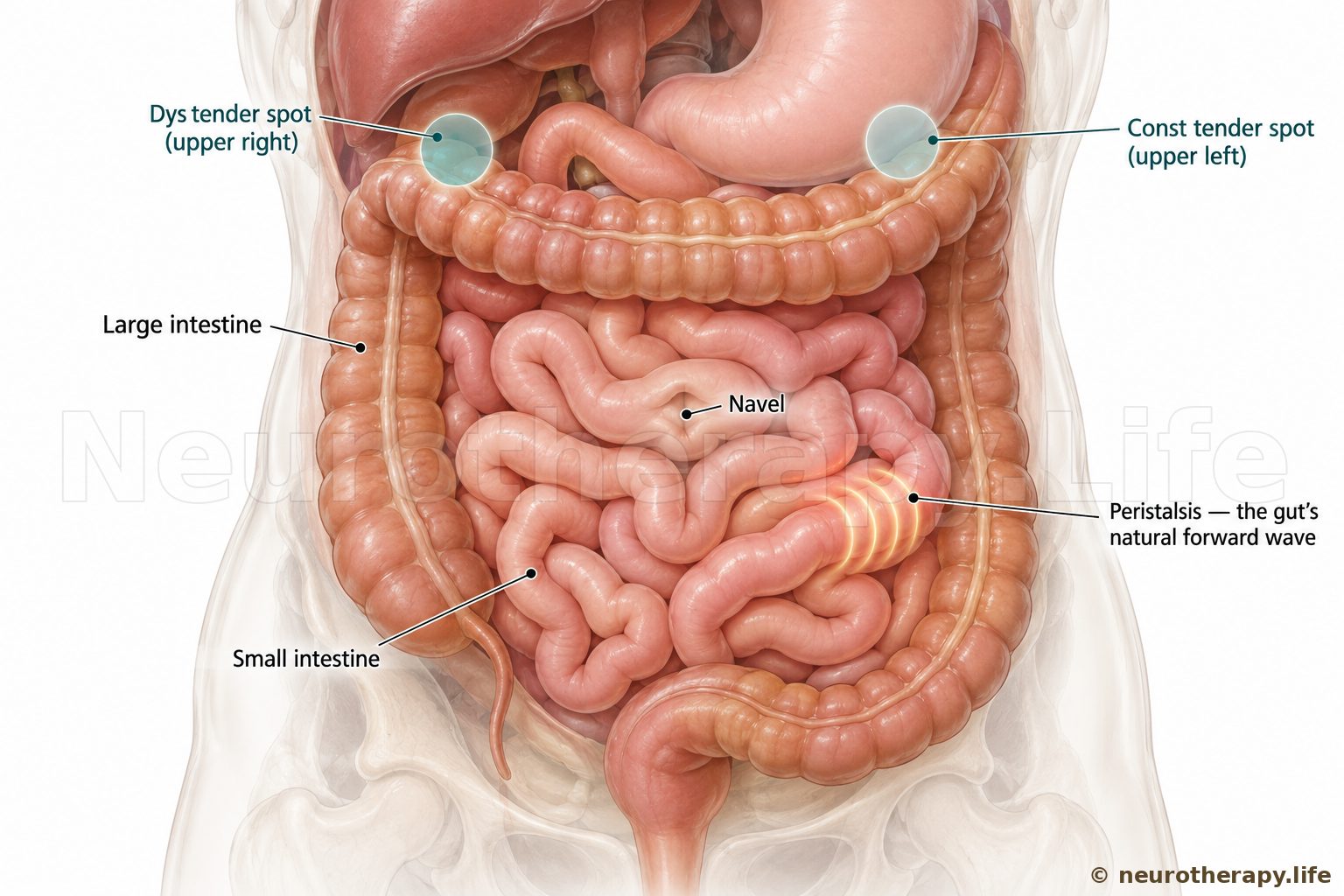
Dys is short for dysentery, but its stated use is milder: relief in ordinary loose motions. LMNT teaching finds that loose motions can show as a tender spot on the belly above and to the right of the navel, between the navel and the right rib edge — and Dys is given only when that pain is found.
The therapy is unusually plain about this point. It is recorded 'for information only', and in practice it is used next to never. Students learn it so they can read a card that carries it — not so they go looking for reasons to give it.
The reason for the caution is the way it works. Dys acts against peristalsis — the natural wave-like movement that pushes food through the gut. Slowing a bowel is sometimes useful for a day; slowing it longer, or slowing a bowel that is already slow, does harm.
Dys answers the upper right of the navel, Const the upper left. Dys works against the gut's forward wave — which is why it is used so rarely.
Where it is given
Where is Dys given?
PositionLying on the back
Body areaFront of the left thigh, in the middle of the thigh
You lie on your back with one pillow under both thighs. Dys is given in the middle of the front of the left thigh.
The tender spot is on the right of the belly, but the point is on the left thigh. That is LMNT's crossing rule: the left limb answers the right of the navel. Dys is felt on the right and treated on the left; Const is felt on the left and treated on the right.
How it is given
How is Dys given?
How this point is given — the tool, the pressure, the count and the exact movement — is deliberately not described here. A demonstration video for this point is being prepared; until it is on this page, learn the method hands-on from a trained Neurotherapist before giving it. Please do not give any point from a written description alone: a point given in the wrong place or the wrong way can do harm.
Chosen byPain above and to the right of the navel
The exact technique is taught hands-on in the Neurotherapy (LMNT) course. See the course →
What it does
What does Dys do?
The source gives one use and three brakes. The use: relief in ordinary loose motions. The brakes: a pain finding that must be present, a limit of a day or two, and a warning that it works against the gut's own movement.
Gives relief in ordinary loose motions, when there is pain above and to the right of the navel.
Slows the movement of the intestine — the stated reason it is barred in constipation.
Is given for a day or two at most, never as a routine.
Organs it reaches
Intestines — The gut whose forward wave Dys is said to slow.
Bowel — Loose motions mean the bowel is moving too fast and absorbing too little water.
Navel — The tender spot that selects Dys lies above and to the right of the navel.
Its family
Which points are its partners?
Dys and Const are a matched pair on opposite thighs, answering opposite corners of the belly.
Const — Its mirror — constipation, on the right thigh, one foot after the other.
Gas 'I' — Gas 'I' and Const are blocked in dysentery and loose motions.
Gas Only — Blocked with Dys in constipation and in piles, fissure and fistula.
TF — Toe Fingers, which has its own form for a child's ordinary loose motions.
What it is used for
What is Dys used for?
Only ordinary loose motions — and only with the pain finding, for a day or two, and with great thought. Loose motions with fever, blood, drowsiness or dehydration go to a doctor.
Never in constipation. Dys stops the movement of the intestine, so constipation would increase further. Constipation
Blocked in piles, anal fissure, fistula and rectal prolapse — diseases of acid in which hard constipation is a chief cause. Piles (haemorrhoids) and fissure
Given only when there is pain above and to the right of the navel, and for a day or two at most. Because it works against peristalsis, its use is undertaken only with great thought.
Do not mix up the thighs: giving Dys to a constipated patient — by reasoning from the side of the pain instead of the crossing rule — asks an already slow bowel to slow further. Why a point for the right side is given on the left limb
A child who is drowsy, passing blood, feverish, or not drinking and not passing urine needs a doctor and fluids today. The same for anyone with signs of dehydration or bloody stools. Dysentery (bloody loose motions)
Probably not. Dys is given only when there is pain above and to the right of the navel, for a day or two, and with great care. In practice it is used next to never; other treatments are usually chosen.
Why is a point that is hardly used still taught?
So a therapist can read a card that carries it, understand the crossing rule through it, and never give it by mistake to a constipated patient.
Is Dys the same as treatment for dysentery?
The name comes from dysentery, but its stated use is ordinary loose motions. Bloody dysentery, fever or dehydration need a doctor first.
Surprising facts
1A wave that never stops
Peristalsis is a ring of muscle squeezing behind the food and relaxing in front of it, moving everything forward — it works even when you are asleep.
Source: Guyton & Hall, Textbook of Medical Physiology, 14th ed. — propulsive movements of the gastrointestinal tract.
2Litres of fluid every day
About eight to nine litres of fluid — drink plus the gut's own juices — pass into the intestines each day, and almost all of it is absorbed back. Loose motions happen when too little is taken back.
Source: Guyton & Hall, Textbook of Medical Physiology, 14th ed. — absorption in the small and large intestine.
3A simple drink saves lives
Oral rehydration solution — clean water with the right mix of salt and sugar — has saved millions of lives from diarrhoea, especially in children.
Source: World Health Organization, Diarrhoeal disease fact sheet, 2024.
This page explains what a Neurotherapy (LMNT) treatment is for; it is not a self-treatment guide and does not diagnose. Neurotherapy (LMNT) works alongside your medical care — keep taking the medicines your doctor prescribed.
Ready to begin?
Send COURSE for course details, or your name, age and health issue for a consultation.