Also called: B12 point, Vitamin B12 point, the left-hip vitamin point, बाएँ कूल्हे वाला विटामिन पॉइंट
B₁₂ is the Neurotherapy (LMNT) point on the front rim of the left hip bone that is linked with vitamin B₁₂ deficiency. Extreme tenderness there is read as a sign to look for that deficiency; the treatment is given lying on your right side and aims at digestion and absorption — it is never a substitute for a blood test.
Overview
What is the B₁₂ point?
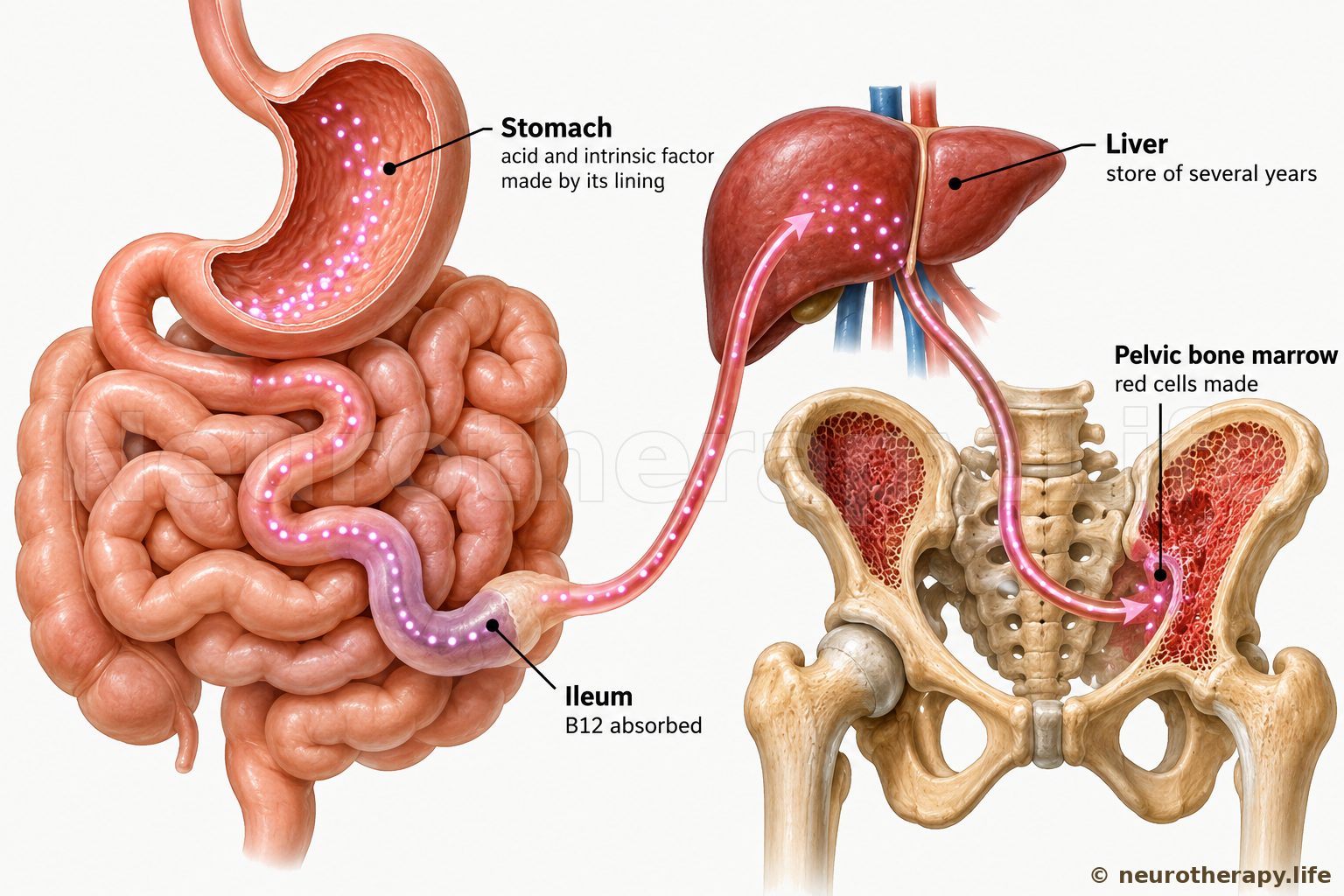
Vitamin B₁₂ is a nutrient your body needs to make healthy red blood cells and to keep the nerves working. The body cannot make it; it must come from food and then be absorbed — first freed by stomach acid, then joined to a carrier the stomach lining makes (intrinsic factor), and finally taken up at the far end of the small intestine.
The teaching found that people with the signs of B₁₂ deficiency had extreme pain at one place: in front of the thigh bone on the left side, in the hollow just inside the hip bone (the left iliac fossa). That place came to be called the B₁₂ point. It is one of four vitamin points on the rim of the hip bone — B₁₂ and Nia on the left, Folic and Thia on the right.
The honest claim is about absorption, not manufacture. The therapy's work is aimed at the stomach, the gut and the liver — the places where B₁₂ can be lost even in someone who eats well. If a person is truly short of B₁₂, they need B₁₂, and a doctor's test and treatment.
B₁₂ has a long journey: stomach, the end of the small intestine, the liver store, and the bone marrow. The therapy's work is aimed at the early steps of that journey.
Where it is given
Where is B₁₂ found and given?
PositionLying on one side
Body areaUpper left hip, lying on the right side; tenderness checked just inside the front of the left hip bone
During examination, the therapist feels the soft strip just above and inside the front rim of the left hip bone — never the hard rim itself, which is tender in everybody. Extreme tenderness here is the finding that points to the B₁₂ picture.
For the B₁₂ treatment you lie on your right side, with the chest normal and the knees straight in line with the body, and a pillow between the thighs. The therapist works on the upper (left) hip.
How it is given
How is B₁₂ given?
How this point is given — the tool, the pressure, the count and the exact movement — is deliberately not described here. Watch the demonstration video on this page, and learn the method hands-on from a trained Neurotherapist before giving it. Please do not give any point from a written description alone: a point given in the wrong place or the wrong way can do harm.
The exact technique is taught hands-on in the Neurotherapy (LMNT) course. See the course →
What it does
What does the B₁₂ point do?
The teaching links pain at this point with B₁₂ deficiency and uses it, with the gall bladder and liver, to support the body's absorption and storage of the vitamin. Body science agrees that absorption depends on the stomach, the end of the small intestine and the liver store; that a press on the hip changes absorption is the therapy's own explanation from long clinical experience.
Reads the body: extreme pain here, with the deficiency signs, points toward a shortage of B₁₂.
Supports the absorption of B₁₂ as part of the Vitamin B₁₂ formula.
Is aimed at the tiredness, numbness, darkened knuckles and mouth ulcers of the deficiency picture.
Works on the bowel of the left side — which is why, where folic acid work is also given, the teaching fixes the order of the two.
Organs it reaches
Stomach — Makes the acid and the intrinsic factor without which B₁₂ cannot be absorbed.
Intestines — B₁₂ is taken up at the far end of the small intestine.
Liver — Holds a store of B₁₂ that lasts several years.
Blood — Without B₁₂ the red cells cannot mature, and anaemia follows.
Its family
Which points are close to B₁₂?
B₁₂ is one of four vitamin points on the rim of the hip bone, and it works hand in hand with Left Parkhoo.
Lt. Parkhoo — The left-hip treatment through which the B₁₂ formula works.
Folic — The folic acid point on the right hip — B₁₂ and folic acid are needed together for red cells to mature.
Nia — The niacin point, given in the same side-lying position on the left hip.
Thia — The thiamine (vitamin B₁) point on the right.
Rt. Parkhoo — The right-hip partner, added for folic acid.
What it is used for
What is B₁₂ used for?
The deficiency picture is read on the mat; the deficiency itself is confirmed by a blood test.
A deficiency is not diagnosed with a fingertip. Tenderness at B₁₂ is a prompt to ask for a blood test, never a diagnosis given to the patient. How to tell a patient to see a doctor
Numb feet, an unsteady walk, pins and needles in the hands, a sore smooth tongue or new forgetfulness: think of B₁₂ and get the blood test this week. Nerve damage can begin before any anaemia shows, and can become permanent if replacement is delayed. Numbness in the legs
Nothing the doctor has prescribed is stopped. Some long-term medicines, including a common diabetes tablet, reduce B₁₂ absorption — ask the doctor for a B₁₂ level rather than stopping them. Diabetes
Where the folic acid work and the B₁₂ work are given together, the order is fixed by the teaching; reversing it can cause severe constipation. This is one reason the formula is given only by a trained therapist. Constipation
“Apart from vitamin K and folic acid, the vitamins are not made in the body; they must come from food. As the digestive system is set right and the pain is drawn out of those points, the symptoms of the deficiency begin to reduce.”
— Dr. Lajpatrai Mehra
A teaching case
Teaching case: the feet that had gone quiet
A teaching case, put together from several patients: a man in his fifties on a diabetes tablet for many years came with burning and numbness in both feet and asked simply to be 'given the B₁₂ point'. His sugar reports were good and his haemoglobin normal, which is exactly why nobody had checked his B₁₂. The therapist did not give the vitamin point that day; he explained that the body cannot make B₁₂, asked for a B₁₂ blood test, began digestive work, and stopped nothing the doctor had given.
A composite case written to teach the reasoning — not one patient’s file.
Common questions
Can pressing my hip make vitamin B₁₂?
No. The body cannot make B₁₂. The therapy's work is aimed at digestion and absorption — one of the places a person who eats well can still lose it. If you are short, you need B₁₂ itself, as your doctor advises.
My feet go to sleep when I sit cross-legged. Do I have B₁₂ deficiency?
Everyone's feet go to sleep. What matters is the recovery: ordinary feet come right within a few seconds of standing. Feet that stay asleep are the sign worth a blood test.
I am vegetarian. Should I worry?
B₁₂ comes mainly from animal foods, including milk and curd. Vegetarians, and especially those who take little dairy, are more often short — ask your doctor about a test.
Why do my knuckles look dark?
The teaching lists blackening of the skin over the knuckles as one sign of the B₁₂ picture. Compare both hands in daylight — and confirm with a blood test.
Surprising facts
1A store that lasts years
The liver holds enough B₁₂ for several years, so a deficiency can take years to show — and when it does, the shortage has been building for a long time.
Source: Guyton & Hall, Textbook of Medical Physiology, 14th ed., vitamin B12 and red cell maturation.
2A carrier from the stomach
B₁₂ can only be absorbed when joined to intrinsic factor, a protein made by the stomach lining. When the stomach stops making it, the vitamin passes straight through, however much is eaten.
Source: Guyton & Hall, Textbook of Medical Physiology, 14th ed.
3Your hip bone is a blood factory
In adults, much of the red blood is made in the marrow of flat bones such as the pelvis — the very bone on whose rim the vitamin points lie.
Source: Guyton & Hall, Textbook of Medical Physiology, 14th ed., sites of red cell production.
4A common tablet, a hidden shortage
In a four-year trial, people taking metformin, a common diabetes medicine, had lower B₁₂ levels than those on a dummy tablet — one reason long-term users are advised to have B₁₂ checked.
Source: de Jager J et al. Long term treatment with metformin in patients with type 2 diabetes and risk of vitamin B-12 deficiency. BMJ 2010;340:c2181.
Watch
Vitamin B12 Treatment in Neurotherapy | LMNT Formula for Anaemia, RBC & Nerve Health
Shows the Vitamin B12 treatment: (3) Gal and (7) Liv on the thigh and forearm, then (8) Left Parkhoo at the left hip with the patient lying on their side. It is given to support the body's absorption of vitamin B12.
This page explains what a Neurotherapy (LMNT) treatment is for; it is not a self-treatment guide and does not diagnose. Neurotherapy (LMNT) works alongside your medical care — keep taking the medicines your doctor prescribed.
Ready to begin?
Send COURSE for course details, or your name, age and health issue for a consultation.