The ring rule: how the distance of a pain from the navel decides where on the limb it is treated
On the Neurotherapy (LMNT) chart, each point around the navel is found at three distances, marked as rings. The ring is not a grade of how bad the pain is — it tells the therapist where along the arm or leg the treatment belongs.
Overview
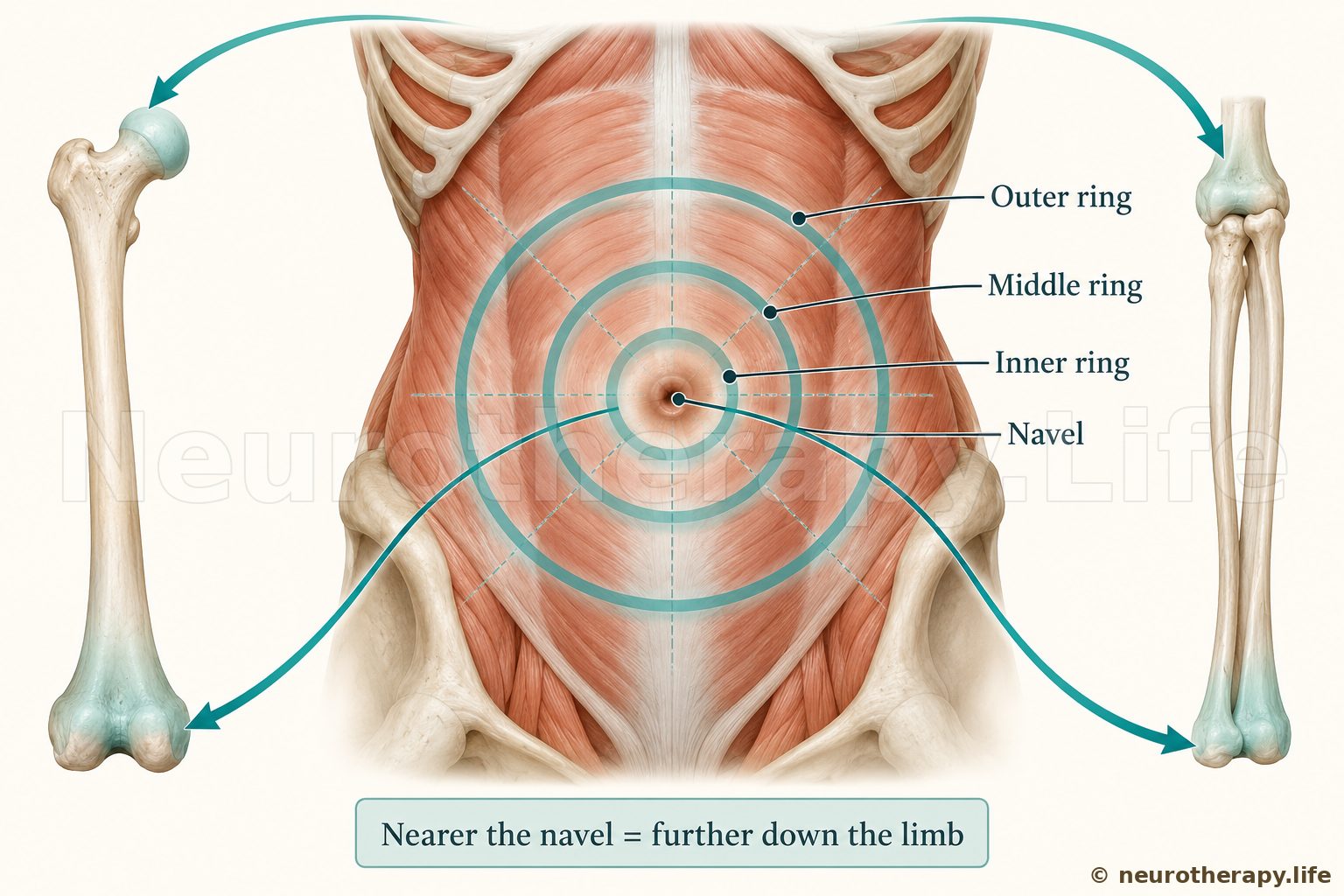
Look closely at the Neurotherapy (LMNT) front chart and you will see small boxes carrying the numbers one, two and three. Beginners often think a three means ‘worse’ than a two. It does not. These numbers are rings — positions, like an address — and they say nothing about how strong the pain is.
In each of the eight directions around the navel — the four straight ones and the four diagonals — the same named point appears at three distances. Ring three sits right around the navel. Ring two forms a middle circle. Ring one lies furthest out, towards the rib margins, the flanks and the hip bones.
The surprise is that the rule runs inside out. The nearer a tender spot lies to the navel, the further down the arm or leg it is answered. A pain at ring one is answered close to the trunk; a pain at ring three only from the far end of the limb. Put this together with the other basic rules — legs for pains above the navel, arms for pains below it, and the opposite side for each side — and every spot on the belly has its own address on a limb.
This is why the ring must always be written on the patient's card. A treatment given at the wrong place on the limb does very little, however well it is given. The exact places on each limb are taught hands-on in the course.
Key points
- The numbers around the navel are rings (positions), not grades of pain.
- Each point appears at three distances: inner, middle and outer ring.
- The nearer the pain is to the navel, the further down the limb it is answered.
- If a treatment is not working, the answer is never more pressure — it is a fresh examination, and very often the ring.
Go deeper
Navel
The navel, the centre of the map
Gal
Gal — a point read by its ring
WD
WD — the midline point answered on both arms
The Hand That Heals: What Neurotherapy (LMNT) Is
Guide: The Hand That Heals — legs, arms and crossed sides
The Educated Hand: How the Pain Points Are Felt
Guide: The Educated Hand — re-examine when nothing moves
The Navel Speaks First: The Map of the Pain Points
Guide: The Navel Speaks First
Read the full guide
This topic is part of: The Navel Speaks First: The Map of the Pain Points
Safety: when it is held back
- When a treatment is not moving, never press harder. Re-examine the patient from the beginning — the tenderness may have moved to another ring.
Watch

An overview of LMNT's diagnostic pain points — the places around the navel that the therapist presses to read the body before choosing a treatment.
This page explains what a Neurotherapy (LMNT) treatment is for; it is not a self-treatment guide and does not diagnose. Neurotherapy (LMNT) works alongside your medical care — keep taking the medicines your doctor prescribed.