How blood, nerves and glands work as one system
In Neurotherapy (LMNT), blood supply, nerve signals and glands are seen as one linked chain. When an organ is short of blood or nerve supply, the body's fluids change, the muscles around the glands tighten, and the glands' output slips, which can lay the ground for disease.
Overview
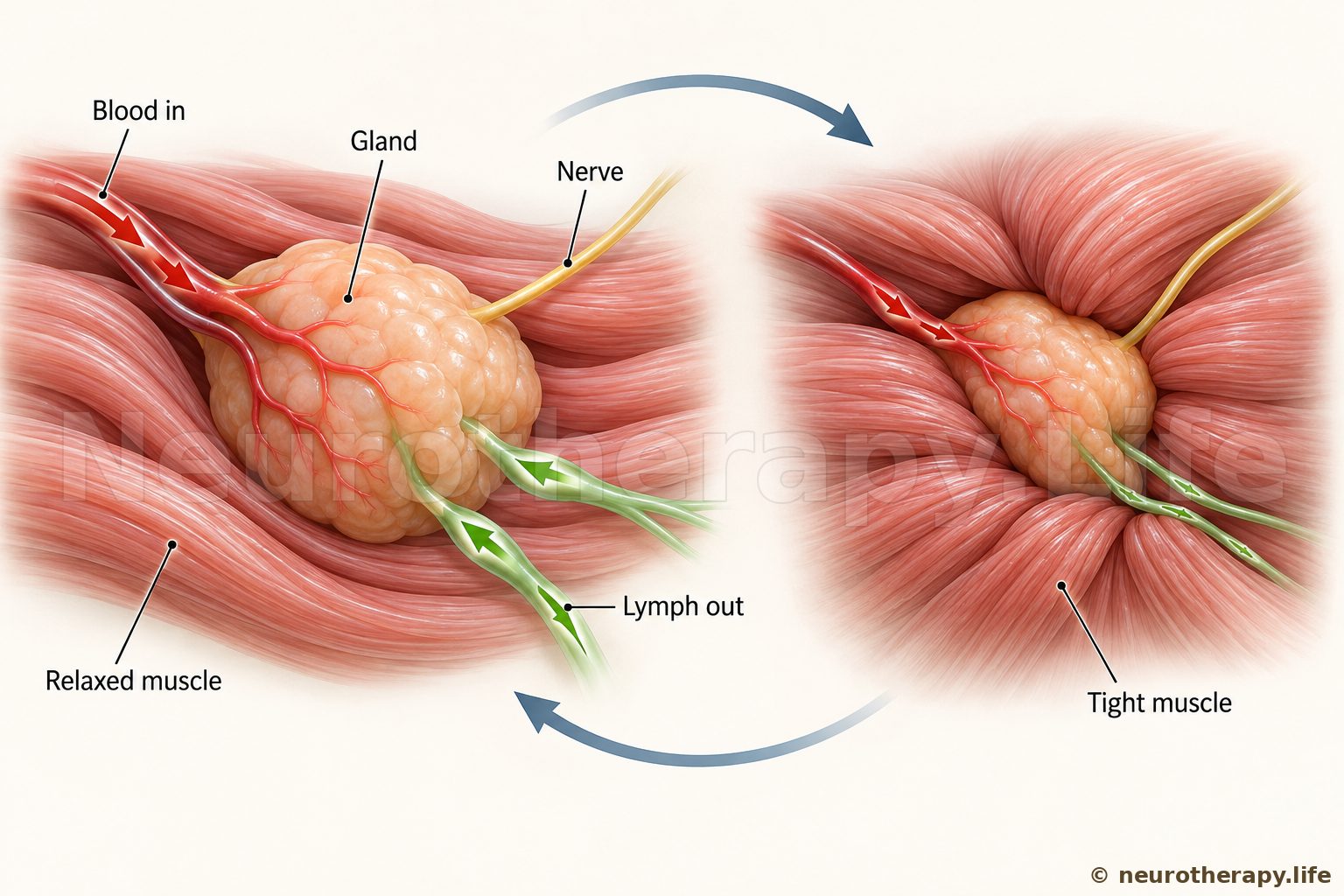
Science lessons usually describe blood, nerves and glands separately. Neurotherapy (LMNT) treats them as one system and explains disease as a chain of six steps. First, an organ gets too little blood or nerve supply. Second, the chemistry of the body's fluids changes. Third, the muscles around the glands and organs become too tight or too slack.
Fourth, the glands make too much or too little of their secretions. Fifth, since the glands govern every function of the body, the body begins to work wrongly. Sixth, this lays the foundation of disease.
The third step is the one most people skip. A gland sits in a bed of muscle. Squeeze a sponge in your fist and pour water on it: the water runs round, not in. Open the hand and the sponge drinks. Muscle held tight for years by posture, tension or pain is that closed fist.
The chain also turns into a circle: wrong fluid tightens the muscle, tight muscle cuts the supply, and poor supply makes the fluid worse. Treatment aims to break into this circle from outside, by restoring the flow of blood, lymph and nerve signals so the glands and organs can return to normal work.
Key points
- Blood, nerves and glands are one linked system, not three.
- Poor supply changes body fluids, which changes muscle tone.
- Tight muscle around a gland is like a sponge in a closed fist.
- The chain can become a circle that worsens on its own.
- Treatment aims to restore the flow of blood, lymph and nerve signals.
Go deeper
The Body's Own Pharmacy: How the Body Makes and Balances Its Chemicals
The body's own pharmacy of glands
Glands and hormones
Glands and hormones
Heart, blood and circulation
Why blood must keep moving
Lymph and immunity
Lymph, the fluid that drains the tissues
Nervous system and brain
Nerves and the messages they carry
The Timed Press: Why Time, Angle and Order Are Fixed
How pressure is fixed in place, time and angle
The Navel Speaks First: The Map of the Pain Points
The pain points where a shortage shows
Read the full guide
This topic is part of: The Body's Own Pharmacy: How the Body Makes and Balances Its Chemicals
Watch

An overview of LMNT's diagnostic pain points — the places around the navel that the therapist presses to read the body before choosing a treatment.
This page explains what a Neurotherapy (LMNT) treatment is for; it is not a self-treatment guide and does not diagnose. Neurotherapy (LMNT) works alongside your medical care — keep taking the medicines your doctor prescribed.