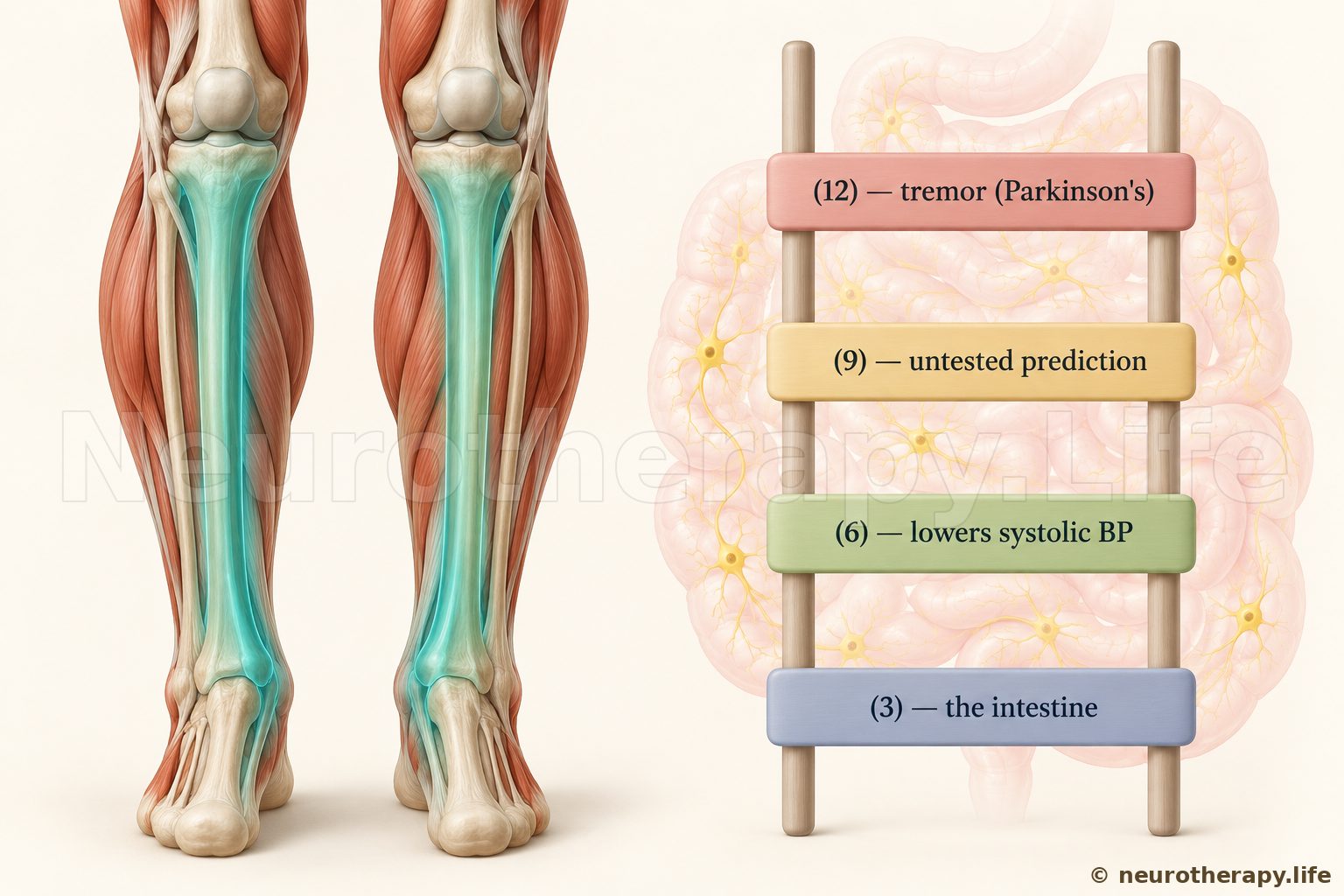
Also called: the Gas 'I' forms, (12), (9), (6) and (3) Gas 'I'
The Gas 'I' ladder is a set of named forms of one Neurotherapy (LMNT) point, Gas 'I', on the calves. Each form is a different treatment: one is linked with the tremor of Parkinson's disease, one with lowering high blood pressure, one with the intestine, and one is a prediction never fully tested.
Overview
What is the Gas 'I' ladder?
Gas 'I' is the intestine point, given down both calves with the patient lying on the back. In Neurotherapy (LMNT) it can be given in several named forms — (12) Gas 'I', (9) Gas 'I', (6) Gas 'I' and (3) Gas 'I'. The number is part of the name, and each name is a separate treatment.
Read from top to bottom, these forms make a 'ladder', and each rung is held to do something different. The teaching calls this the plainest example in the whole therapy of one idea: the same point, in two different forms, is two different treatments — and they can even pull in opposite directions.
The ladder grew from one patient and one question, and the teaching records honestly which rungs were tested on many patients and which were not.
One point on the calves, four named forms, four different treatments — from the tremor of Parkinson's disease to the intestine.
What it is for
What is each rung of the ladder used for?
(12) Gas 'I' — linked with Parkinson's disease, after a patient's hand tremor was seen to lessen greatly.
(9) Gas 'I' — predicted perhaps to raise blood pressure, for use in low blood pressure; never tested on enough patients, and the teaching says so.
(6) Gas 'I' — given for many years to patients with high blood pressure to help bring the systolic (upper) reading down.
(3) Gas 'I' — to rouse the intestine; nowadays a lighter, spread form of Gas 'I' is given in its place.
Inside the UDF formulas, the Gas 'I' step of the Ajay Normal closing is chosen by the stool — normal, hard or loose.
Points it works through
Which point does the ladder work through?
Every rung is the same point, Gas 'I', in the same position — lying on the back, down both calves. What separates the rungs is the form given. The exact method is taught hands-on in the Neurotherapy (LMNT) course. This page lists the points of the formula and what each one contributes; it does not describe how any point is given. For the method, watch the demonstration video of each point on its own page and learn hands-on from a trained Neurotherapist. Please do not give a formula from a written description alone.
Position:Lying on the back (supine), down both calves from knee to heel, for every rung.
The exact technique is taught hands-on in the Neurotherapy (LMNT) course. See the course →
How it works
How did the ladder come about, and how is it thought to work?
A patient with Parkinson's disease had marked tenderness at Gas 'I'. The point was chosen by the tenderness, not the diagnosis. When (12) Gas 'I' was given, his hand tremor became much less. Parkinson's disease comes from a shortage of the brain chemical dopamine, so a question followed: could this form be helping the body make dopamine?
Body science adds a clue. The gut has its own nervous system of very many nerve cells, which make, in small amounts, some of the same chemicals as the brain. And dopamine given as a drug in hospital acts differently at different doses: a small dose widens the arteries of the kidney and gut and lowers blood pressure, while a larger dose raises it.
From that, the teaching inferred that a lighter form, (6) Gas 'I', might lower high blood pressure — and when tried, systolic pressure came down. It then predicted that (9) Gas 'I' might raise it, but too few low-pressure patients came to test this. The teaching leaves that gap open rather than filling it. Nothing is given by mouth or injection in any of these forms.
Its family
Which formulas are related to the Gas 'I' ladder?
The ladder sits among the acid–alkali formulas and reaches into the stomach formulas through Ajay Normal.
Ajay Normal — Its Gas 'I' step is the rung that changes with the stool inside UDF treatments.
General UDF formula — A UDF formula whose closing Gas 'I' step has three settings chosen by the bowel.
1,25 DCC (ordinary form) — Another formula whose form is chosen by the stool — the same principle.
ALTF (chief form) — The chief alkali treatment, taught alongside the ladder.
What it is used for
When are the forms of the ladder used?
Each rung has its own use. All of them work alongside medical care, never instead of it.
The form is the treatment. A small slip in the method can turn the blood-pressure-lowering form into the form held to raise it. The therapist gives it in silence, fully focused — this is why it is given only by a trained therapist. Why each Medulla number is a different treatment
Never stop or reduce blood pressure medicines because a reading is better. Only the doctor who prescribed them changes them. High blood pressure
Medicines for Parkinson's disease are never stopped or reduced because a tremor is better on the mat. They are changed only by the doctor. Parkinson's disease
(9) Gas 'I' is an untested prediction. It is not offered as a treatment for low blood pressure. Low blood pressure
Very high blood pressure with severe headache, chest pain, breathlessness, confusion or weakness on one side is an emergency: call 108/112 or go to hospital at once. How to tell a patient to see a doctor
Keep taking the medicines your doctor prescribed. Neurotherapy (LMNT) works alongside your medical care, never instead of it.
A teaching case
Teaching case: the tremor that eased
Recorded in Guruji's own account, without the patient's name. An adult with Parkinson's disease had marked tenderness at Gas 'I'; the point was given for that finding, and his hand tremor became much less. Instead of claiming a result, Guruji asked which body chemical could explain it — and that question became the ladder.
A composite case written to teach the reasoning — not one patient’s file.
Common questions
Are these four different points?
No. It is one point, Gas 'I', on the calves, in the same position each time. The named form is what changes, and each form is treated as a separate treatment.
Can this replace my blood pressure tablets?
No. (6) Gas 'I' is used alongside your medicines. If your readings improve, show them to your doctor, who alone decides any change in dose.
Is dopamine put into my body?
No. Nothing is administered. The teaching only used what is known about dopamine as a drug to reason about how the forms of Gas 'I' might act.
Why does my therapist not talk while giving it?
Because the exact form matters so much here. The teaching specifically asks the therapist not to talk to anybody while giving it, so that one form does not slip into another.
Surprising facts
1Your gut has a 'second brain'
The wall of the gut holds hundreds of millions of nerve cells — the enteric nervous system. It can run waves of bowel movement on its own, even with its link to the brain cut.
Source: Furness JB. The enteric nervous system and neurogastroenterology. Nat Rev Gastroenterol Hepatol. 2012;9:286–294.
2One drug, opposite effects
In hospitals, dopamine at a low infusion rate widens kidney and gut arteries, at a medium rate strengthens the heartbeat, and at a high rate tightens blood vessels and raises pressure.
Source: Goodman & Gilman's The Pharmacological Basis of Therapeutics, 13th ed. — dose-dependent actions of dopamine.
3Dopamine starts as a protein building block
The body makes dopamine from the amino acid tyrosine, found in food proteins such as casein in milk. Good digestion supplies the raw material.
Source: Guyton & Hall, Textbook of Medical Physiology, 14th ed. — synthesis of catecholamines from tyrosine.
Watch
LMNT 1 Gas I Point Practical Training | Dr. Diwakar Shukla |Clinical Guide & Positioning for Student
A practical demonstration of where the Gas 'I' point lies down the calves, how the patient is positioned, and how the six-second presses are given.
The video shows the (1) Gas 'I' count. In Parkinson's the count is (12) Gas 'I' — still exactly six seconds at every place, and never with loose motions.
Test yourself
Research
Strong evidence
This review describes the gut's own nervous system — hundreds of millions of nerve cells that use many of the same chemical messengers as the brain — the body science behind the idea that Gas 'I' works on the intestine's chemistry.
This page explains what a Neurotherapy (LMNT) treatment is for; it is not a self-treatment guide and does not diagnose. Neurotherapy (LMNT) works alongside your medical care — keep taking the medicines your doctor prescribed.
Ready to begin?
Send COURSE for course details, or your name, age and health issue for a consultation.