The twelve cranial nerves and the numbered Medulla treatments
Twelve pairs of nerves leave the brain directly, each with its own number. In Neurotherapy (LMNT) each cranial nerve is linked to the Medulla treatment that carries the same number, and the left and right sides work in opposite ways.
Overview
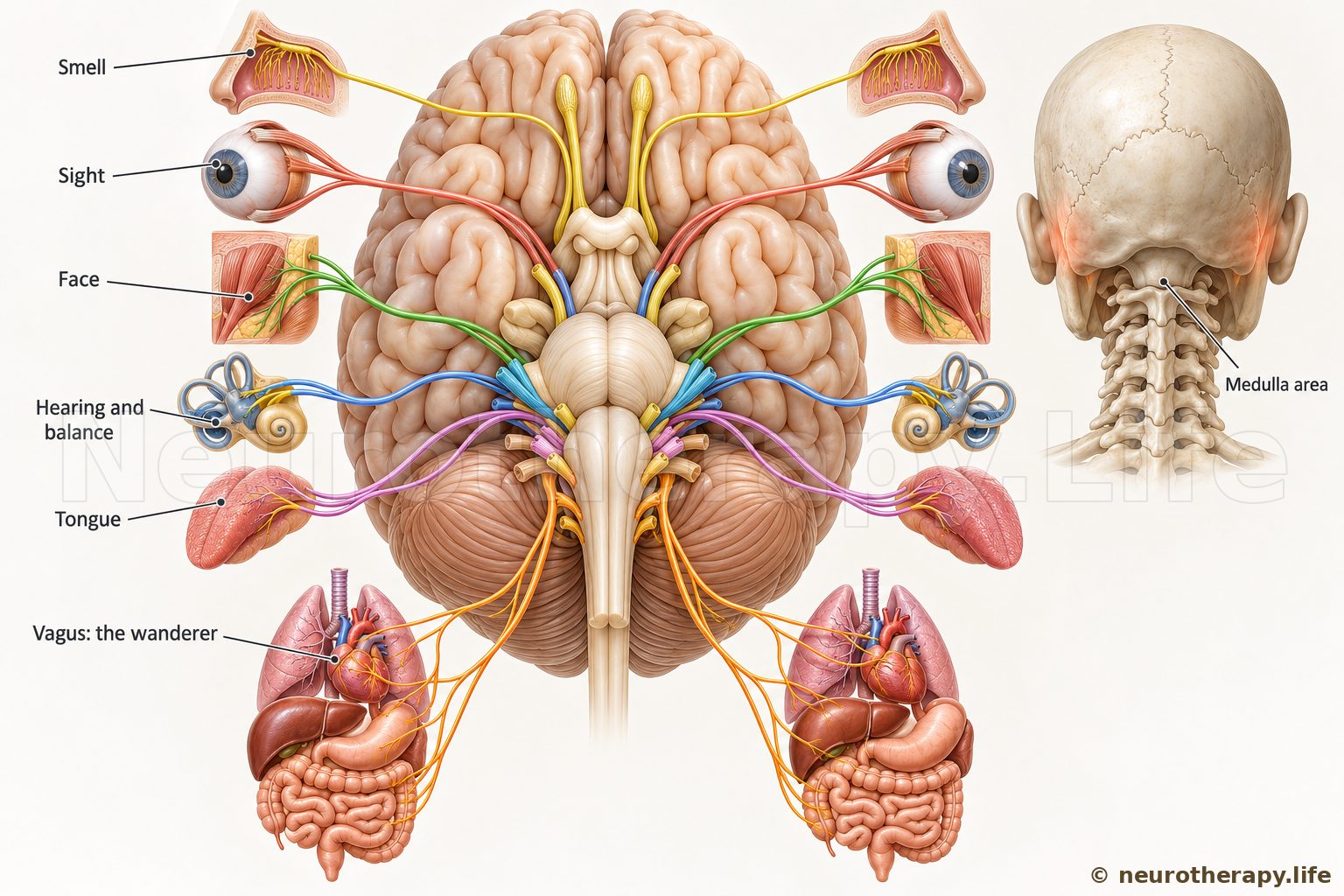
Thirty-one pairs of nerves leave the spinal cord. Above them, twelve pairs leave the brain itself, through small holes in the floor of the skull. They serve the nose, the eyes and their muscles, the face, the ear, the tongue, the throat, the voice and the shoulder, and one, the vagus, wanders all the way to the belly. Each is a pair, left and right, and each has a number running from front to back.
The source records a discovery, made by trying treatments on many patients: each cranial nerve can be stimulated by the Medulla treatment of the same number. So (2) Medulla is linked to the second nerve, of sight, and (10) Medulla to the tenth, the vagus. It is offered openly as an observation, not a proven mechanism, and the source itself notes that the work of some numbers is still not fully understood.
The second rule is about side. Left Medulla raises acid and, together with Left Swt, opens narrowed passages such as a tight food pipe. Right Medulla raises alkali and, with Right Swt, narrows slack ones, as with swollen varicose veins. So a Medulla line on a card is never complete without its side.
Some functions need two nerves. Taste travels both ways between the tongue and the brain, so two numbers are linked to it; swallowing is shared by several. In one teaching case, a man who could barely swallow even water for years reported he could drink comfortably after a left-side treatment, while his medical care continued.
Key points
- Twelve pairs of cranial nerves leave the brain directly, each numbered.
- Each nerve is linked to the Medulla treatment of the same number.
- Left Medulla opens and raises acid; Right Medulla closes and raises alkali.
- A Medulla line is incomplete without its side.
- Functions shared by two nerves need both numbers.
Go deeper
Cranial Nerve and Brain Formulas
Cranial nerve and brain formulas: the full guide
Cranial nerves
The cranial nerves
Vagus nerve
The vagus nerve, the wanderer
Medulla
The Medulla point
(10) Medulla
(10) Medulla, linked to the vagus
Bell's palsy
Bell's palsy, the facial nerve
Difficulty in swallowing (dysphagia)
Difficulty in swallowing
Nervous system and brain
The nervous system
Read the full guide
This topic is part of: Cranial Nerve and Brain Formulas
Safety: when it is held back
- In heart disorders, (10) Medulla is never given on both sides; only (10) Left Medulla is used. (10) Medulla
- In cancer, (30) Medulla is never given. (30) Medulla
- A headache that is new, unlike any before, wakes the person from sleep, reaches full strength within moments, or comes with fever, weakness, numbness or a change in vision is assessed by a doctor first. No neck work is given until then. How to tell a patient to see a doctor
- The exact method is taught hands-on in the course, under a trained therapist. Please do not try it on yourself or others from this page.
- Neurotherapy (LMNT) works alongside your medical care. Do not stop or change any medicine on your own; ask the doctor who prescribed it.
Watch

Shows (15) Medulla four times below both ears, a fingertip head massage in lines from the forehead to the back of the head, and gentle circles between the eyebrows. It is shared as self-care for relief in migraine and headache.
Note: the video gives (15) Medulla; the LMNT migraine treatment uses (5) Medulla. Follow your therapist's plan.

Shows a five-minute self-routine before bed: (8) Medulla below the ears three times, pressure while sitting in Vajrasana, massage just below the knees and at the back of the head, plus tips on screens and dim light. It is shared to support better sleep.
This page explains what a Neurotherapy (LMNT) treatment is for; it is not a self-treatment guide and does not diagnose. Neurotherapy (LMNT) works alongside your medical care — keep taking the medicines your doctor prescribed.