Milk and dried dates for heavy periods: a simple home support
When menstrual bleeding is heavy, a woman is advised to drink plenty of lukewarm milk, so that her body does not run short of calcium, and to take a dried date boiled in milk each morning.
Overview
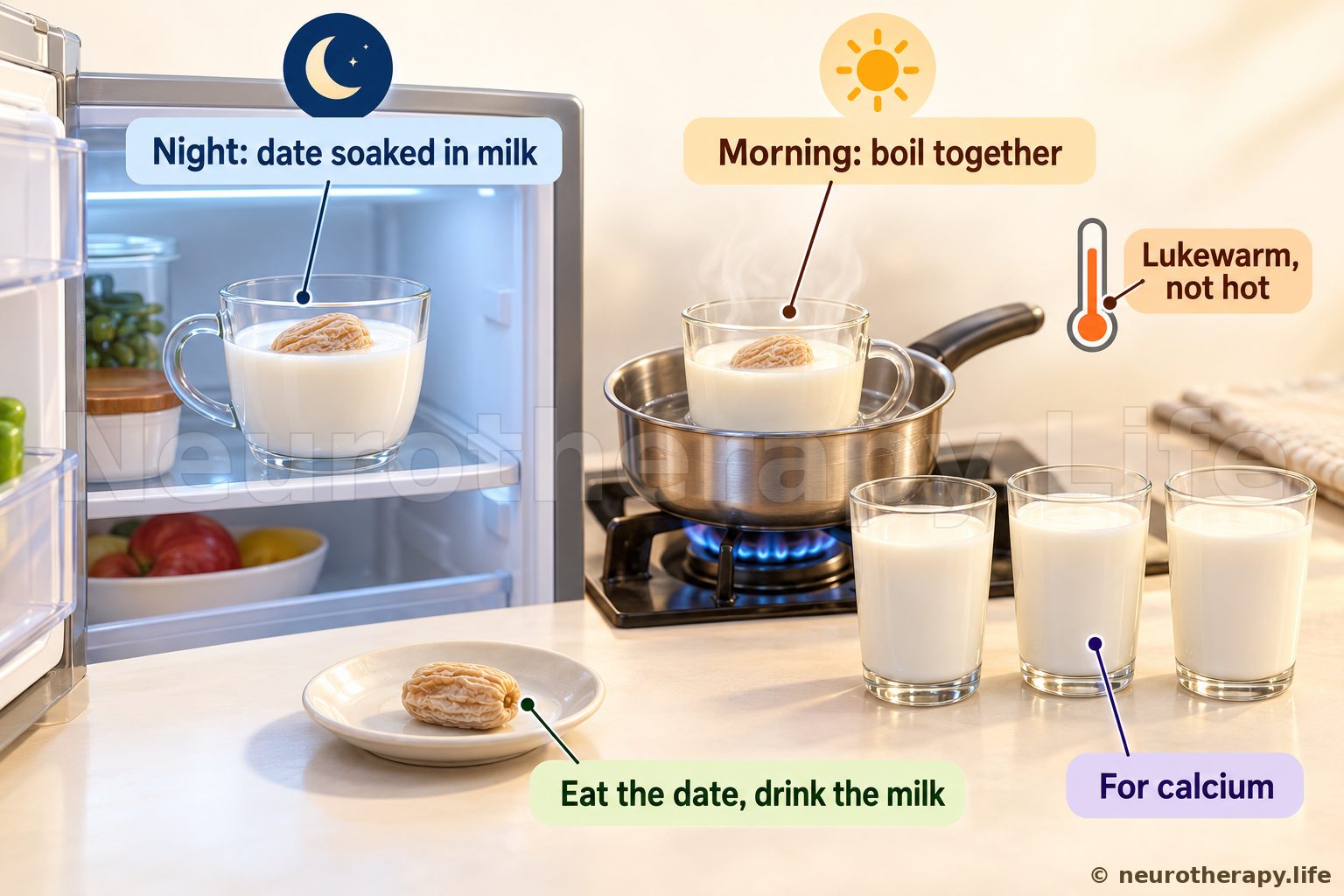
This is the household half of the heavy-flow advice, and a woman can begin it the same evening. If bleeding during the period is heavy, she should drink at least three-quarters of a litre of lukewarm milk in the day, so that her body does not become short of calcium. That is about three ordinary tumblers, so the household needs to plan for it.
The temperature matters. The milk should be lukewarm, not hot, because hot milk may increase the bleeding further. Warm enough to drink comfortably, not so hot that you need to blow on it.
The dried date, called khārak, kharik or chhuhara, is the second part. At night, put one dried date into a cup of milk and keep it in the fridge. In the morning, boil that milk together with the date. Eat the date and drink the milk. This morning cup counts as part of the day's milk.
The home advice and the treatment point the same way. On the mat, heavy flow is supported with the calcium work of (4) Para and the 1,25 DCC formula. At home, milk supplies the calcium.
Key points
- At least three-quarters of a litre of milk a day while the bleeding is heavy.
- Lukewarm, never hot: hot milk may increase the bleeding.
- A dried date soaked overnight, boiled in the morning, eaten with the milk.
- The purpose is to keep the body from running short of calcium.
Go deeper
Period problems (irregular, heavy or painful)
Period problems, and how heavy flow is treated
(4) Para
(4) Para, the calcium point used in heavy flow
1,25 DCC (ordinary form)
The 1,25 DCC formula, the calcium work on the mat
Anaemia
Anaemia, which heavy periods often cause
Uterine fibroids
Fibroids, one cause of heavy bleeding a doctor can find
Food as Medicine: Eating and Drinking Rules
Food as medicine, and the rest of the kitchen rules
Treating Women: Periods, Pregnancy and Care
Treating women: the cycle, pregnancy and after
Read the full guide
This topic is part of: Treating Women: Periods, Pregnancy and Care
Safety: when it is held back
- Heavy bleeding can also drain iron. A simple haemoglobin blood test shows whether the blood is running short. Anaemia
- See a doctor the same day for any bleeding after menopause, bleeding in pregnancy, soaking a pad within an hour, very large clots, or bleeding with faintness, breathlessness or a racing heart. Period problems (irregular, heavy or painful)
- Bleeding between periods or after intercourse, or a cycle that has changed and stayed changed, also needs a doctor's look. Treatment can go on alongside.
This page explains what a Neurotherapy (LMNT) treatment is for; it is not a self-treatment guide and does not diagnose. Neurotherapy (LMNT) works alongside your medical care — keep taking the medicines your doctor prescribed.