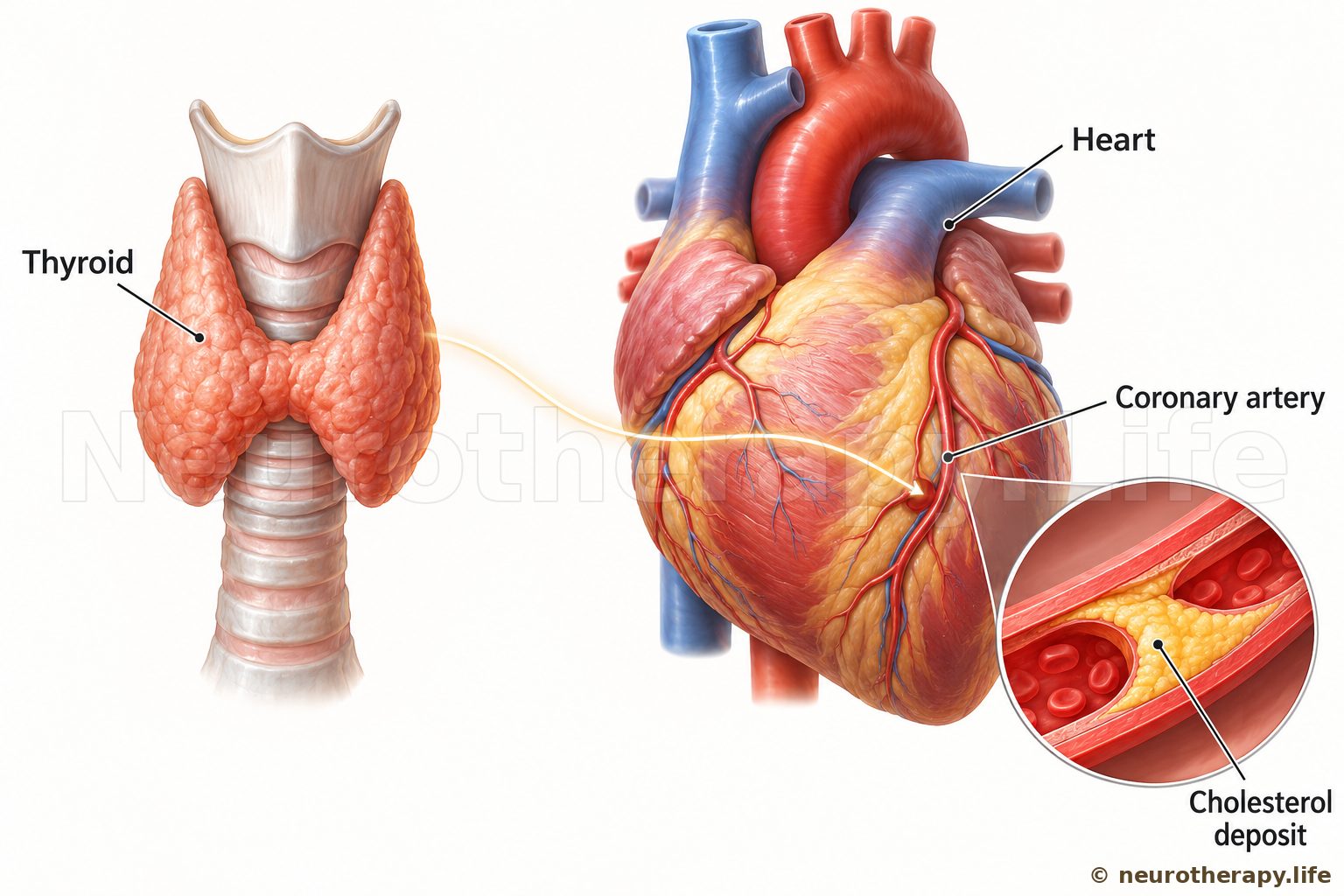
(2) Thrd is the smaller count of the Thyroid point. It is given in place of (4) Thrd in angina and other heart patients, to reduce cholesterol without speeding the body up so much that the heart is burdened.
Overview
What is (2) Thrd?
(2) Thrd is the Thyroid point, given at a smaller count. It is not a refusal of thyroid work but a gentler version of it, written for a vulnerable patient.
The reason is simple. (4) Thrd raises the metabolism — the body's rate of building up and breaking down. In a heart patient that increase throws a burden onto the heart, and the trouble can grow. So in angina, which is chest pain from a heart short of blood, (2) Thrd is given in place of (4) Thrd, to reduce cholesterol.
The two halves of this substitution always travel together: which count is withheld, which one replaces it, in whom, and why.
(2) Thrd is the gentle thyroid treatment, written for the heart that must not be raced.
Where it is given
Where is (2) Thrd given?
PositionLying on the back
Body areaBoth sides of the hollow of the throat
At the same place as every Thrd: you lie on your back with the neck loose, and the work is on both sides of the hollow of the throat, with the flats of both palms.
How it is given
How is (2) Thrd given?
How this point is given — the tool, the pressure, the count and the exact movement — is deliberately not described here. A demonstration video for this point is being prepared; until it is on this page, learn the method hands-on from a trained Neurotherapist before giving it. Please do not give any point from a written description alone: a point given in the wrong place or the wrong way can do harm.
The number written before a point's name is not a strength setting. Each numbered form is a separate named treatment with its own method and timing, taught hands-on in the course.
The exact technique is taught hands-on in the Neurotherapy (LMNT) course. See the course →
What it does
What does (2) Thrd do?
In the source teaching, (2) Thrd is given:
In angina and other heart patients, to reduce cholesterol.
Wherever a formula asks for (4) Thrd but the patient has heart disease.
The heart patient's gateway treatment opens with the clockwise Medulla, T1/T2, Raman, (10) Pan and (2) Thrd
Safety: when it is held back
Heart patients are never given (4) Thrd — always (2) Thrd. Write the substitution on the treatment line itself, not on the back of the card. What goes on a patient's treatment card
A line on a card that you cannot explain is never changed. Ask the therapist who wrote it, or leave it out and say so.
New, severe or worsening chest pain is an emergency: call 108/112 first. Neurotherapy (LMNT) works alongside your heart medicines — never stop them. Heart attack (myocardial infarction)
In heart disorders (10) Medulla is never given on both sides — only (10) Left Medulla. (10) Medulla
All the neck rules of Thrd apply, and they bite harder in older patients and anyone on blood thinners. Children receive light treatment. Thrd
A teaching case
Teaching case: the line that was changed
A young woman with a heart-valve problem moved cities carrying an old treatment card on which the thyroid line had been written at the smaller count, with 'in place of (4)' beside it. A new therapist, seeing no reason for it, gave the usual larger count. Within weeks her heart raced on the stairs; treatment was stopped and a physician saw her the same day, and no harm lasted. The lesson: a substitution on a card is an instruction, not a mistake to be corrected.
A composite case written to teach the reasoning — not one patient’s file.
Common questions
Is (2) Thrd weaker or just different?
It is the same point at a smaller count, chosen so that the thyroid is supported without loading the heart.
I have angina. Will (2) Thrd replace my medicines?
No. Keep all your heart medicines exactly as prescribed. Neurotherapy (LMNT) works alongside them.
Why does it matter where the substitution is written?
Cards outlive the therapist who wrote them. If the reason sits on the back, the next reader may miss it and give the larger count.
Surprising facts
1The thyroid and cholesterol
An under-active thyroid tends to raise blood cholesterol, because thyroid hormone helps the liver clear cholesterol from the blood.
Source: Hall JE, Hall ME. Guyton and Hall Textbook of Medical Physiology, 14th ed. Elsevier, 2020.
2A heart that speeds up
Thyroid hormone makes the heart beat faster and more strongly. Too much of it can bring palpitations — a real load on a heart already short of blood.
Source: Hall JE, Hall ME. Guyton and Hall Textbook of Medical Physiology, 14th ed. Elsevier, 2020.
3Angina is a warning
Angina is chest pain that comes when the heart muscle gets less blood than it needs, often during effort, and eases with rest.
Source: Hall JE, Hall ME. Guyton and Hall Textbook of Medical Physiology, 14th ed. Elsevier, 2020.
This page explains what a Neurotherapy (LMNT) treatment is for; it is not a self-treatment guide and does not diagnose. Neurotherapy (LMNT) works alongside your medical care — keep taking the medicines your doctor prescribed.
Ready to begin?
Send COURSE for course details, or your name, age and health issue for a consultation.