Coma treatment — (8) Pan (1) Gal (2) acid (4) Lt. Ch. Only
Also called: Coma treatment, (8) Pan (1) Gal (2) acid (4) Lt. Ch. Only treatment
This is a stripped-down acid formula recorded from one patient who was in a coma with both kidneys failing. It is taught as an example of changing a formula for the state of the patient's organs — not as a treatment for coma, which is always a hospital emergency.
Overview
What is the coma treatment?
In Neurotherapy (LMNT), the Acid Treatment Formula (ATF) is the main formula for acidosis — too much acid in the blood. This formula is ATF with parts taken away. It was given to one patient in one extreme situation, and it is taught for one reason: it is the clearest example of a formula changed to fit the organs of the person in front of you.
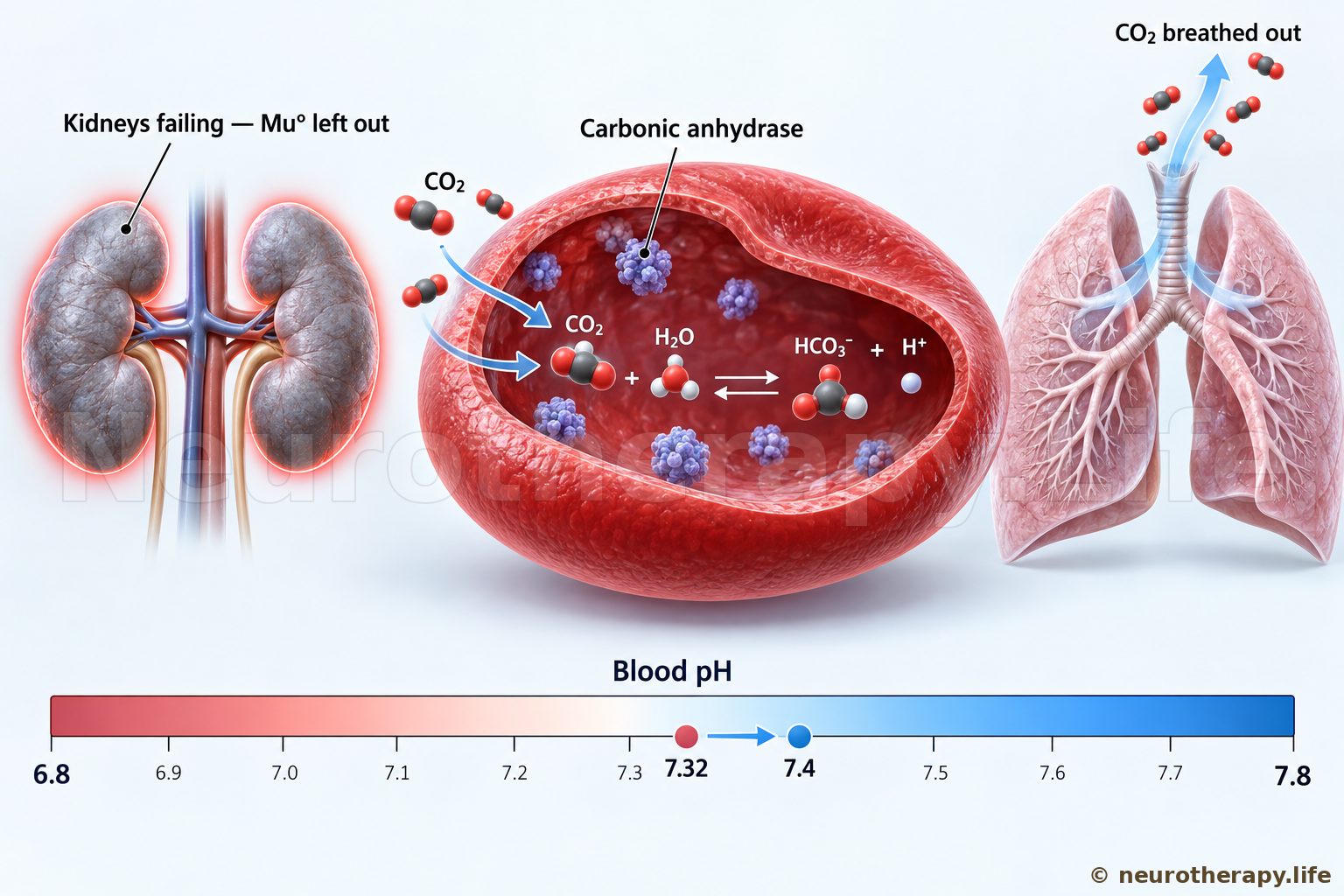
The patient was an adult who arrived unconscious. Both his kidneys had failed and his creatinine — a waste product the kidneys normally clear — was very high. The usual acid formula includes Mu°, the point linked to the left kidney. That point was left out, because his kidneys were already failing.
What was recorded is a measurement: after the treatment, his blood pH moved from 7.32, which is acidic, to 7.4, which is normal. And the account ends honestly, in Guruji's own words — this patient had gone into coma from some other cause. No claim is made that the formula woke him.
The recorded case: the kidney point was left out because both kidneys had failed, and the blood pH was measured before and after.
What it is for
What is this formula for?
To show how the acid formula is reshaped when the kidneys have failed — the kidney point is left out.
To support the body's correction of acidosis, as recorded in one patient whose blood pH moved back to normal.
It is not a general formula, and it is never a replacement for emergency hospital care of an unconscious person.
Points it works through
Which points does it work through?
(8) Pan (1) Gal (2) acid (4) Lt. Ch. Only
Four points, listed as a set with what each contributes. Two parts of the usual acid formula are missing on purpose. The exact method is taught hands-on in the Neurotherapy (LMNT) course. This page lists the points of the formula and what each one contributes; it does not describe how any point is given. For the method, watch the demonstration video of each point on its own page and learn hands-on from a trained Neurotherapist. Please do not give a formula from a written description alone.
Left Chest Only, on the left side of the chest — linked in the teaching with carbon dioxide leaving the body, and with the acid coming down.
Position:Lying on the back (supine), turned on the side for the Acid point, then back again.
The exact technique is taught hands-on in the Neurotherapy (LMNT) course. See the course →
How it works
How was it reasoned?
The important thing about this formula is what it leaves out. The usual acid formula includes Mu°, the point that provokes the left kidney. In a patient whose kidneys had failed, that point was dropped. The therapist checked the creatinine before deciding what to leave out — that is the habit the teaching asks you to copy.
Guruji's explanation was that the treatment helped the body make carbonic anhydrase, an enzyme inside red blood cells. It joins carbon dioxide with water; in the lungs the reverse happens and the carbon dioxide is breathed out. With less carbon dioxide held in the blood, the blood becomes less acidic. This is offered as his reasoning, not as a proven mechanism.
Its family
Which formulas are related?
This is a cut-down member of the acid–alkali family. Its parents are the forms of ATF.
ATF, form (a) — The default acid formula, which includes Mu° and ends with the adrenal point.
ATF, form (b) — The acid formula that ends with Thymus + Chest, for injury, infection or skin flare-ups.
ALTF (chief form) — The opposite formula, for alkalosis. It must never be given in acidosis.
What it is used for
Where does it belong?
The teaching records this formula in one patient only. It belongs to the study of acidosis and of the failing kidney.
The recorded case
AcidosisThe blood pH moved from acidic back to normal after the treatment
Kidney diseaseThe kidney point was left out because both kidneys had failed
ComaThe patient was unconscious — but the coma was from another cause, and coma is always a hospital emergency
Safety: when it is held back
An unconscious person is a medical emergency, minute by minute. Call emergency services (108/112) or go to hospital at once. No pressure formula is ever offered instead of hospital care, and nothing should delay the journey. How to tell a patient to see a doctor
Many causes of coma — low or high sugar, breathing failure, bleeding, poisoning, infection — can be reversed only if found fast in hospital. An unconscious person also cannot give consent. Coma
This is an acid formula. Never give ATF, or any form of it, in alkalosis. Never give ALTF in acidosis. Alkalosis
Mu° is left out when the kidneys have failed. Check kidney reports such as creatinine before deciding what to leave out. Mu°
Pan raises alkali, so it is ordinarily not given in fits, convulsions or seizures, and it is not given at all in schizophrenia. Pan
“In fact this patient had gone into coma from some other cause.”
— Dr. Lajpatrai Mehra
Common questions
Can Neurotherapy (LMNT) bring someone out of a coma?
No such claim is made. In the one recorded case a blood measurement improved, and Guruji himself wrote that the coma had another cause. An unconscious person needs a hospital immediately.
What is blood pH?
It is a measure of how acidic the blood is. Healthy blood stays in a very narrow range, about 7.35 to 7.45. Below that is acidosis; above it is alkalosis.
Why was the kidney point left out?
Because both of the patient's kidneys had failed and his creatinine was very high. The teaching uses this to show that a formula is fitted to the patient's organs, not copied blindly.
Is this formula used in everyday practice?
No. It is a teaching example. Everyday acidosis work uses the regular forms of ATF, chosen after checking the pain points.
Surprising facts
1One of the fastest enzymes in the body
Carbonic anhydrase inside red blood cells can join carbon dioxide and water, or split them apart, hundreds of thousands of times a second. Without it, the reaction would be far too slow to keep up with breathing.
Source: Guyton & Hall Textbook of Medical Physiology, 14th ed., transport of carbon dioxide in the blood (carbonic anhydrase).
2Breathing changes blood acidity within minutes
The lungs are one of the body's two big levers on blood pH. Breathing faster blows off carbon dioxide and makes the blood less acidic within minutes; the kidneys adjust it more slowly, over hours to days.
Source: Guyton & Hall Textbook of Medical Physiology, 14th ed., respiratory and renal regulation of acid–base balance.
3Healthy blood pH barely moves
Normal arterial blood pH is about 7.35 to 7.45. A change that looks tiny on paper, such as from 7.4 to 7.1, is a serious emergency.
Source: Guyton & Hall Textbook of Medical Physiology, 14th ed., acid–base regulation (normal pH range).
This page explains what a Neurotherapy (LMNT) treatment is for; it is not a self-treatment guide and does not diagnose. Neurotherapy (LMNT) works alongside your medical care — keep taking the medicines your doctor prescribed.
Ready to begin?
Send COURSE for course details, or your name, age and health issue for a consultation.