The rule of dilution: how water decides whether the bowel turns acid, and why constipation follows
Add water and an acid weakens; take water away and it strengthens. Neurotherapy (LMNT) follows this simple rule along the large intestine to explain why too little water brings hard stools and an acid direction.
Overview
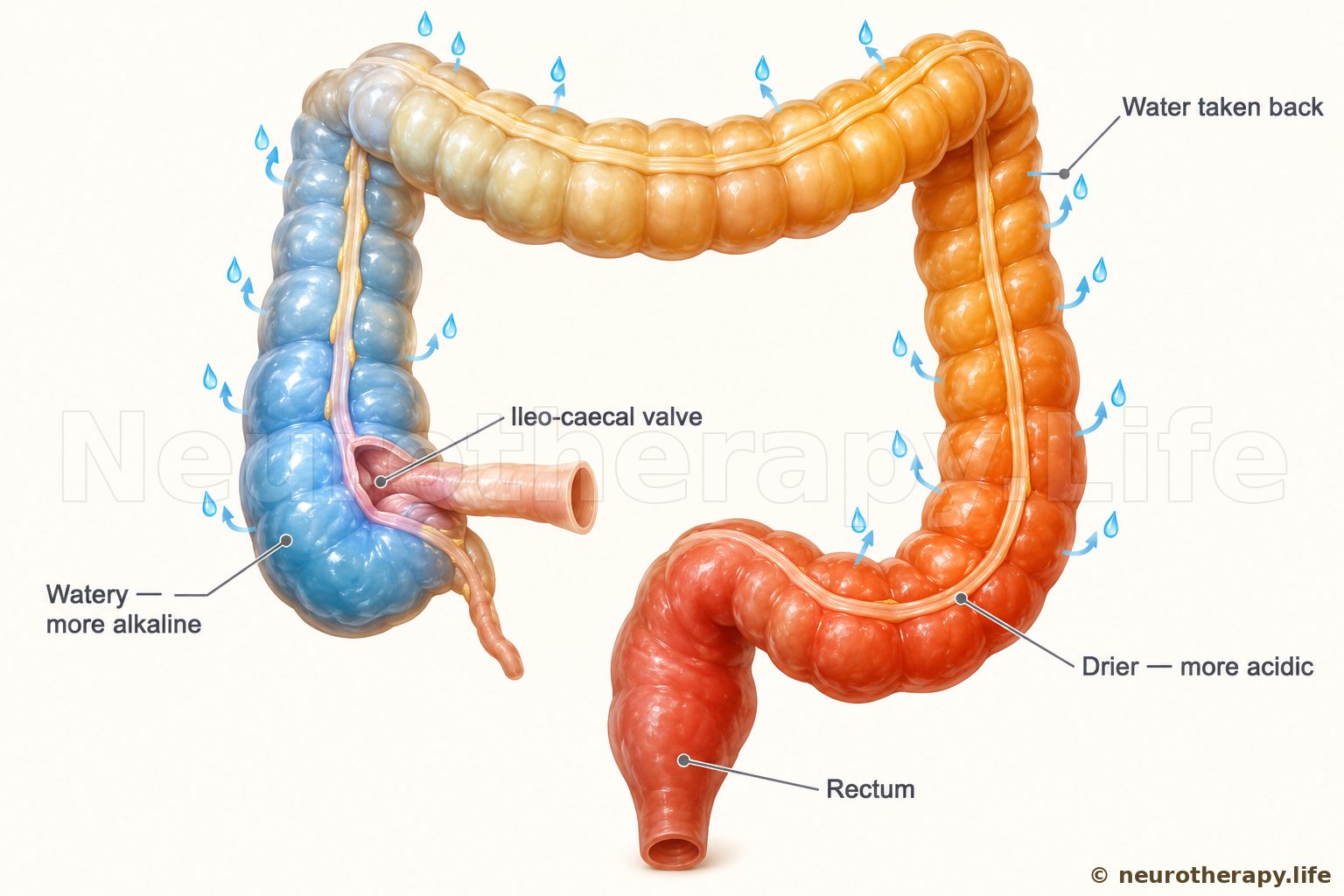
Take a strong acid and slowly add water: it becomes weaker, moving towards the alkaline side. Take water away from any fluid and it becomes more acidic. Every Indian kitchen knows this. A spoon of tamarind in a whole pot of water is barely sour; the same spoon in a small cup makes your eyes water. Only the water changed.
Now follow this rule through the large intestine. Partly digested food (chyme) enters it very watery, carrying juices from the pancreas, liver and gut, so at the start it is strongly alkaline. As it travels up the right side and across, the colon takes water back, and the contents turn weakly alkaline. Down the left side more water is drawn out, and they turn more and more acidic. At the rectum the stool is most acidic of all — especially in severe constipation.
An average person loses almost two litres of water a day through sweat, urine and breath. Drink less than that and the body closes its exits: less sweat, less urine, less saliva — and less water let out with the stool. The stool turns hard and acidic, and constipation follows. Tea, coffee, buttermilk and cold drinks are not water. No other drink can take its place.
This gives Neurotherapy (LMNT) a useful lever. By reducing acidity and stimulating the descending colon, constipation can be relieved — and many symptoms that travel with an acid picture often ease with it.
Key points
- Add water and an acid weakens; take water away and it strengthens.
- Along the colon, contents move from watery and alkaline to dry and acidic.
- Too little water closes the body's exits and makes stools hard and acidic.
- Tea, coffee, buttermilk and cold drinks do not count as water.
- Ask how much plain water a patient drinks before advising more.
Go deeper
Constipation
Constipation
Acidosis
Acidosis — the acid direction
Intestines
The intestines
Bowel
The bowel and what the stool tells you
Water and Salt: Kidney, Blood Pressure and Fluid Formulas
Guide: Water and Salt
The Two Kingdoms: Acidic and Alkaline Bodies
Guide: The Two Kingdoms
Read the full guide
This topic is part of: The Two Kingdoms: Acidic and Alkaline Bodies
Safety: when it is held back
- Do not tell everyone to drink large amounts of water. For people treated for heart or kidney disease, on certain blood pressure tablets, or already holding fluid (swollen ankles, puffy face in the morning), the amount of fluid is managed by their doctor — send the question back to that doctor. Oedema (swelling in the body)
This page explains what a Neurotherapy (LMNT) treatment is for; it is not a self-treatment guide and does not diagnose. Neurotherapy (LMNT) works alongside your medical care — keep taking the medicines your doctor prescribed.