Undigested food in the stool: what it says about your digestion
When pieces of food come out in the stool looking the way they went in, Neurotherapy (LMNT) reads it as a sign that the stomach acid and digestive juices are too weak. This sign is called UDF, and in long-standing illness it is corrected first.
Overview
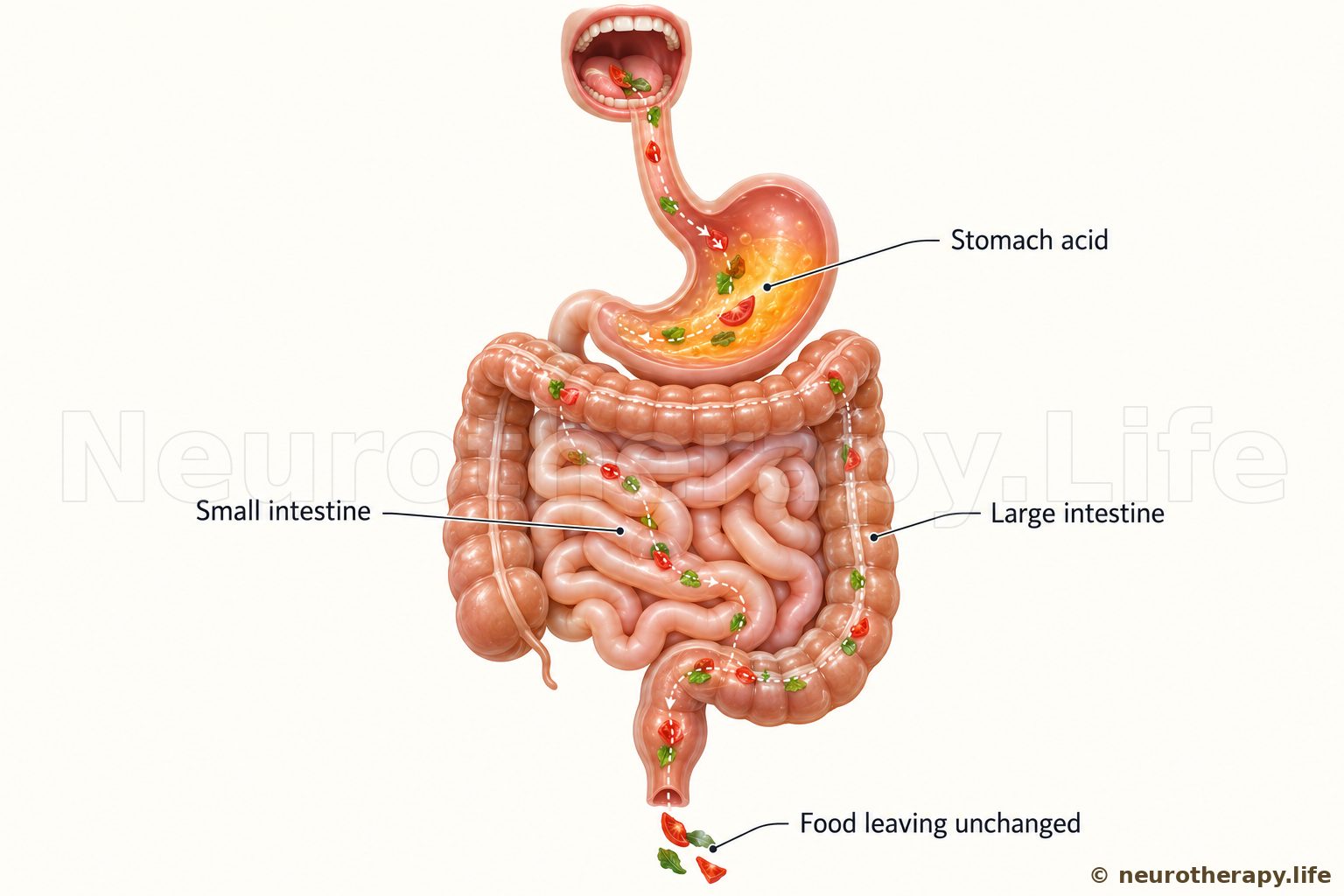
After questioning a very large number of patients over many decades, Guruji found that people with old, chronic illnesses almost always admitted to one thing: something in their stool came out in its original shape or colour. Tomato or brinjal skins, chana or peas, coriander or spinach leaves, raw carrot pieces, mustard or cumin from the tempering.
Many people say this is natural, or that the food was not chewed well. Neurotherapy (LMNT) disagrees. A healthy stomach makes hydrochloric acid, a very strong acid. It kills germs, lets the enzyme pepsin start digesting protein, and starts the signal that brings bile for digesting fats. In such strong acid, food should change shape and colour whether it was chewed or not.
So undigested food in the stool means the acid or the digestive juices are too weak, and protein is not being digested well. That matters because the body builds its enzymes, brain chemicals and most hormones from protein. UDF is not a disease. It is a reading, like a thermometer reading for a fever.
The therapist also uses simple bedside signs: tenderness between the bottom of the breastbone and the navel, soft stools several times a day, lines on the tongue, and in a small child, whether vomited milk comes out as milk or as curd. In any long-standing illness, the work to correct UDF is the first stage of treatment, before the disease itself is treated.
Key points
- Food seen unchanged in the stool is called UDF, undigested food.
- UDF is a sign of weak stomach acid and weak protein digestion, not a disease in itself.
- In chronic illness, the UDF work comes first, whatever the disease.
- The patient’s half matters: eat only when hungry, prefer fresh and sprouted food, and avoid water with meals.
- UDF can come back with old habits, so a check every few months is advised.
Go deeper
Undigested food in stool (UDF)
Undigested food in the stool: signs, causes and care
Clearing the Ash: The UDF Formulas
The family of treatments used to correct UDF
The Fire and the Ash: Undigested Food in the Stool
The fire and the ash: why digestion leads everything
Stomach
How the stomach makes its strong acid
Digestive system
The whole digestive system, from mouth to bowel
HCl treatment formula
The treatment built to support stomach acid
The three levels of undigested food (UDF): stomach, digestive organs and immunity
The three levels from which UDF is corrected
Read the full guide
This topic is part of: Clearing the Ash: The UDF Formulas
Safety: when it is held back
- An infant who vomits forcefully again and again, is hungry straight after, and is not gaining weight must see a doctor the same day. Green or yellow vomit also needs a doctor at once. Nausea and vomiting
- A child with fever who is drowsy, breathing fast, will not drink, has a stiff neck, a fit, or a rash that does not fade when pressed goes to a doctor now. Fever and viral fever
- Fasting should be done only under the guidance of a trained person. Neurotherapy (LMNT) works alongside medical care; do not stop any medicine on your own.
Guruji says
“The cause of the world’s greatest diseases is the coming of undigested food in the stool.”
Watch

A podcast conversation on indigestion: its common signs, causes such as rushed meals, stress and some medicines, and how Neurotherapy (LMNT) looks at digestion through the body's acid–alkali balance. No points are demonstrated.
This page explains what a Neurotherapy (LMNT) treatment is for; it is not a self-treatment guide and does not diagnose. Neurotherapy (LMNT) works alongside your medical care — keep taking the medicines your doctor prescribed.