Also called: Chole variant I (secretin), Chole for setting the stomach — secretin form
Chole variant I is a form of the Chole treatment used for setting the stomach. It keeps the Chole frame but ends at the liver point instead of the gall bladder point, to work by way of secretin.
Overview
What is Chole variant I?
The Chole treatment was made for burning in the chest after fried or heavy food. Its teaching adds a short note: if the treatment is being used for setting the stomach, it brings still better results when it is given in one of two matched forms. This is the first of them.
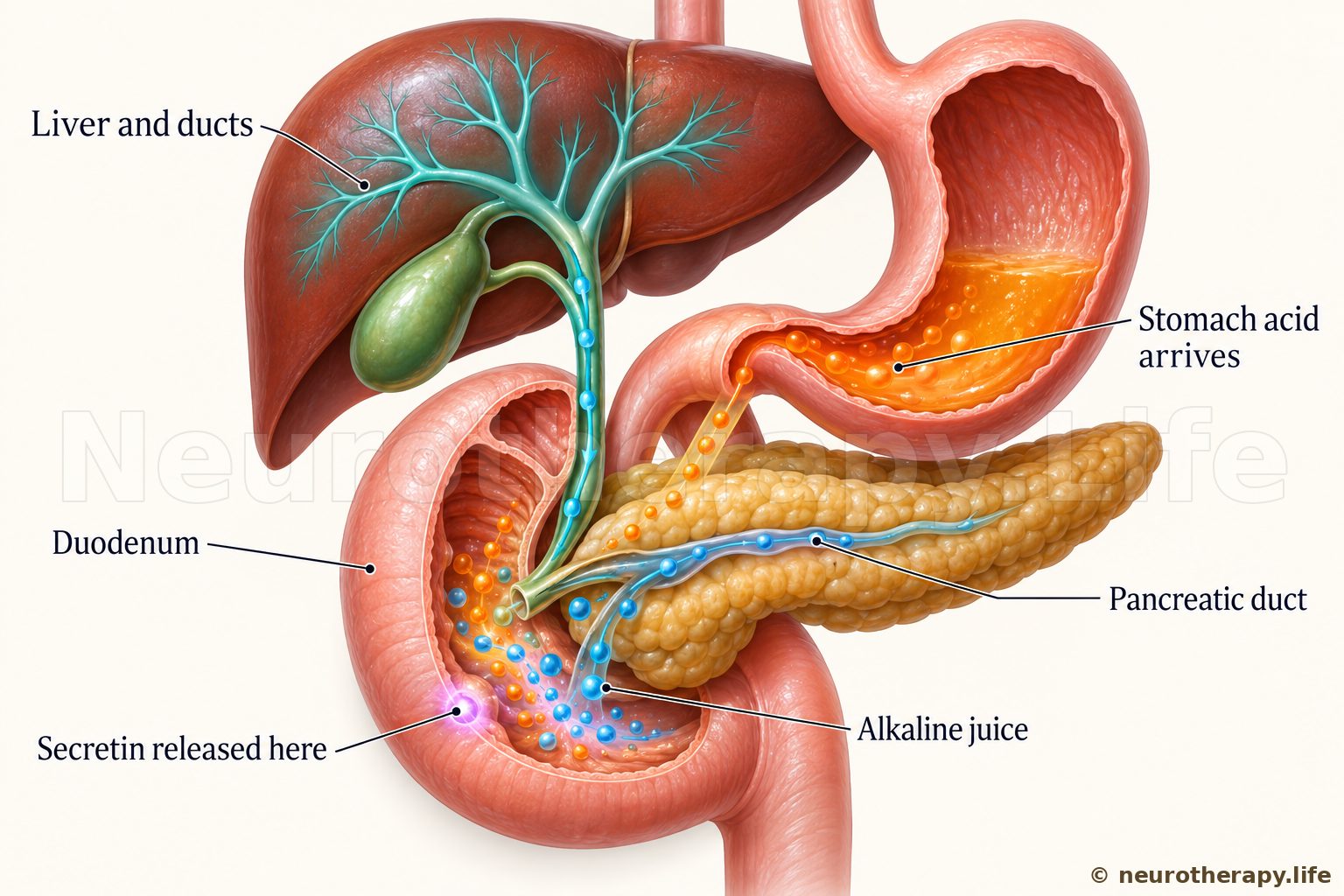
Only one thing changes. The first two points stay exactly as in Chole. The last point becomes Liv, the liver point. The teaching ties this form to secretin, the gut hormone that calls for a watery, alkaline juice to cool the acid arriving from the stomach.
The pairing is not random. Secretin works mainly on the ducts — the small tubes of the liver and pancreas that carry this alkaline juice — and the liver belongs to that response. Its twin, variant II, ends at the gall bladder instead and works by way of CCK.
Variant I ends at the liver point, matching secretin — the hormone that calls for alkaline juice from the ducts.
What it is for
What is Chole variant I used for?
Setting the stomach — when the Chole treatment is being used to put the stomach right, rather than only for burning after fried food.
Working by way of secretin, the hormone of the alkaline juice.
Points it works through
Which points does Chole variant I work through?
(10) Medulla (6) Gas 'I' (3) Liv — for secretin
The same three-point frame as Chole, listed as a set. Only the last point differs. The exact method is taught hands-on in the Neurotherapy (LMNT) course. This page lists the points of the formula and what each one contributes; it does not describe how any point is given. For the method, watch the demonstration video of each point on its own page and learn hands-on from a trained Neurotherapist. Please do not give a formula from a written description alone.
Liv, the liver point, on the left arm and thigh — the point that makes this the secretin form.
Position:Seated for the Medulla part, then lying on the back (supine).
The exact technique is taught hands-on in the Neurotherapy (LMNT) course. See the course →
How it works
How does variant I differ from Chole?
When food leaves the stomach, two messengers go out from the duodenum. Acid releases secretin, which tells the ducts to pour out an alkaline juice. Fat and protein release CCK, which squeezes the gall bladder and calls for pancreatic enzymes. Neurotherapy (LMNT) matches one point to each: Liv for secretin, Gal for CCK.
Which variant suits a patient is decided by the therapist from the examination that day. The route by which a point reaches a hormone is Neurotherapy (LMNT)'s own claim; the map of which hormone acts where is standard physiology.
Its family
Which formulas are related?
Variant I is one of a matched pair taken from the Chole treatment.
Chole Treatment — The parent formula, for chest burning after fried food.
Chole variant II — The twin: ends at the gall bladder point and works by way of CCK.
CCK Normal — A longer CCK-based formula reaching the whole digestive tract.
Keep taking the medicines your doctor prescribed. Neurotherapy (LMNT) works alongside your medical care.
Common questions
Is variant I stronger than Chole?
No. It is not stronger or weaker; it aims at a different messenger. Variant I leans on secretin, the Chole treatment and variant II on CCK.
Who decides which variant I get?
Your therapist, from your pain points and history on that day. You will not choose it from a list yourself.
What does 'setting the stomach' mean?
In Neurotherapy (LMNT) it means bringing digestion back into working order — the stomach, its helper organs and the movement of food — before other problems are treated.
Surprising facts
1Secretin was the first hormone ever discovered
In 1902, Bayliss and Starling found that acid in the duodenum released a chemical messenger into the blood that made the pancreas pour out juice. They called it secretin, and the word 'hormone' was coined soon after because of it.
Source: Bayliss WM, Starling EH. The mechanism of pancreatic secretion. J Physiol. 1902;28(5):325–353.
2Your gut makes its own antacid
The juice that secretin calls up is rich in bicarbonate — the same kind of chemical as baking soda. It neutralises stomach acid so the enzymes of the small intestine can work.
Source: Guyton & Hall Textbook of Medical Physiology, 14th ed., pancreatic secretion and secretin.
3The duodenum is short but busy
The duodenum is only about 25 centimetres long, yet bile and pancreatic juice both empty into it, and it releases several of the gut's key hormones.
This page explains what a Neurotherapy (LMNT) treatment is for; it is not a self-treatment guide and does not diagnose. Neurotherapy (LMNT) works alongside your medical care — keep taking the medicines your doctor prescribed.
Ready to begin?
Send COURSE for course details, or your name, age and health issue for a consultation.