Also called: UDF formula for knee and back pain, UDF formula for CP children, UDF formula for raised alkali
This is one of the symptom-matched formulas of Neurotherapy (LMNT)'s UDF (undigested food) family. It is used for knee pain, back pain, children with cerebral palsy (CP) and people whose alkali has increased. It is the shortest formula of its group, brings in the Raman treatment, and is the only one that ends without the absorption step.
Overview
What is this formula?
UDF means undigested food: pieces of food coming out in the stool looking much as they went in. Neurotherapy (LMNT) teaches that UDF is a chief cause behind many bigger diseases, and that it should be corrected first. Retired anaesthetist Dr. Krishnamurthy Jalihal found that many symptoms improved in the first days of UDF treatment alone, before any disease formula was given.
Later the UDF family split into formulas matched to the patient's tendency. This one is written for knee pain, back pain, children with CP, and those whose alkali has increased. Like every formula of the group, it keeps the compulsory pair: (10) Medulla with Gas Only.
Two things set it apart. The Raman treatment, given seated at the shoulders, arrives here for the first time in the family. And there is no Ajay Normal closing: the other formulas end with the absorption step, but this one stops at the compulsory pair. The absence is the formula.
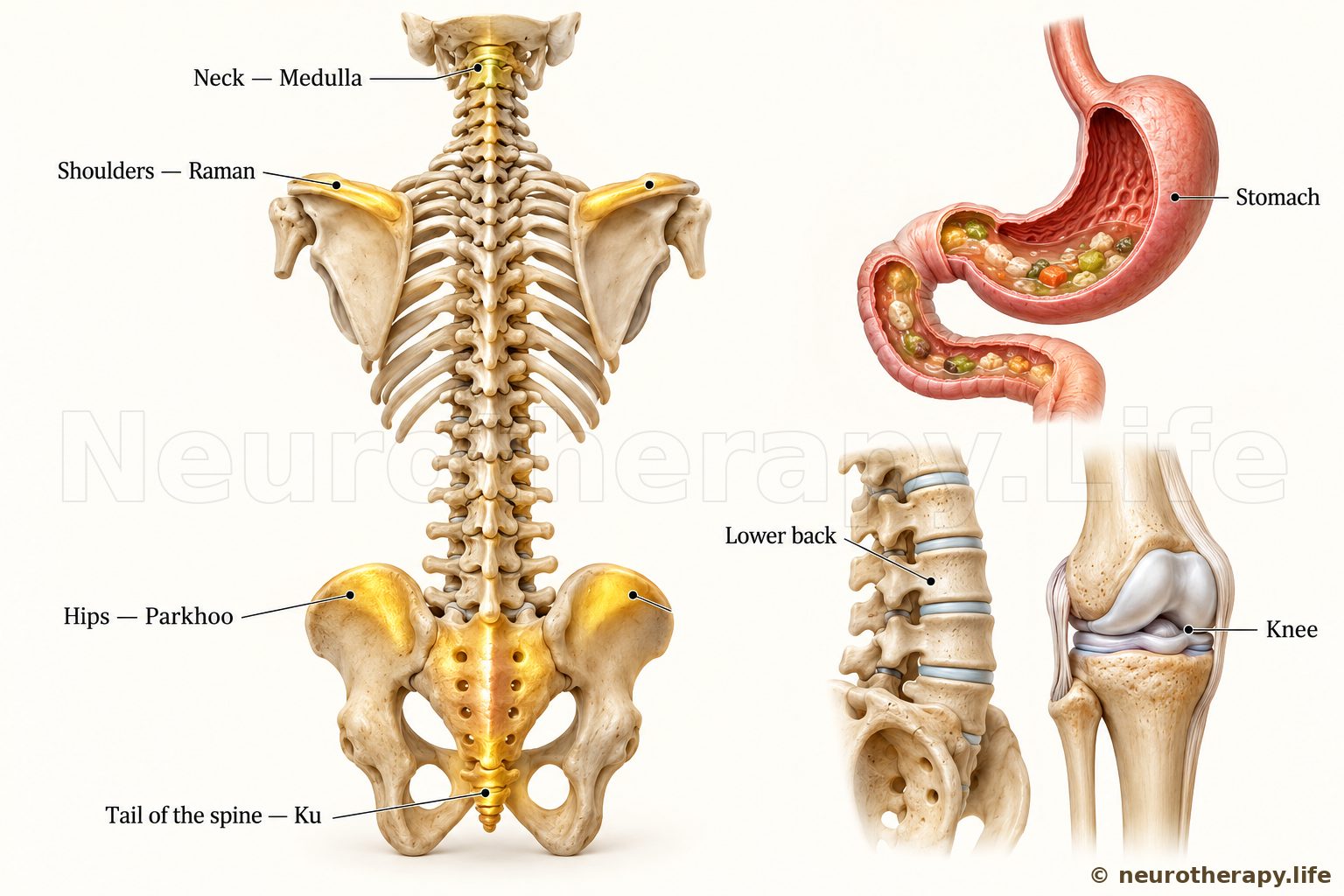
The formula works at the neck, shoulders, hips and the tail of the spine, and through the stomach — not on the knee or back directly.
What it is for
What is this formula used for?
Knee pain, where undigested food is part of the picture.
Back pain, where undigested food is part of the picture.
Children with cerebral palsy (CP), with extra care at every step.
People whose alkali has increased.
Points it works through
Which points does this formula work through?
I (15) Medulla · II (3) Raman treatment · III (2) Rt Parkhoo (2) Lt Parkhoo · IV (½) Ku – 20 secs × 4 treatments · V (10) Medulla (1) Gas Only – 6 points + if there is constipation, then (4) Gas 'I' – 6 points
The formula works through the points below, listed here as a set with what each contributes. The exact method is taught hands-on in the Neurotherapy (LMNT) course. This page lists the points of the formula and what each one contributes; it does not describe how any point is given. For the method, watch the demonstration video of each point on its own page and learn hands-on from a trained Neurotherapist. Please do not give a formula from a written description alone.
Down the calves — added only if the patient is constipated.
Position:Seated for the Medulla steps and Raman; lying on each side for the hip points; face down (prone) for Ku; on the back (supine) for Gas Only and Gas 'I'.
The exact technique is taught hands-on in the Neurotherapy (LMNT) course. See the course →
How it works
How does this formula work?
Every UDF formula keeps one spine: brainstem, hips, the sacral hold, then (10) Medulla with Gas Only. This one keeps that spine, adds Raman after the opening Medulla, uses only the light pass at the hips, and stops at the compulsory pair. The calves are added only for a constipated bowel.
Why treat digestion for a knee or a back? Because Neurotherapy (LMNT) treats according to the condition of the body, not the name of the complaint. The teaching holds that once food is digested and absorbed properly, the raw materials for repair reach the joints, and many symptoms ease.
A raised alkali may sometimes only look raised because the stomach is not making enough acid. That is why the teaching checks the Gas point and asks about undigested food in the stool before any alkali-reducing formula is given.
Its family
Which formulas are related to this one?
It is one of four symptom-matched UDF formulas, chosen by the patient's tendency.
General UDF formula — The general formula, written to benefit everybody, with an Ajay Normal closing.
Children with cerebral palsy often have fragile bones, hips that sit badly and a curving spine, and may not be able to say what hurts. Pressure is light, positioning slow, parents present, and the child's medical team is told. Fit medicines are never reduced because a child seems better. Cerebral palsy (CP)
A single hot, swollen, very painful knee goes to a hospital the same day. Back pain with a cancer history, pain that wakes at night, new weakness, numbness around the seat, or loss of bladder or bowel control ends the session. How to tell a patient to see a doctor
(10) Medulla is not given in diabetes or cancer; in heart patients only (10) Left Medulla is given. (10) Medulla
Ku is not given to women during menstruation, or to people with low blood pressure — asked at every session. Low blood pressure
Gas 'I' is never given with loose motions. Gas Only is not given with a stomach or duodenal ulcer. Gas 'I'
Children always receive light treatment. Keep taking the medicines your doctor prescribed — Neurotherapy (LMNT) works alongside your medical care, never instead of it.
Guruji says
“The coming of UDF is itself a chief cause of the coming of the great diseases.”
— Dr. Lajpatrai Mehra
Common questions
Why is my knee pain treated through digestion?
Neurotherapy (LMNT) treats the condition of the body, not only the place that hurts. If food is not being digested, the materials the body needs for repair do not arrive. Correcting UDF first is how the teaching approaches many long-standing problems.
How do I know if I have UDF?
Look at the stool: seeds of tomato, leaves of spinach or curry leaf, whole groundnut, gram, peas or corn coming out looking much as they went in are signs of it. Your therapist will also check the Gas point.
Is it safe for my child with CP?
It is written for such children, but with extra care: light pressure, slow and gentle positioning, a parent present, and the child's doctors and physiotherapist kept informed. It is given alongside their care, never in place of it.
Why does it not end with Ajay Normal like the others?
The teaching wrote it that way: it is the one formula of its group that stops at the compulsory pair, without the absorption step. The calves are added only if the patient is constipated.
Surprising facts
1The vagus nerve wanders the whole gut
The vagus, the tenth cranial nerve, runs from the brainstem down into the abdomen. It helps switch on stomach acid, digestive juices and gut movement.
Source: Guyton & Hall, Textbook of Medical Physiology, 14th ed. — parasympathetic (vagal) control of gastric secretion.
2Stomach acid is needed for protein
Pepsin, the stomach's protein-digesting enzyme, only works well in strong acid. When acid is low, protein digestion suffers.
Source: Guyton & Hall, Textbook of Medical Physiology, 14th ed. — pepsin activity requires acid pH.
3CP is the commonest physical disability of childhood
Cerebral palsy affects about two in every thousand children. Many also have weak bones, hip problems or a curving spine, which is why gentle handling matters.
Source: Graham HK, Rosenbaum P, Paneth N, et al. Cerebral palsy. Nat Rev Dis Primers. 2016;2:15082.
Test yourself
Research
Strong evidence
This major review explains what cerebral palsy is, how common it is, and the bone, hip and spine problems many children with CP develop — the reason every hands-on treatment must be gentle.
This page explains what a Neurotherapy (LMNT) treatment is for; it is not a self-treatment guide and does not diagnose. Neurotherapy (LMNT) works alongside your medical care — keep taking the medicines your doctor prescribed.
Ready to begin?
Send COURSE for course details, or your name, age and health issue for a consultation.