1A tail we no longer have
The coccyx is made of three to five tiny vertebrae fused together — the remains of the tail that every human embryo briefly has in the womb.
Source: Standring S (ed.). Gray's Anatomy, 41st ed. Elsevier, 2016 — the coccyx.
Also called: Tail bone pain point, Coccyx point, टेल बोन पेन
Tail Bone Pain is a Neurotherapy (LMNT) treatment given lying face down at the very end of the spine. It is used to remove the pain of an injured tail bone — the kind that often follows a slip on the stairs or sitting down with a thud.
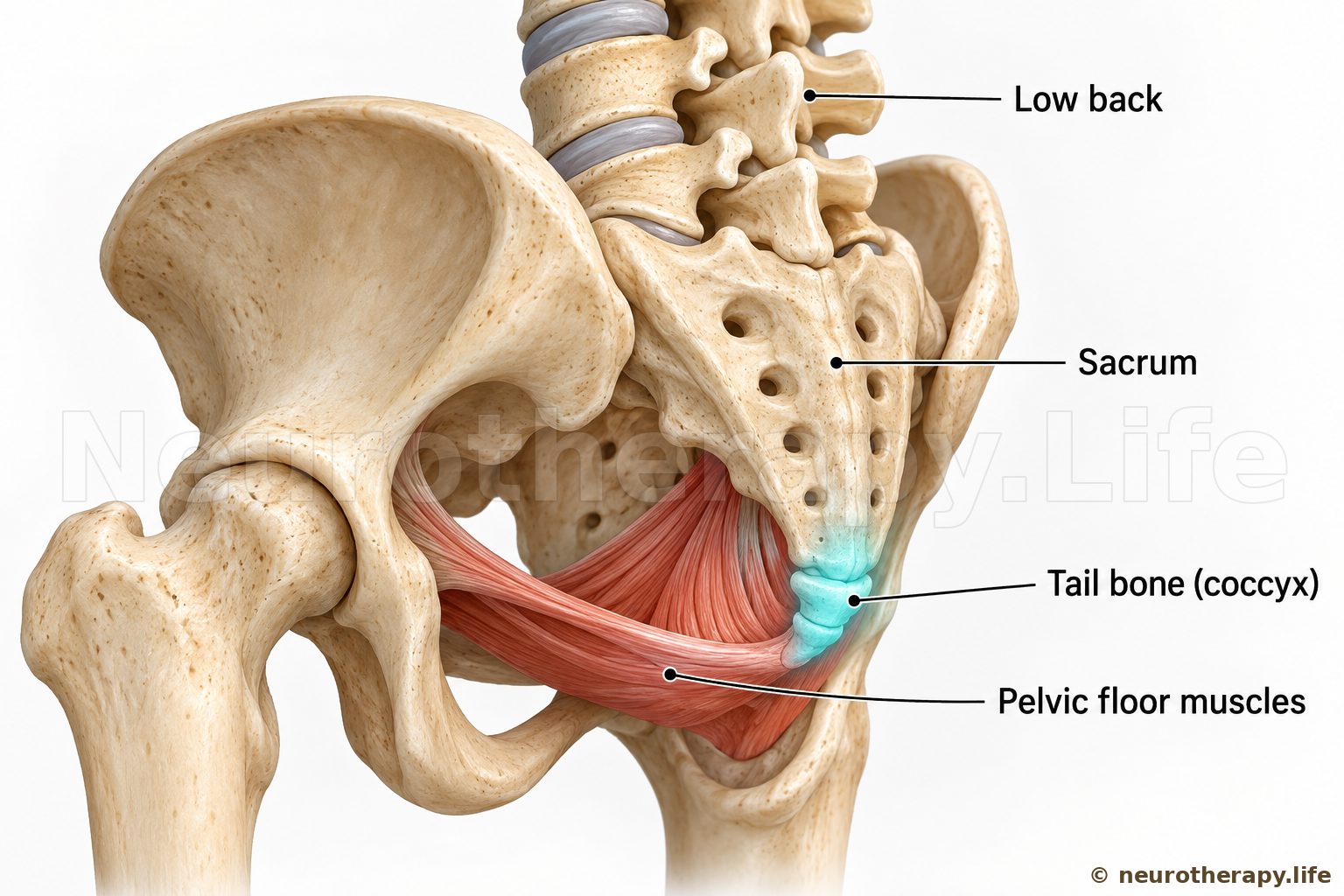
The tail bone, or coccyx, is the small, curved last end of the spine, just above the cleft of the buttocks. It is made of a few tiny bones joined together, and it sits below the sacrum, the flat triangular bone at the back of the pelvis.
When someone slips on the stairs or sits down hard, this small bone takes the blow. The result can be a sharp, lingering pain when sitting, or when getting up from a chair. The Tail Bone Pain treatment is given to remove the pain of exactly this kind of injury.
It is a physical point — named for the pain it answers — and belongs to the low back and sacrum group, where the cautions bite hardest because the hand is over bone that can break and nerves that matter.
You lie face down. The treatment starts at the last end of the spine — the tail bone (coccyx), at the top of the cleft of the buttocks — and moves upward along the lower spine; the direction is always upward, and the pressure on the tail bone itself stays light. The chemical treatment (the Injury treatment) is given first; the demonstration video shows the adult form and the children's finger form.
How this point is given — the tool, the pressure, the count and the exact movement — is deliberately not described here. A demonstration video for this point is being prepared; until it is on this page, learn the method hands-on from a trained Neurotherapist before giving it. Please do not give any point from a written description alone: a point given in the wrong place or the wrong way can do harm.
The number written before a point's name is not a strength setting. Each numbered form is a separate named treatment with its own method and timing, taught hands-on in the course.
The exact technique is taught hands-on in the Neurotherapy (LMNT) course. See the course →
The teaching gives one clear purpose: to remove the pain of an injury at the last end of the spine. Body science confirms that a fall onto the buttocks is the commonest cause of tail-bone pain, and that the muscles of the pelvic floor attach to this bone; how the treatment eases the pain is the therapy's own finding from practice.
The sacrum and tail bone carry several treatments, each with its own purpose and its own bar.
It has one use: pain from an injury to the tail bone — once a fracture or a serious cause has been ruled out.
This is the injury the treatment was made for. If the pain is severe, the bone looks out of place, or you have weak bones, see a doctor first to rule out a fracture.
You are covered with a light cloth, and only the small area needed is uncovered. You may ask for a chaperone.
If there is numbness between the legs, trouble with urine or stool, leg weakness, fever, or pain with no injury that keeps getting worse.
The coccyx is made of three to five tiny vertebrae fused together — the remains of the tail that every human embryo briefly has in the womb.
Source: Standring S (ed.). Gray's Anatomy, 41st ed. Elsevier, 2016 — the coccyx.
Tail-bone pain is about five times more common in women, partly because the wider female pelvis leaves the coccyx more exposed when sitting.
Source: Lirette LS, Chaiban G, Tolba R, Eissa H. Coccydynia: an overview of the anatomy, etiology, and treatment of coccyx pain. Ochsner J. 2014;14(1):84–87.
Several pelvic floor muscles and the great buttock muscle attach to the tail bone. That is why sitting, standing up and even passing stool can hurt after an injury.
Source: Lirette LS et al. Ochsner J. 2014;14(1):84–87.
This page explains what a Neurotherapy (LMNT) treatment is for; it is not a self-treatment guide and does not diagnose. Neurotherapy (LMNT) works alongside your medical care — keep taking the medicines your doctor prescribed.
Send COURSE for course details, or your name, age and health issue for a consultation.