How a therapist asks about undigested food in the stool: the UDF questions, the tongue and the curd test
Most patients call their motions ‘normal’ without ever having looked. Neurotherapy (LMNT) uses a fixed set of gentle questions, a list of everyday foods, a look at the tongue and, for babies, one question to the mother, to find out whether food is passing undigested.
Overview
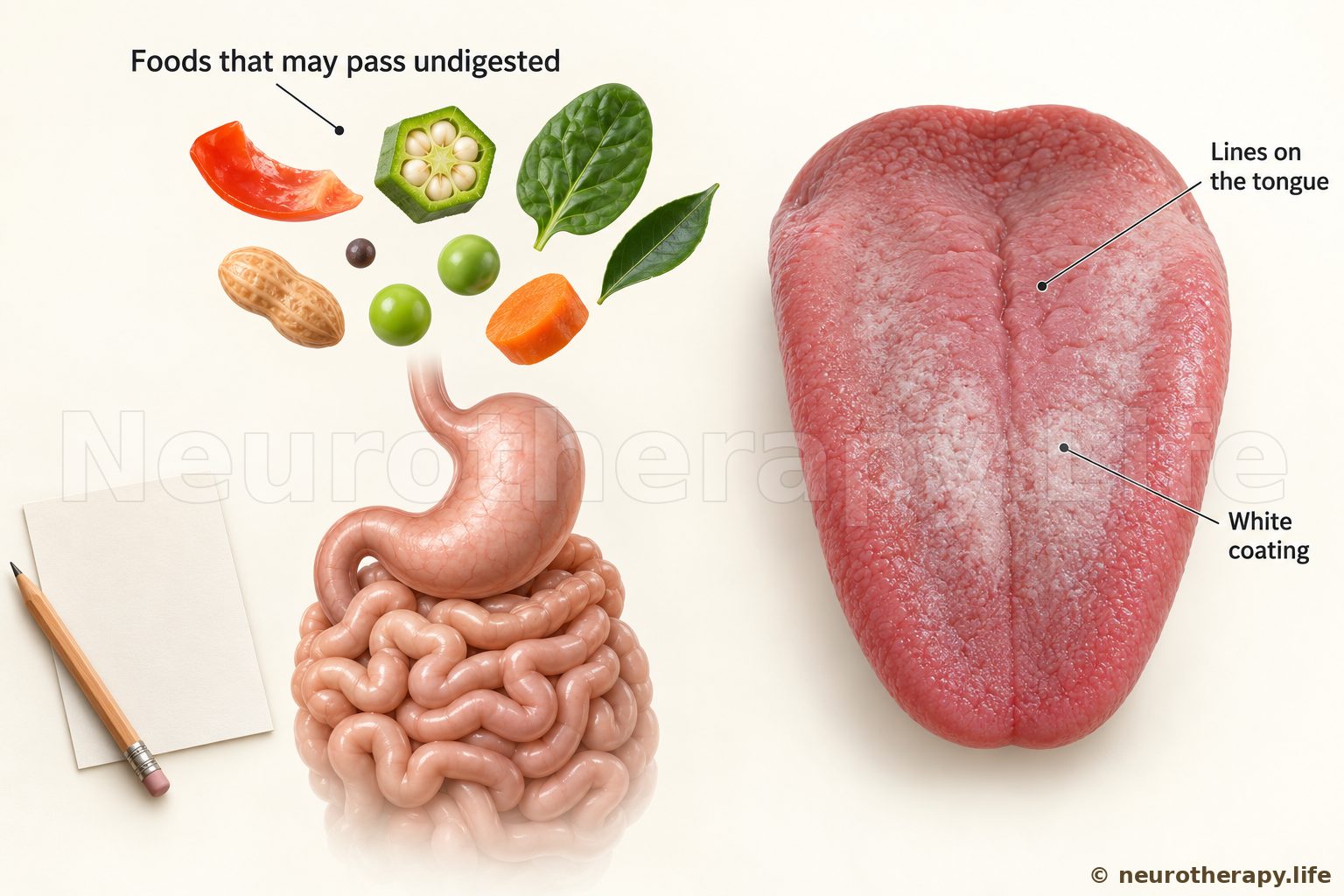
Most people do not like to talk about their stools. Many also believe that soft or frequent motions are healthy. So when asked, a patient often says ‘It is normal’ just to end the subject. A trained therapist learns to tell a real answer from an answer given to close the talk. In Neurotherapy (LMNT), ‘normal’ is only the patient's opinion — if undigested food is present, it is not normal.
The questions come in a fixed order, asked in the same calm tone as any other question: how often stools are passed, whether they are hard or soft, once or more than once, easily or with difficulty, and whether they come right after food. Then the therapist slowly reads out a list of everyday foods — tomato or brinjal skin, jeera or mustard seeds, okra or tomato seeds, bits of palak, methi, curry leaves or dhaniya, raw salad, groundnut — and asks whether any have been seen in the stool. Usually the honest answer is ‘I have never looked.’ Asked to observe, many come back the next day and say yes.
Two simple checks help. Lines or cracks on the tongue suggest the gut lining is not absorbing well, and a white coating often comes with little hunger. For a small child, the mother is asked: when the child vomits after milk, does it come out as milk or as curd? Milk coming back as milk suggests the stomach is not making its acid.
Key points
- A patient's ‘normal’ is an opinion, not a finding.
- The questions follow a fixed order, asked calmly and without hurry.
- A list of everyday foods helps the patient recognise undigested food.
- Lines on the tongue and milk vomited as milk are useful clues.
- Undigested food can appear on either side — ask everybody.
Go deeper
Undigested food in stool (UDF)
Undigested food in stool (UDF)
Bowel
The bowel and what the stool tells you
Stomach
The stomach and its acid
What the Bowel Tells You: Constipation, Stool and Water
Guide: What the Bowel Tells You
Taking a Patient's Story: The History That Cannot Mislead
Guide: The History That Cannot Mislead You
The Fire and the Ash: Undigested Food in the Stool
Guide: The Fire and the Ash
Read the full guide
This topic is part of: The Fire and the Ash: Undigested Food in the Stool
Safety: when it is held back
- Only ask the mother; never ask her to make a baby vomit to check. A baby who vomits forcefully and repeatedly, is not gaining weight, brings up anything green or blood-stained, or is floppy or hard to wake needs a doctor the same day. Nausea and vomiting
- A child with fever needs a doctor the same day if under three months old, or with a rash that does not fade when pressed, drowsiness, a stiff neck, a fit, fast breathing, cold mottled hands and feet, much less urine, refusing all fluids, or fever beyond five days. Fever and viral fever
Watch

A podcast conversation on indigestion: its common signs, causes such as rushed meals, stress and some medicines, and how Neurotherapy (LMNT) looks at digestion through the body's acid–alkali balance. No points are demonstrated.
This page explains what a Neurotherapy (LMNT) treatment is for; it is not a self-treatment guide and does not diagnose. Neurotherapy (LMNT) works alongside your medical care — keep taking the medicines your doctor prescribed.