1The 'solar plexus' is named for its rays
The great nerve knot in front of the spine behind the stomach sends fibres out in all directions like the sun's rays, which is how it got its name.
Source: Gray's Anatomy, 41st ed. — the coeliac plexus.
Also called: The simplest treatment for undigested food, UDF generation five
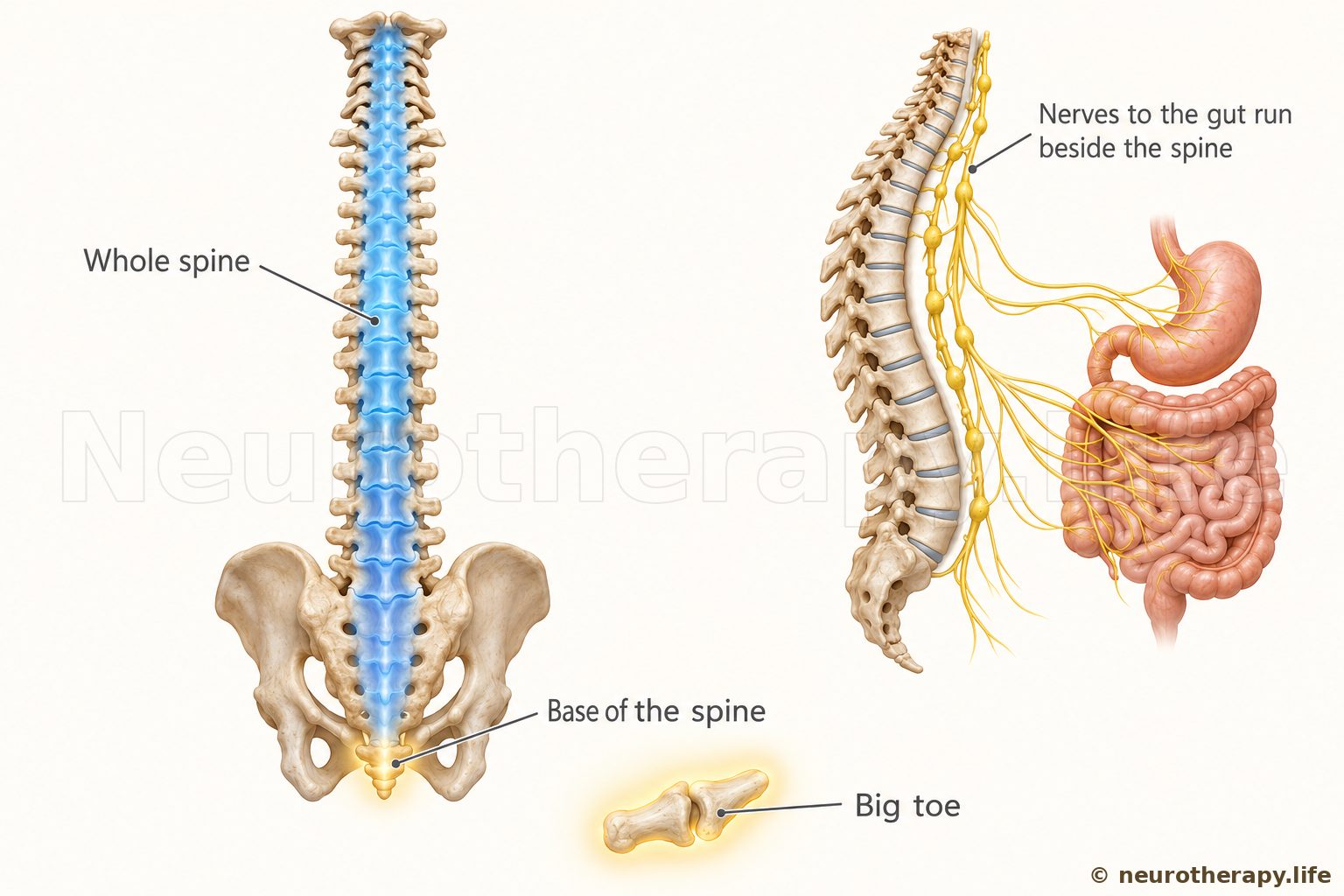
The simplest UDF treatment is the shortest complete Neurotherapy (LMNT) protocol for undigested food in the stool. It uses three techniques — a sustained hold at the base of the spine, a point on the big toe, and light clearing strokes along the back — and none of them touches the abdomen.
UDF means undigested food seen in the stool. The teaching reads it two ways: the stomach is short of acid, so protein is not digested, and germs that come with food are not killed. Every UDF formula answers one or both of these.
The UDF family grew over eight generations. The simplest treatment is the fifth, and the shortest of the complete protocols. Its surprise is where it works: on the back and the foot, never on the belly.
This makes anatomical sense. The nerves that serve the gut leave the spinal cord and run in chains beside the spine. Working over and beside the spine reaches the same corridor those nerves travel in.
I (½) Ku – 20 secs × 6 treatments · II Big Toe Gas × 6 treatments · III (10) Organ clearance + Sacral clearance (L1–L5)
Three techniques, listed here as a set with what each contributes. Some parts are given over a short run of sessions rather than all at once. The exact method is taught hands-on in the Neurotherapy (LMNT) course. This page lists the points of the formula and what each one contributes; it does not describe how any point is given. For the method, watch the demonstration video of each point on its own page and learn hands-on from a trained Neurotherapist. Please do not give a formula from a written description alone.
A sustained hold at the very end of the spinal column, with the patient lying face down. In the UDF family it is the part aimed at infection and immunity.
A point on the big toe. Its stated purpose here is to raise the acid in the stomach.
Light clearing strokes over and around the spine from the neck downward, joined with the same strokes over the lower back. It clears the whole back.
Position: Lying face down (prone) for the sacral hold and the clearing strokes — or seated for the strokes if needed — and lying down for the big-toe point.
The exact technique is taught hands-on in the Neurotherapy (LMNT) course. See the course →
The teaching solves UDF at three levels. This treatment touches two of them directly: the sacral hold works on the infection level, and the big-toe point on the acid level. The clearing strokes along the back complete it.
It is short, it needs no work on the abdomen, and it can be given seated if lying face down is difficult for the clearing strokes. That makes it a gentle option within a family of much longer formulas.
Some parts are given as a course across days, one session a day, not repeated within one hour. Mixing these up is a common student mistake that tires the patient out.
It belongs to the UDF family, which began with the two-point Seed formula.
It is chosen on the finding of undigested food in the stool. Many old diseases carry that finding.
The nerves that serve the stomach and intestines run beside the spine. Working along the back reaches the same corridor. The big-toe point is also taught to raise stomach acid.
Some parts are written as a course of sessions, one a day. Neurotherapy (LMNT) found that milder stimulations repeated over days work better than one strong dose.
The teaching says UDF comes from eating habits and way of life, so it can return. A check every four or five months is advised, along with the food changes your therapist gives you.
The great nerve knot in front of the spine behind the stomach sends fibres out in all directions like the sun's rays, which is how it got its name.
Source: Gray's Anatomy, 41st ed. — the coeliac plexus.
Strong stomach acid kills most bacteria swallowed with food. When acid is low, more germs survive into the intestine.
Source: Guyton & Hall, Textbook of Medical Physiology, 14th ed. — gastric acid and protection against infection.
The wall of the gut holds hundreds of millions of nerve cells — the enteric nervous system — which talks constantly with the spinal cord and brain.
Source: Furness JB. The enteric nervous system and neurogastroenterology. Nat Rev Gastroenterol Hepatol. 2012;9(5):286–294.
This page explains what a Neurotherapy (LMNT) treatment is for; it is not a self-treatment guide and does not diagnose. Neurotherapy (LMNT) works alongside your medical care — keep taking the medicines your doctor prescribed.
Send COURSE for course details, or your name, age and health issue for a consultation.