1You breathe out what you burn
Most of the weight people lose when they burn fat leaves the body as carbon dioxide, breathed out through the lungs.
Source: Meerman R, Brown AJ. When somebody loses weight, where does the fat go? BMJ 2014;349:g7257.
Also called: (2) Ch. Only, (4) Ch. Only, Chest Only, lighter forms, हल्का चेस्ट ओनली
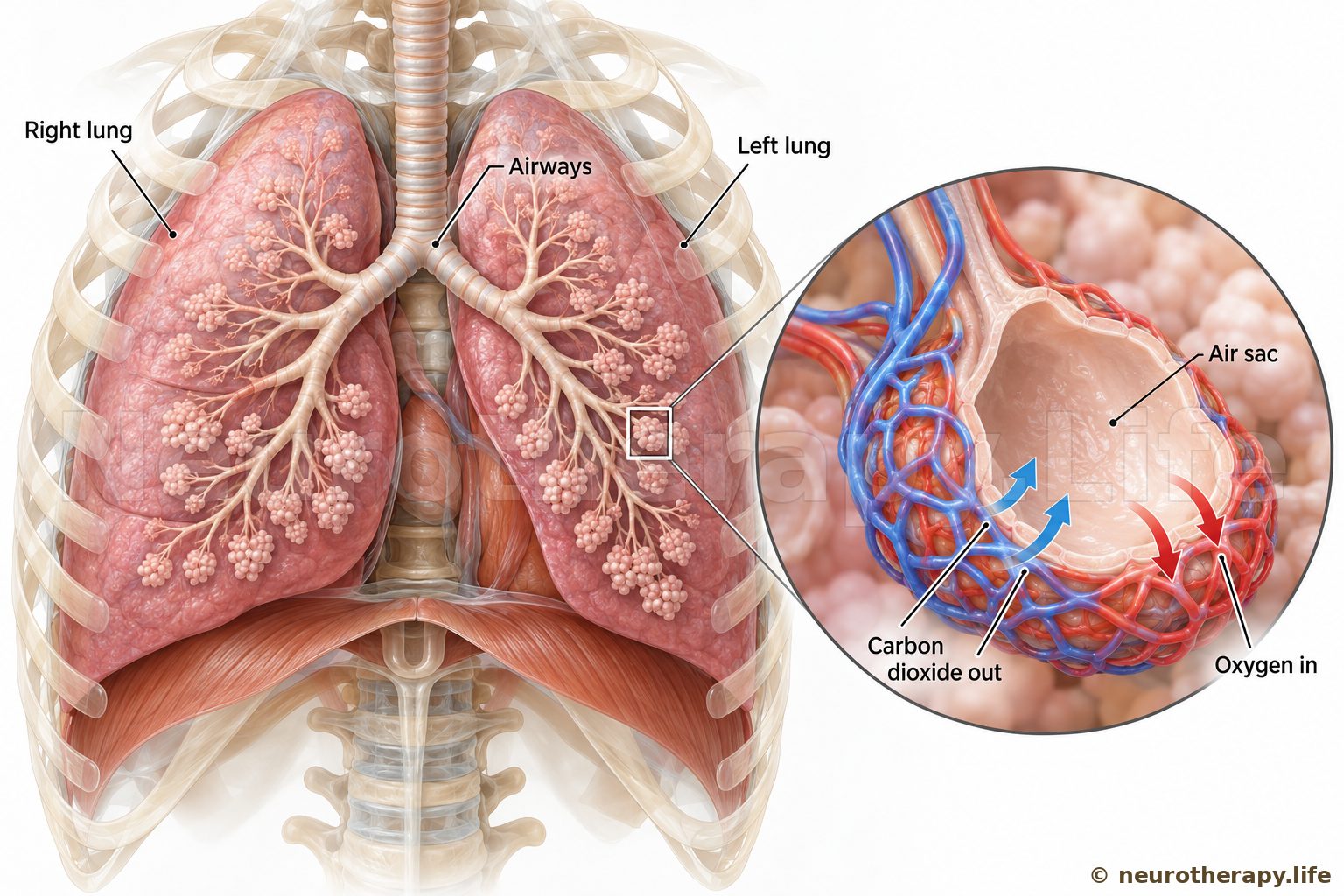
(2) Ch. Only and (4) Ch. Only are the lighter forms of Chest Only, a soft glide over the chest given while the patient lies on the back. The teaching says they stimulate the lungs to expel carbon dioxide completely through the breath, and they appear in several lighter formulas.
Ch. Only stands for Chest Only. It is the Neurotherapy (LMNT) treatment that stimulates both wings of the lungs. Like Pan, it is written with a number in brackets, and the number names which form is meant.
(2) Ch. Only and (4) Ch. Only are the lighter forms. Their stated use is the therapy's most directly breathing-related claim: they stimulate the lungs to expel carbon dioxide — the waste gas the body makes from burning food — completely through the breath.
Chest Only also has a chemical side in LMNT teaching: it reduces alkali, so the symptoms of acid can increase if it is given alone. That is why it is paired with a matching Round Arrow, and why the lighter forms appear in lighter formulas such as Mild Genes.
The patient lies flat on the back. No pillow goes under the back for any treatment on the chest.
The area is the front of the chest, from the lower chest up toward the shoulders, on both sides. Where the card names only one side — Left Chest Only or Right Chest Only — only that side is worked.
How this point is given — the tool, the pressure, the count and the exact movement — is deliberately not described here. Watch the demonstration video on this page, and learn the method hands-on from a trained Neurotherapist before giving it. Please do not give any point from a written description alone: a point given in the wrong place or the wrong way can do harm.
The number written before a point's name is not a strength setting. Each numbered form is a separate named treatment with its own method and timing, taught hands-on in the course.
The exact technique is taught hands-on in the Neurotherapy (LMNT) course. See the course →
LMNT teaching says Chest Only stimulates both wings of the lungs, and that the lighter forms help the lungs expel carbon dioxide completely. Body science confirms that clearing carbon dioxide is one of the lungs' main jobs and that it shapes the body's acid–alkali balance; how a light glide on the chest affects this is the therapy's own explanation.
Each form of Chest Only has its own use, and the lung-cancer block covers the whole family.
The lighter forms are used mainly inside formulas, chosen from the patient's acid–alkali findings.
The light Genes formula, closed with the lighter Chest Only and Round Arrow.
A long family-taught treatment that includes a lighter Chest Only.
The acid branch of Heparin, which returns to the chest at a lighter form.
For left-side kidney stones and related problems.
The mirror of Kidney Clear, for the right side.
The number names the form written for your plan; it is not a simple strength setting. Both are the lighter forms of Chest Only, and your therapist follows what your card says.
No. It is a very soft glide over your clothing, so light that the sole slips over the cloth. Tell the therapist at once if you feel any discomfort.
In LMNT teaching, Chest Only and Round Arrow push the acid–alkali balance in opposite directions. Given together in matched amounts, they hold the balance where the rest of the formula has placed it.
Most of the weight people lose when they burn fat leaves the body as carbon dioxide, breathed out through the lungs.
Source: Meerman R, Brown AJ. When somebody loses weight, where does the fat go? BMJ 2014;349:g7257.
The urge to breathe comes mainly from rising carbon dioxide in the blood, not from falling oxygen. The brainstem senses it and speeds up your breathing.
Source: Guyton & Hall Textbook of Medical Physiology (14th ed.), regulation of respiration.
Carbon dioxide forms an acid in the blood. By breathing faster or slower, the lungs can shift the blood's acidity within minutes; the kidneys take hours to days.
Source: Guyton & Hall Textbook of Medical Physiology (14th ed.), acid–base regulation.

This page explains what a Neurotherapy (LMNT) treatment is for; it is not a self-treatment guide and does not diagnose. Neurotherapy (LMNT) works alongside your medical care — keep taking the medicines your doctor prescribed.
Send COURSE for course details, or your name, age and health issue for a consultation.