Also called: Right Vitamin Formation, Left Vitamin Formation, Vitamin formation, राइट / लेफ्ट विटामिन फ़ॉर्मेशन
Right and Left Vitamin Formation are two gentle hand treatments given while you lie on your side: the fingers circle clockwise beside the bony knuckle at the side of the hip, travelling upward. They are given to take out the pain there — and each side also belongs to one half of the acid–alkali balance.
Overview
What is Vitamin Formation?
Vitamin Formation is a pair of points, one for each hip. Right Vitamin Formation is given on the right waist and hip; Left Vitamin Formation on the left. They are taught beside the four vitamin points — Folic, Thia, B₁₂ and Nia — and given in the same side-lying positions, but worked quite differently.
Their stated purpose is local and honest: to take out the pain there — the pain at the side of the hip. Teaching is clear that the name is an address, not a claim. A point carries the name its finder gave it; the word 'vitamin' here does not promise that vitamins are made.
Each side also has a place in the acid–alkali teaching. Right Vitamin Formation is listed among the treatments that reduce alkalosis; Left Vitamin Formation among those on the acid side, and it is named to relieve pain at Mu° in high blood pressure.
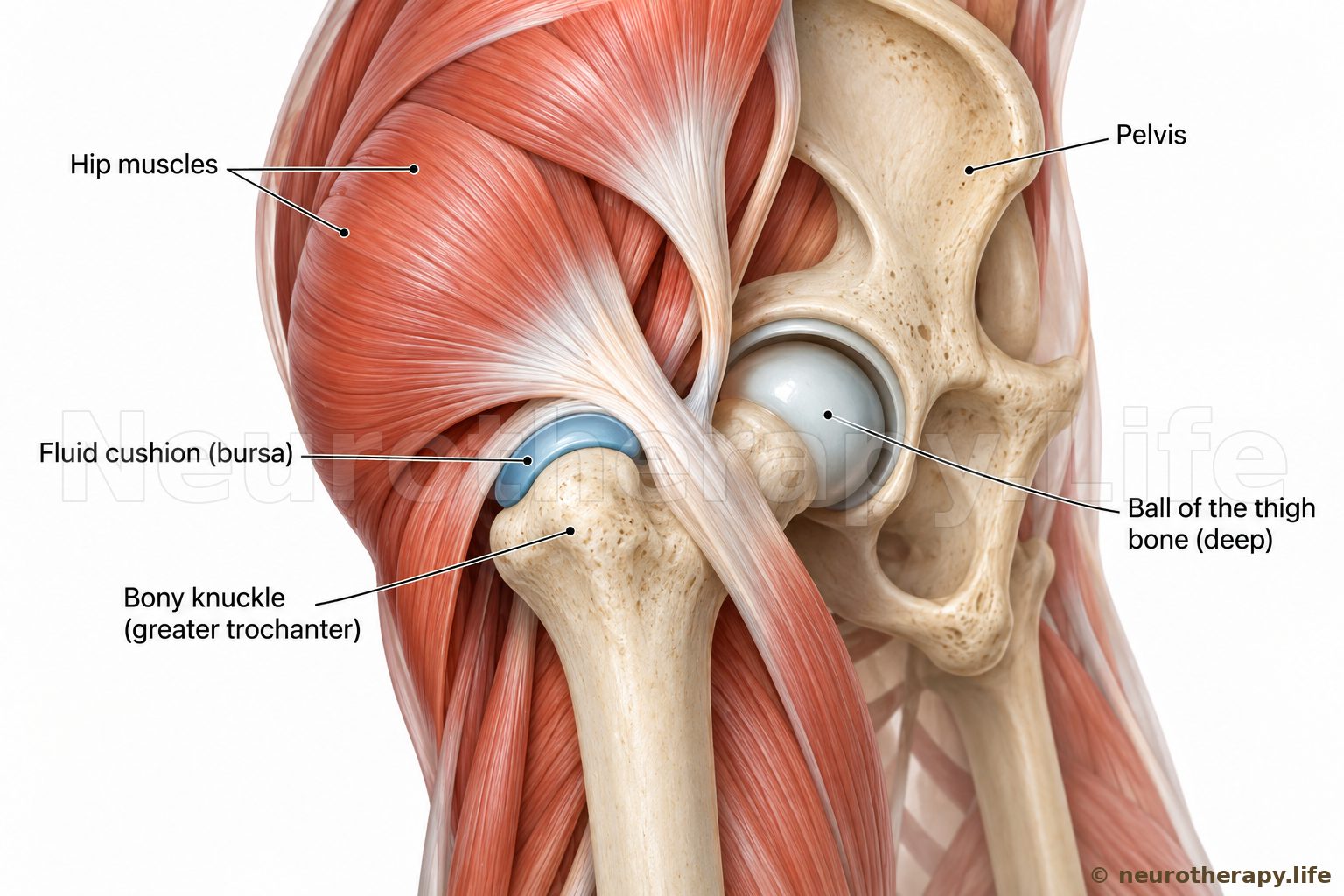
The fingers circle beside the bony knuckle at the side of the hip — the ball itself lies deep and out of reach.
Where it is given
Where is it given?
PositionLying on one side
Body areaBeside the bony knuckle at the side of the hip, on the upper (ceiling-facing) hip
For Right Vitamin Formation you lie on your left side, as for the Folic and Thiamine points, with a pillow between the thighs; it is given on the right waist and hip. For Left Vitamin Formation you lie on your right side, as for B₁₂ and Niacin, and it is given on the left.
The hip worked is always the one facing the ceiling. The fingers work beside the bony knuckle you can feel at the side of the hip — beside it, not on it.
How it is given
How is it given?
How this point is given — the tool, the pressure, the count and the exact movement — is deliberately not described here. A demonstration video for this point is being prepared; until it is on this page, learn the method hands-on from a trained Neurotherapist before giving it. Please do not give any point from a written description alone: a point given in the wrong place or the wrong way can do harm.
Feels likeA slow, firm circling at the side of the hip
The exact technique is taught hands-on in the Neurotherapy (LMNT) course. See the course →
What it does
What does it do?
Teaching gives these points one direct purpose and one place in the wider acid–alkali plan.
To take out the pain at the side of the hip and waist on the side treated.
Right Vitamin Formation is listed among the treatments used to reduce alkalosis, with ALTF, Right Raman and Right Chest Only.
Left Vitamin Formation sits on the acid side; in high blood pressure, where Mu° may not be given alone, it is named to relieve the pain at Mu°.
Organs it reaches
Joints — Worked beside the hip joint, over tendon, cushion and bone.
Muscles — The hip muscles that hold the pelvis level wrap over this knuckle.
Kidneys — Through the kidney points Liv° and Mu°, whose sides these two points mirror.
Its family
Which points sit beside it?
The side-lying group shares positions, but each point has its own hip, direction and purpose.
Folic — Right Vitamin Formation uses the same lying position as Folic.
Thia — The same position as Folic — lying on the left side.
B₁₂ — Left Vitamin Formation uses the position of B₁₂ — and the B₁₂ formula shares its high-BP use at Mu°.
Nia — The same position as B₁₂ — lying on the right side.
Rt. Parkhoo — Another point at the edge of the thigh bone, given with presses, not circles.
Fluid or Alkali — The next side-lying point taught after these two.
What it is used for
What is it used for?
The side is chosen by where the pain is, and by which side of the acid–alkali balance the examination shows.
Hip and waist pain
Low back painFor pain at the side of the waist and hip.
Acid and alkali
AlkalosisRight Vitamin Formation, among the alkali-reducing treatments.
High blood pressureLeft Vitamin Formation relieves pain at Mu° when Mu° cannot be given alone — alongside the doctor's treatment.
A painful hip after a fall, especially in an older person, needs an X-ray before any hip work — a broken hip can hide as 'hip pain'. Frail and elderly patients (gentle care)
Side is part of the point. Right belongs to the alkali-reducing side, left to the acid side; the Liv° and Mu° findings choose, not habit. Never ATF in alkalosis, never ALTF in acidosis. Acid or alkali? The two treatment families, left and right
In high blood pressure Mu° is not given alone, because if acid falls the symptoms of alkali increase — Left Vitamin Formation or the B₁₂ formula is used for the Mu° pain instead. Mu°
The name does not promise that. Teaching says plainly that it is given to take out the pain there. The name is how a therapist finds the point on a card.
Why do I lie on my left side for the right one?
Because the hip being treated must face the ceiling, so the therapist's fingers can reach the side of it.
Is it painful?
It is a slow, firm circling. A tender hip may feel sore at first; tell the therapist if it becomes sharp.
Surprising facts
1The knuckle you can feel
Put a hand on the side of your hip and stand on the other leg: the bony knuckle you feel is the greater trochanter, the top corner of the thigh bone — not the ball of the hip, which lies deep in its socket.
Source: Gray's Anatomy, 41st edition, the femur and hip region.
2Muscles that keep you level
The muscles fixed to that knuckle stop the pelvis dropping each time you lift a foot to walk. When they are weak, the hip on the other side sags with each step.
Source: Gray's Anatomy, 41st edition, the gluteal region.
3A name built on a mistake
The word 'vitamin' began as 'vital amine', because the first one found was an amine — and it was wrongly assumed all of them were. The name stuck after the belief was dropped.
Source: Guyton & Hall, Textbook of Medical Physiology, vitamins; history of the term (Funk, 1912).
This page explains what a Neurotherapy (LMNT) treatment is for; it is not a self-treatment guide and does not diagnose. Neurotherapy (LMNT) works alongside your medical care — keep taking the medicines your doctor prescribed.
Ready to begin?
Send COURSE for course details, or your name, age and health issue for a consultation.