Dr. Lajpatrai Mehra (Guruji): the man who built Neurotherapy
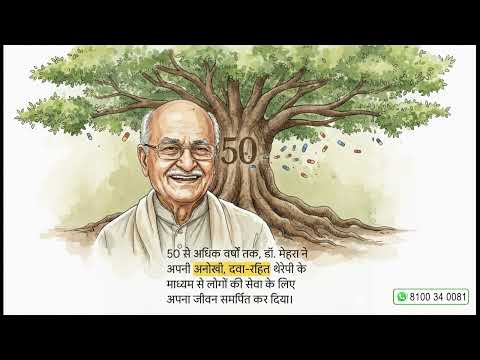
Dr. Lajpatrai Mehra, called Guruji by his students, built Neurotherapy over seventy years — from a navel set in Amritsar when he was eleven, through partition and decades of free treatment, to an ashram, an academy and hundreds of centres across India. The therapy carries his name, LMNT, so that nobody confuses it with the other systems in the world that share the word.
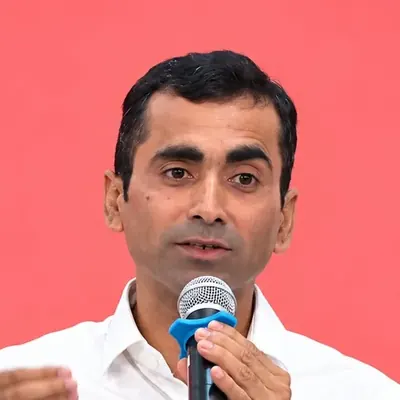
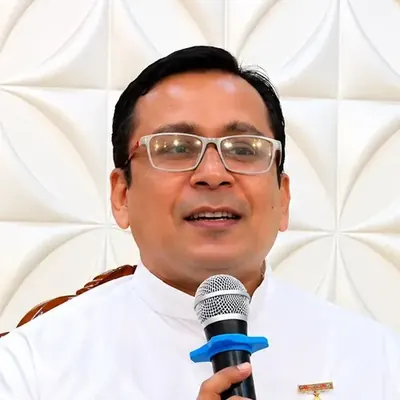
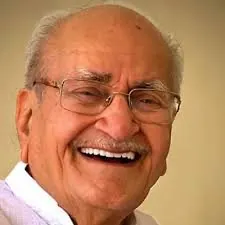
Amritsar, and a stomach ache at eleven
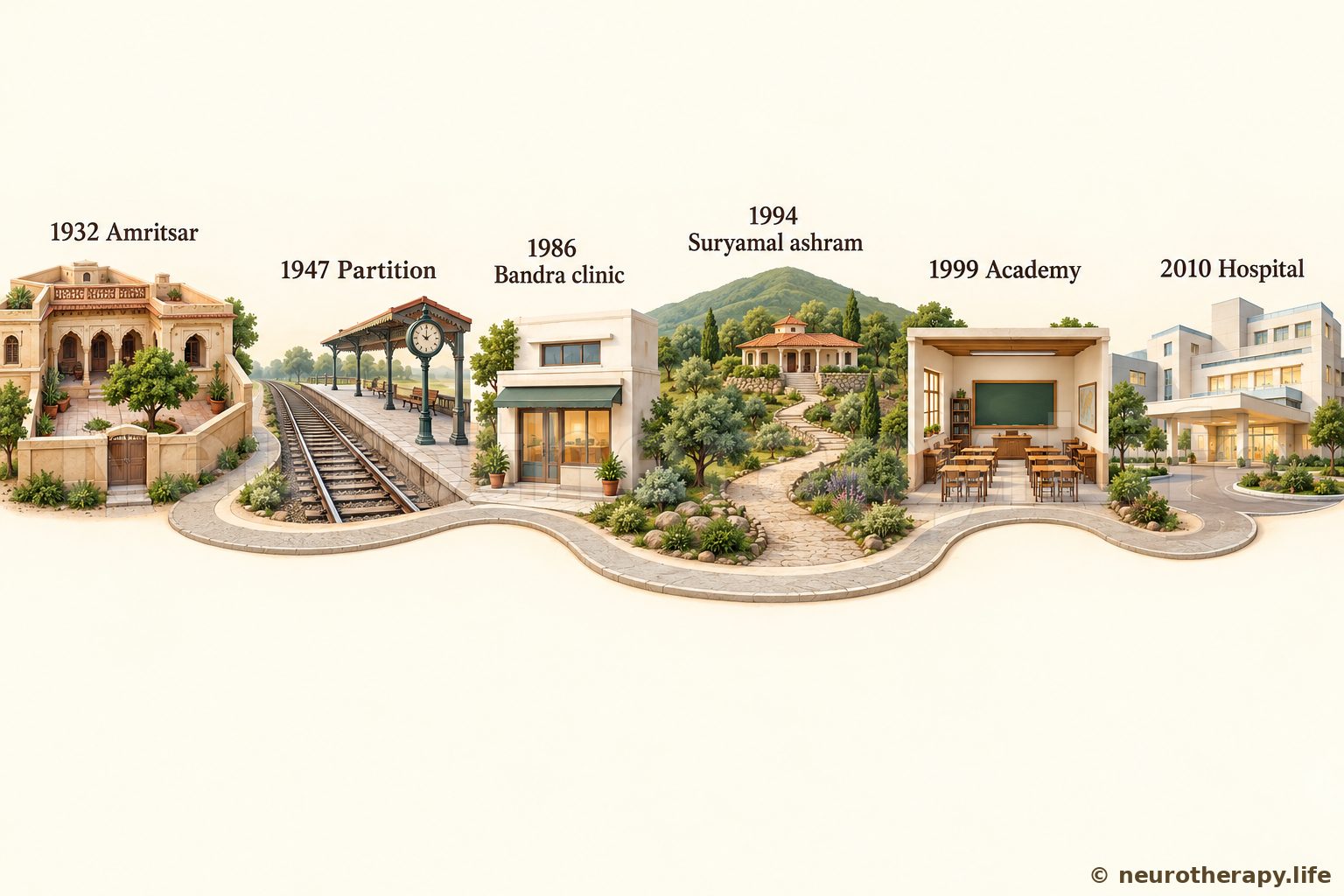
Lajpatrai Mehra was born in a well-respected family of Amritsar on 23 August 1932, the seventh child of Shri Ramgopal Mehra and Shrimati Kesara Devi, the only son among many sisters. At eleven he had a severe stomach ache that lasted for months, and the best medical help of the time could not relieve it. Then he met an old man who made him lie face down and drew his hands and feet in a particular way — the folk practice of setting the navel. The pain went almost at once. The old man explained nothing and never came back. The boy was left with a memory, in his own body, of where the pressure had been.
“I must do something!”— Dr. Lajpatrai Mehra — the line printed beneath his own photograph
The first patient, and why the foot
Most children run off to play once a pain is gone. This boy kept asking how so simple a method had worked such a marvel. His mother often suffered from stomach pain, and she let him try — the first act of trust in the history of this therapy. A child's hands cannot hold firm, steady pressure on an adult, so he used his feet, taking his weight on his arms, and freed his mother of her pain.
The foot solved three problems at once: the body's weight does the work instead of muscle strength; the amount of weight can be raised or taken back in an instant; and the broad, soft sole spreads the force so it does not hurt. That is still how the therapy is given today. Soon a queue formed at his father's door — people with constipation, dysentery and other belly troubles. By 1944, at twelve, he was known around Amritsar for treating them free of charge. Those early patients were digestive patients, and that is one reason the therapy still begins its work at the belly.
1947: the house lost, the habit kept
The riots of partition took the family home. A prosperous family reached Bombay in 1947–48 as refugees with nothing, and a boy of fifteen or sixteen became the earner for ten people. Even so, he spent hours every day in the refugee camps, treating people free. Partition had stopped him sitting his tenth-class examination; in appreciation of his camp service he was offered the certificate without the exam, and refused it, because holding a certificate he had not earned hurt his self-respect. About four years later he sat the examination and passed.
For the next four decades he set up one factory after another, and one after another they closed through losses. Through all of it he treated patients free before and after office hours, and visited those who could not come, at his own cost. He read about nature cure, anatomy and physiology for the rest of his life, and in time qualified in naturopathy. In 1971, during the war, he ran a canteen at Dadar that fed about 1,800 soldiers a day for some forty-five days.
1986 onward: a clinic, a name and an institute
In 1986, at fifty-four, he began treating patients outside his home for the first time, from a clinic at Bandra, Mumbai, for a nominal fee. He set the techniques of forty years into formulas, which made the knowledge teachable. Around this time the therapy came to be called Neurotherapy. The name LMNT — Dr. Lajpatrai Mehra's Neurotherapy — came later, from his students, to set it apart from other systems around the world that share the word.
In 1992 the Neurotherapy Institute opened at Bandra with three jobs from day one: a day clinic, a training centre running a six-month course twice a year, and a research centre to study the results and build better treatments. Even then he kept giving free treatment on Sundays at the Hindu Seva Samaj for some years.
The women he taught
Many patients came with no way ahead, among them widowed and orphaned women for whom society would perhaps have done nothing. He treated them free, then taught them the therapy free, and helped them earn a living by it — with the living came name and honour. Many of them went on to open their own centres and support their families. This is the moral centre of the whole life. A blanket is a gift; a trade is a livelihood. The therapy needs no equipment, stock or premises — the training itself is the capital. That made it one of the few doors open to a woman with little schooling and no money.
Suryamal: the Sunday dispensary, the Academy and the hospital
What moved him most was the sight of village people who could not afford even the bus fare to the nearest health centre. In 1994 a Neurotherapy Ashram came up at Suryamal village, in Mokhada taluka of Thane district, Maharashtra, a mainly tribal area. A free treatment camp has run there every Sunday ever since, with free food for those who come from far, so the area knows it as the Sunday Dispensary — रविवारीय दवाखाना.
In 1999 he made the most far-reaching decision of his life: instead of keeping the work in one place, he would teach young people to serve villages in their own areas. The Neurotherapy Academy opened at the ashram with a residential course, and every student had to write up at least one case study for the research library. From then on he was called Guruji. In 2010 a residential hospital, the Arogya-Mandir, opened at the ashram with four beds, soon growing to thirty-seven, for long-term conditions such as paralysis, Parkinson's, muscular dystrophy and cerebral palsy.
His own estimate of his knowledge
He never claimed a training in modern medicine and said so openly all his life. His two doctorates were honorary, given by private institutions in recognition of his service. What he did have was a lifetime of reading one standard physiology textbook many times over, and an experience of patients running into lakhs. By his students' count, about eight hundred centres opened across India, with a few abroad, and thousands of families came to earn their living through the therapy. His wish was simple to say and huge to do: a Neurotherapy centre for at least one village in six.
Yet he called his life's work a thing still in its infancy, and kept revising his formulas. "I am yet to understand the human body," he said. "My knowledge is hardly the tip of the iceberg. Neurotherapy is just in its infancy. There is a long way to go." A founder who says there is a long way to go expects his students to keep their eyes open and record what they see. That is the spirit in which Neurotherapy.Life teaches it — and why we say, in every message, that it works alongside your medical care, never instead of it.
Watch
Frequently asked questions
Was Dr. Mehra a medical doctor?
No, and he never claimed to be. His schooling ended at the tenth class. He taught himself physiology by reading over many decades and qualified in naturopathy. His doctorates were honorary titles given by private institutions for his service.
Why is the therapy called LMNT?
Several different systems around the world use the word neurotherapy. To show which one this is, his students named it Dr. Lajpatrai Mehra's Neurotherapy — LMNT.
Where is the ashram?
At Suryamal village, Mokhada taluka, Thane district, Maharashtra. A free treatment camp has run there every Sunday since 1994.
Is Neurotherapy.Life part of the Suryamal institute?
No. Neurotherapy.Life is an independent clinic and teaching centre in Greater Noida, led by Dr. Diwakar Shukla (BNYS), that teaches and practises Guruji's method as he set it out. We honour his work; we do not speak for his institutions.
Read next
Want to learn it, or try it?
Join the Foundation Course in Neurotherapy, or book an online consultation with Dr. Diwakar Shukla. Neurotherapy works alongside your medical care — never instead of it.
This page is educational and does not replace medical advice. In an emergency call 108 / 112 first.